How do you think the brain "stores" our personal memories? 🧠

This is a question for everyone out there, especially for non-neuroscientists and regardless of education level or familiarity with biology.

I'd just like to hear all your ideas and theories, however crazy they may sound. Be as specific or vague as you like. Please do not look at the answers before giving yours so you are not influenced.
More specifically:

  • What do you think happens (in the brain) at the time of experiencing something that we will end up remembering?
  • What do you think happens (in the brain) when, later, we remember that thing?
  • Boosts welcome but answers even more welcome!
    #Neuroscience #Memory #EpisodicMemory

    If you're trying to read the answers before answering yourself: please go back up and answer first!

    If you're wondering what exact type of memory I'm asking about: the one we'd call Episodic memory, so memories of personal, experienced events from your own past.

    If you're wondering what the answer actually is: I might post later what I think we know on the topic, and any other neuroscientists are welcome to answer any time, but I don't think we know for sure yet!

    Amazing answers so far! Please keep them coming! 😃

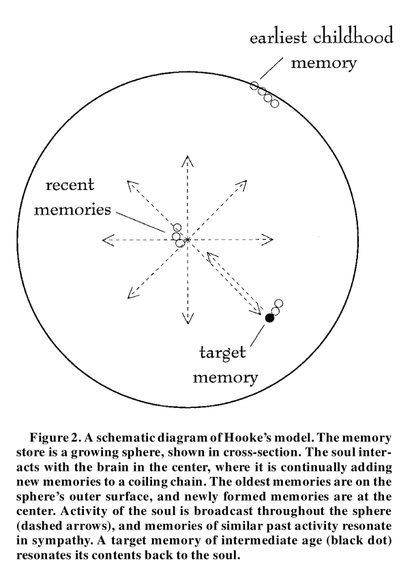
    @elduvelle_neuro Robert Hooke’s (1635 – 1703) model of memory https://link.springer.com/article/10.3758/BF03196465

    The lecture addressed questions of encoding, memory capacity, repetition, retrieval, and forgetting—some of these in a surprisingly modern way.

    (1) it allows for attention and other top-down influences on encoding;
    (2) it uses resonance to implement parallel, cue-dependent retrieval;
    (3) it explains memory for recency;
    (4) it offers a single-system account of repetition priming; and
    (5) the power law of forgetting can be derived from the model’s assumptions in a straightforward way.

    @elduvelle_neuro When you say "remember", it means different things to me.

    I have personal mnemonics that I relate to a situation, but weeks-wide.

    I have vivid "video" flashbulb memories of intense moments, a few seconds long.

    Other memories, say 9-11, are a sequence of those flashbulbs with stuff I know is missing but can guess at.

    HOW is it stored? By best guess is a heirarchy of "strengths" of connections. I have a lot of weak mnemonics, a few strong flashbulbs, and stuff inbetween.

    @elduvelle_neuro But that's my intuitive reaction as a brain user, not a neuroscientist.
    @elduvelle_neuro how does the brain retrieve them? My only reference here is programming. Maybe, in the case of the flashbulb memory, something is written into the visual bit of the brain so strongly that it is not easily overwritten if "space is needed for new stuff", so it persists. And by re-accessed, becomes more persistent? In the case of mnemonics, i tend to do them "verbally", by repetition, so maybe faking that intensity over time on a less over-writeable bit of the brain?
    @elduvelle_neuro
    J'ai trop de mal à ne pas voir le cerveau comme un ordinateur tres evolué.
    (Quel manque d'imagination)
    Du coup on recupere des infis via nos organes sensoriels qui balancent de l'electricité ds les neurones. Y'a des neurones qui analysent et soit stockent un peu brutalement qd c'est des emotions soit on digere le truc et on en crée une histoire (verbale)
    @elduvelle_neuro
    qu'on enregistre ds une serie de neurones fait avec eventuellement des images mentales (y'a le cas des musiques qui est specifique, et celui des gestes de travail). Et je suis trop fatiguée pour allr jusko bout
    ...
    @elduvelle_neuro je verrai demain si j'oublie pas
    @elduvelle_neuro I repressed memories from my childhood traumas which came tumbling out at a later stage. So for those with me, it felt like different parts of the memory lived in different places in my mind. Pictorial, sensory, sound, emotional responses all in different parts. I had glimpses into part of the memories but not the full picture. When everything fitted together it felt almost like electric and over whelming.
    @LuluHelle I am sorry to hear about this (and I don't want to make you think about those memories if you don't want to). However I have to say this is super interesting from a neuroscience point of view!! Thank you for sharing 🙂

    @elduvelle_neuro

    1. moves from working memory to [somewhere else], creating connections to existing memories and ideas

    2. strengthens some of the connections, creates new connections. May trigger physiological responses as though the experience was current, eg salivating remembering food, PTSD triggers amygdala response

    @elduvelle_neuro I believe the electrical signals from the senses are sent through the nerves and recorded (encoded maybe) in a recallable way.

    When they’re recalled they’re replayed to our senses, or an emulation of our senses.

    E.g.; I can see a blue car, I can visualize in my brain a blue car.

    Cool question. I’d not really thought about this before.

    @elduvelle_neuro
    I believe that the pattern of neural firings and synaptic signals make up a memory.

    The firing pattern created to perform/experience the memory can be recreated, causing the memory to be recalled. The person can then continue the pattern to relive the sequence of patterns that make up the remembered experience.

    Unbidden memories can also be recalled if a current experience fires a similar pattern.

    @JohnLAlford @elduvelle_neuro
    This is what I think also.
    @cshlan
    Keep in mind that I worked as a virologist, not a neurobiologist. My ideas mean little
    @JohnLAlford
    And I'm a bookkeeper who took one neurobiology class so ... 😁
    @elduvelle_neuro the brain remakes itself from one that, when making decisions, doesn't take those events into account, into one that does. It does this by any and all plasticity mechanisms available to it when learning any skill, and consequently may store different memories by different mechanisms. I literally just invented this theory so as to have something fun to say in answer to your question so I'm not going to hold on to it too tightly. 😉

    @neuralreckoning @elduvelle_neuro well, some learning in mice can be passed down epigenetically. And planarians can regenerate memories. Etc etc

    What i mean by that is, maybe you're right

    @elduvelle_neuro

    How do you think the brain "stores" our personal memories? 🧠I think the brain stores memories in the form of connections between neurons which can be made, unmade, strengthened and weakened.What do you think happens (in the brain) at the time of experiencing something that we will end up remembering?As we're experiencing something our brain contains some representations of our sensory experience and internal mental states.

    The representations become associated (one or more connections is made, unmade, strengthened or weakened).
    What do you think happens (in the brain) when, later, we remember that thing?When we remember something an electrical potential propagates through some specific combination of connections.

    @elduvelle_neuro ask the planarians

    (I bet there are multiple mechanisms)

    @elduvelle_neuro
    with our senses like taste, sound , touch,sight & the emotions attribitued to that experience can trigger a memory . stored as energy from the same path it came

    @elduvelle_neuro I am a scientist with basically zero neuroscience background, so:

    I imagine that when we encode a memory, a set (I imagine hundreds at least) of neurons?? are stimulated somehow to form new connections... The stimulus keeps up for a while during the event and gets reinforced without our active awareness later and during sleep... Then when we recall it, that set of connections is probed rather than being stimulated to form, and we get back some of the impressions of the event

    @elduvelle_neuro The recall probably both draws on the real connections that were made but also partly reinforces the ones that we do recall, so the connections are altered by the act of remembering, strengthened but not uniformly the way they were first made

    All based on vague imagination mostly from popular press descriptions! I just do bacteria and biomolecules lol, no eukaryotes please

    @elduvelle_neuro 1: My brain keeps many tiny unreferenced "mental pictures" of what I've experianced, a loose chronology of when they occurred, and a vague sense of my spatial relationship to the content of the "picture". Some of them occur in dreams, the waking ones just have a more vivid time sense.
    2: Experiencing a similar "picture" of the world, spatial relationship to an attention point, and/or a similar feeling of time (of hour, day, year...) may generate a new "picture" that gets filed alongside the previous one(s) - a memory.
    Whether I can connect words to the memory is a separate mystery. The tiny "picture" and the geometry and time sense are solidly there, but words to describe the details may take minutes or hours to re-appear. During which I'm feeling I can't "remember"...
    @elduvelle_neuro I think it might be something like this: The memory is “coded” via physically curating a series of connections between neurons and possibly moderating the synaptic activity as well. When we remember the neurons fire more or less in the same pattern as when the thing happened. This will reinforce the pattern in our brain but can also alter it if something influences the rerun of the memory.
    @elduvelle_neuro not a neuroscientists but my guess is that they are encoded in particular arrangement of neural connections that when excited, fire up a similar neural cascade that the actual event would've excited. So when remembering something you saw, the memory would excite the visual cortex in a similar pattern as the thing you saw.
    @elduvelle_neuro @elduvelle_neuro
    1. Multimodal data acquisition in different regions of the brain, some genes are involved.
    2. Neurons in a region or multiple regions activate if they receive an already known stimulus and compute it in a sort of parallel programming computation
    @elduvelle_neuro Interesting question, I have no real knowledge, and this answer is the result of about 5 minutes thinking about it; I'd think first of all that memories are not just stored in the brain ('muscle memory' seems a real thing). Then when it comes to physical experiences maybe the brain stores 'neural patterns' -> the inputs and states of the body at the time, with a memory being a reflection of those patterns stored. But how this would work for abstract ideas, hmmm....
    @elduvelle_neuro my best guess would be that different parts of our brain can 'translate' an experience or idea, in such a way that it can be represented as a 'neural pattern' that is storable, and maybe even comprehensible to other parts of the brain. I guess with some people this 'translator' function might work better (turning abstract ideas into a mental image or smell into color, or something).
    @elduvelle_neuro I don't know if 'neural pattern' is a term used, but I guess when stored it would be simplified from the actual (neural) experience. So your brain must have mechanisms to weed out details, and 'essentialize' what happened, and to delete older memories and stuff. Now what it would mean, biologically, to store such a neural pattern, I'm not sure. Maybe a more complex version of computer memory, with certain states and combinations of neurons, no clue how that would work
    @elduvelle_neuro Oh and how I would see this 'neural experience' or 'pattern' that is stored is basically a representation of bodily functions (like muscle use, hormon states, pain sensors, however the eye works, and more) at a certain point in time, or during a period. But then, when stored, of course simplified, with loss of data.
    Well I don't know if what I mean is clear, nor how far off I am, but I guess I'll have to start a wikipedia dig now.
    @elduvelle_neuro If the question is about the form of representation, there’s abundant research on concepts showing that the answer is: in several ways (Édouard Machery made that case in philosophy, but there are other accounts). I think it’s probably true of stories or other memories as well. I suspect we might even be able to learn new ways of storing information (e.g. when we learn to code). And that we might leverage several forms and methods for a single memory.
    @elduvelle_neuro

    Neurons that fire together, wire together. Neurons that wire together, fire together. (a once upon a time neurophysiologist's answer)
    @elduvelle_neuro Maybe individual molecular structures are arranged to configurations that can trigger neurons to fire a certain way or in a certain sequence that recreates the way the neurons fired in a previous experience?
    @elduvelle_neuro I speculate that the brain maintains a high dimensional model of it's bodily position in the world, gradually elaborated with conceptual layers such as attachments, emotions, and later, abstractions. Memory then is served by model updating: when novel information is sufficiently close in that high dimensional space to some prior state of the model, it can generate the "experience" if reliving that prior state
    @elduvelle_neuro I am going to say about the thoughts I had before I learnt about neuroscience as a PhD student: as a high schooler I always had a feeling that memory is something outside the brain: you don't remember something or some scene until you had a trigger that is external,
    @elduvelle_neuro
    so you saw a picture of your mum then you remember your mum...etc..so I thought when it was first memorised it is the "niceness" that it coincides with the sensory collective you get to remember, and the "niceness" is the basic material rewards: food, comfort, warmth..etc. of course the opposite is also true you remember "discomfort" associated sensory collectives with hunger, bully and punishment..