also the sympathetic resonance tile would work fine with the "mandolin" scheduler

This could probably also be implemented as a single scheduler with X lanes for notes times Y lanes for alternation times Z lanes for spread. I don't have any immediate ideas for patches where I'd want Y and Z to both be >1 though, so mostly it depends on whether a unified approach simplifies anything.

I'm leaning towards just having separate scheduling strats and adding more if I decide they're too limiting, instead of a more complicated monolithic one.

a bizarre consequence of upgrading to Fedora 42 today is all my patches in mollytime are reporting lower CPU usage. i'm guessing this is entirely due to recompiling with a newer version of llvm. I really hope this means its just faster now and not that it's reordering instructions around my calls to std::chrono::steady_clock::now or something
the 1000 oscillators benchmark (laptop plugged in) is roughly the same as before though so idk

side thought, I've been thinking it would be fun to have inputs for various natural phenomena like the current phase of the moon, what the local tide would be if you lived somewhere with tides, current rainfall, wind speed, etc.

I'm trying to decide how automatic the location stuff should be. I could have a settings page where you just pick what location you want on a map, and that avoids having to weird out players with sketchy permissions requests.

the weather phenomena one is even worse because there's pretty much no good way to do that without requiring an internet connection, and I'd have to find a weather thing I could poll that's bot friendly and not a weird privacy harvesting scheme.

I'm considering maybe making these optional plugins for your optional enjoyment that way games don't have to ship with this stuff if they don't use it which they almost certainly wont.

Mollytime patches now can output mono or stereo sound, and they can have any number of generic inputs and outputs that can be routed to hardware ports or other programs.

I've decided that surround sound doesn't exist for now. I've got some ides for how to handle it, but it's kinda silly to bother right now since I don't have a surround sound system to test it with. I'll probably get some fancy headphones for it later, but it's not a 1.0 feature.

A friend is going to take a shot at a Windows port. Neither of us are familiar with the various Windows audio APIs, so I figure it's best if we just shoot for regular stereo outputs for now and worry about the dynamic i/o ports later. I'm hoping we can have that be a cross platform feature though.
Late last night I was thinking about adding the psmoveapi library to mollytime so I can use my old psvr wands with it, but now this morning I'm wondering if maybe someone else has already wrapped psmoveapi to translate it to midi and if I should just use that instead. I haven't found any such thing though.
anyone down for some drone I made some drone
(remember to turn the sound on) #mollytime
I really need to add a "fade out" button

well, in the other news mollytime has several filters now as of this weekend.

this video shows off some of the mind boggling effects mollytime is capable of now (this is an evolved version of the drum patch I posted a recording of a while back) and I'm very proud of it though I have to apologize I forgot to mute my browser and so there's a discord bloop in the recording just before the two minute mark I don't really feel like doing a retake right now
#mollytime

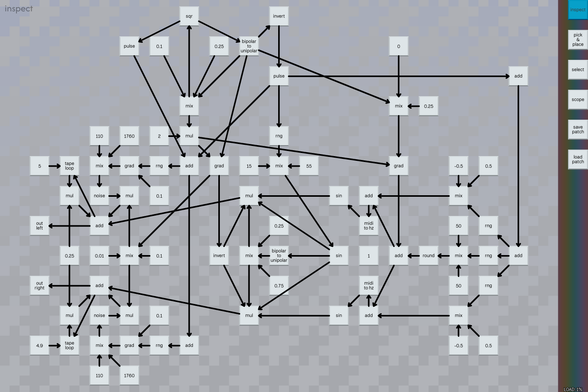
are you in the mood for some chill eerie slow experimental noise music? great, go find your headphones that have the good bass response, because I made some chill eerie slow experimental noise music #mollytime
here's what that patch looks like

I woke up this afternoon and realized this idea I had 98 days ago totally falls apart if you create a data dependency between invocations of the same function eg fn(fn()). Good thing I didn't build it!

I think instead I will probably have polyphony be implemented via shadow copies of polyphonic tiles.

https://mastodon.gamedev.place/@aeva/114968771707424143

another victory for daydreaming driven development
are you ready for 6 minutes and 26 seconds of uplifting harsh yet pleasant sounds because you'll never guess what i just made #mollytime
the patch for this one is a bit sprawling

I wrote a new screen for managing tile connections in mollytime, and I imagine a professional ui designer will feel real physical pain looking at this wonderful screenshot, which is why I decided to share it :3 It's pretty much the opposite of minimalism and it's sooooo functional and I can work a lot faster now ahahaha!

Now it only takes three or four clicks to toggle a wire whereas before it took more in some situations.
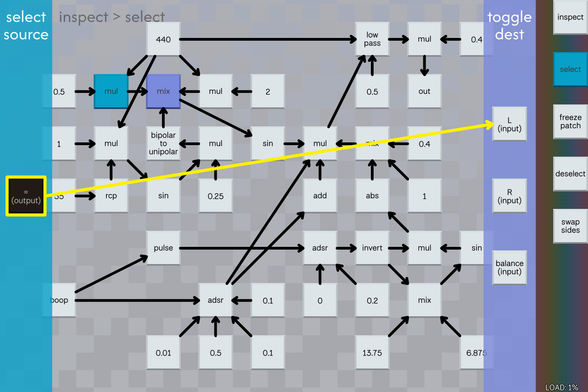
is it ugly enough to cause paint to peel? probably! is it intimidating to hypothetical new players? probably! however, this continues to be my guiding light:

https://mastodon.gamedev.place/@aeva/114612264992461462

This is how the old connection workflow worked if one of the sides of the selection had more than one possible option.

I have made a lot of patches with this old workflow and I am convinced now that despite what phones and tablets and unreal editor and windows 95 would have you believe, click-and-drag is an *awful* interaction verb and should not be used at all in frequently used actions.

https://mastodon.gamedev.place/@aeva/114842120034168266

The real victory today was ripping out the ADSR implementation and replacing it with a better one. Fixed a bunch of edge cases that had been bothering me, but also the new one is much simpler. The attack, decay, and release parameters now are the number of seconds to bring the amplitude from 0 to 1 or vice versa, and can be even modified while the envelope is running like on a proper synthesizer :O
That's the nice thing about this phase of the project. I can make major breaking changes to core functionality and I don't have to worry about things like versioning and such because "simply update every known patch file in existence by hand" is still a viable version migration strategy.
i think it's funny that it's been a little under half a year and i still haven't built any of the cool procedural wire drawing stuff i hashed out at the start of this devlog thread yet, because it turned out not to matter all that much in practice. i'd still like to take a shot at it, but it probably won't be soon
not every self playing patch is a winner but this one is named "barking frogs" #mollytime

I added a quantizer and a thing for generating random repeating sequences to mollytime tonight :D

This song is probably one of my favorite things I've made in a while ^_^

#mollytime

I don't have OBS set up on this machine right now, which is too bad, because otherwise you would have got to see me tinker with the patch while it was playing :)
I think this might be the first time that I've gotten a song stuck in my head that I made myself https://mastodon.gamedev.place/@aeva/115575598757344830

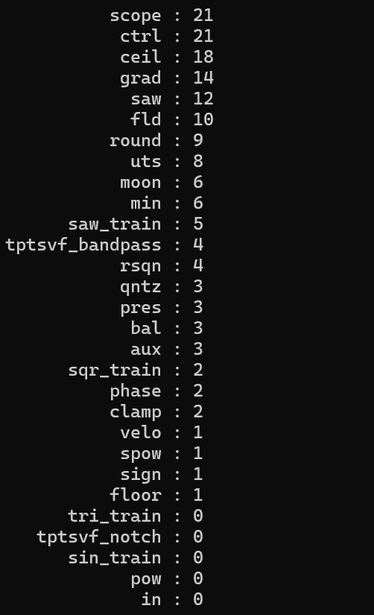
I wrote a python script to survey the distribution of opcodes in the mollytime example patches.

The bipolar-to-unipolar opcode is used 71 times, but the unipolar-to-bipolar opcode is only used 8 times so far. I'm reasonably sure that most of these are used to couple oscillator tiles to mix tiles.

I feel like this is probably a pretty good sign that having mix assume a 0-1 alpha like a normal lerp would was a mistake.

seems like it'll probably be a good idea to change the mix node to take a bipolar alpha value, and update the various random number generators to emit random bipolar values instead of unipolar values, but i'm gonna fiddle with this analysis script some more to better determine if that's a good idea or not

jfc I've written a lot of mollytime patches.

This table shows each opcode I've attached to a "mix" node, and how many times I've made that connection.

"const" is a numeric constant, "stu" is the bipolar-to-unipolar converter, "uts" is its inverse, "flp" is a flip-flop, and "midi_hz" is midi note number to hz.

It's unclear if making the mix alpha unipolar was a mistake or not. There's quite a lot of multiplies here, and I often use multiplies to pull values towards zero.
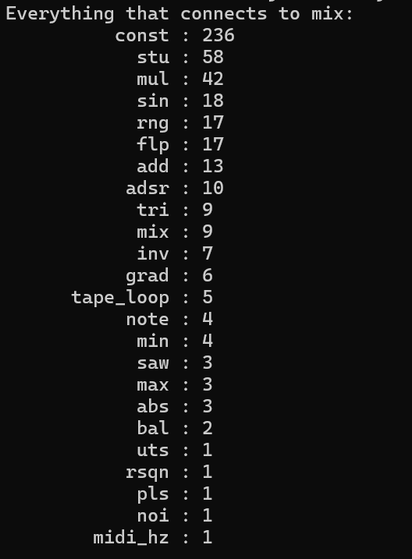
note -> mix is bizarre (that's a midi note from a connected midi device, so usually that's a magnitude of about 30 to 90), but midi_hz -> mix is *really* bizarre (that's hz from a midi note, so somewhere in the ballpark of 3 or 4 digits normally). I don't remember any of these, and its weird that note happened 4 times. I wonder if these are bugged patches
I think I'm gonna keep mix's alpha unipolar. It seems likely that if I were to change it to bipolar, I'd just end up flipping the number conversions the other way.

This is the whole opcode survey. This just lists the total counts of each opcode, no information about what they're connected to. Also this is only for the patches I've bothered to check in to git, since I'm not on my normal computer at the moment.

Each number is me dragging and dropping a tile 😅
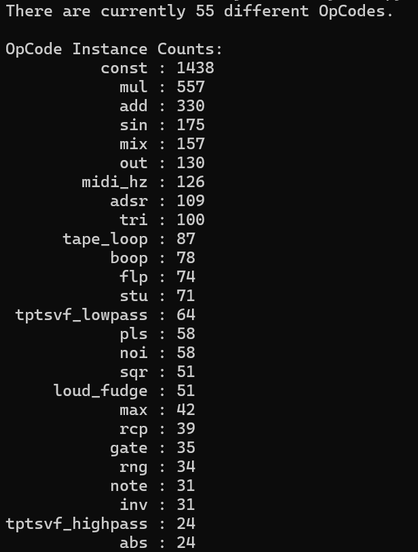
Besides putting to rest whether or not I should change the behavior of the mix instruction, I also put this together to help me decide on categories for organizing the tiles, as the obvious categories are too lopsided.

However, my sister wisely convinced me that top level categories are a waste of time and it is more useful to organize by vibe, eg make tiles adjacent because they feel like they should be together, and so that is what I am planning on doing now.

I know she is correct because I'm already kinda doing that. Also consider, "oscillators" is a category that would make sense. The moon is an oscillator, and sin is an oscillator, but the moon absolutely should not be in the same drawer as sin. This is important.

Rewriting the part catalog in the pick-and-place mode didn't take long at all it turns out. Here's a short video showing how the new version works.

The main difference is you select the catalog page from a sidebar instead of paging through them like its mario paint.

idk why the background looks so distorted in the recording
ok whew yeah the new pick-and-place UI is much nicer to work with. here's a patch a made real quick to validate that it's a better workflow #mollytime
are you in the mood for roughly five minutes and thirty seconds of filtered feedback loops being gently agitated by random noise and the occasional saw wave? because you'll never guess what I made in #mollytime tonight
I rewrote my oscilloscope today
not shown in the video, but if you manage to send the signal off into infinity, the "beam" disappears from the oscilloscope. if you manage to generate NaNs, the oscilloscope screen wipes to black.

alright, I've added a thing that is very definitely not a monad, called "go" which I guess is a sort of macro or syntax sugar to allow you to make the order of a given input port's, uh, inputs... make the order of an input port's inputs explicit.

and then I used it to make a kinda terrible sequencer! enjoy :D

(this is a short video with sound, please turn your sound on! but only if you want to)

#mollytime

I realized there was a bug in that patch (that I don't feel like explaining), and so I recorded a new version for your enjoyment. Also I made the sequence a little more elaborate. #mollytime

I added a new tile called "tweak" which lets you adjust its value live with the mouse wheel when the mouse is hovering over it. I haven't added an indicator for it yet, but the scope tile works fine in the mean time.

Here's a simple FM patch I whipped up to demonstrate it.

(video demonstration with sound)
#mollytime

I really need to make it so I can save the tweak positions next because look er listen to this :O

I HAD A VIOLIN HIDDEN IN HERE THIS WHOLE TIME :O I HAD NO IDEA

(more video w/ sound)
#mollytime

I added a little indicator to the tweak tiles so you can see what the f im doing. Anyways here's four minutes and twenty one seconds of me doing. (video w/ sound) #mollytime
not the final appearance, that's just a widget I threw together in about a half hour tonight
my strategy of allocating registers by simply heap allocating a few hundred floats wrapped in shared pointers has held up astonishingly well so far, but I think I'm going to switch to allocating the register file as a single array up front when a patch is compiled, and then copying values that should persist out of the previous iteration's register file during the program change on the audio thread.
this makes polyphony a lot easier to reason about. the other thing that makes polyphony a lot easier to reason about, is I've decided to have the number of polyphonic lanes be configured in a non-existent patch settings screen, rather than try to infer them from the patch. you get however many midi voices you want times however generic helper lanes you want (such as two if you want to do something fancy for stereo)
if you don't do anything that would be intrinsically polyphonic, like use midi or check which lane you are in, then you get a monophonic patch. I think that is reasonable behavior.
I'm a bit closer to figuring out how to make functions workable, since I'm trying not to paint myself into a corner there while I rework how the compiler works. One of the big open problems was what to do when someone produces a patch with a function that calls itself. The answer turns out to be "nothing" :) It's literally not possible with my chosen priors to support recursion, nor is it useful to.
as it happens, you can already write recursive algorithms anyway because the language supports cycles in the execution graph just fine. it's actually better, because you can't accidentally create infinite loops that block execution forever or oom on accident this way. ironically, allowing functions to recur does not make explicit graph cycles, which makes it impossible to make work without any flow control or stack machine. it's more efficient not to support it at all.

anyways, I think I have a clearer vision now as to how I'm going to implement polyphony. the main unsolved problem right now is how to make diagnostic tools like the oscilloscope have a coherent UI.

also I had this great realization that the execution model is not all that different from that of a spread sheet. registers are addressed by identity rather than position, but that's the main difference. the register file thing will make it a lot more similar though.

side thought: this devlog thread has been long enough to make the mastodon web ui bug out for a while now, but i kinda wanna keep it rolling and see how bad it can get XD

I recorded a video of me constructing a self-playing #mollytime patch from scratch, and I'm pretty happy with how it turned out :O.

If you don't want watch in mostly silence as I set up the basic structure of the patch for ten minutes and thirty six seconds, the music picks up at around 10:36.

https://www.youtube.com/watch?v=Q7qHcTszBhU

"starlight" mollytime live jam

YouTube
#mollytime is polyphonic as of tonight btw
(video with sound)
it's also a crashy mess now. maybe I'll simply riir it in rust tomorrow. (joke)
fixed it 😎 now it is nice and stable. no riiring necessary 😌
I kinda wanna put together a thing that takes the last sent general midi program number on a given midi channel and translates it to a scalar value or three that has them neatly ordered on a gradual spectrum so that mollytime patches can use it as a modulation parameter. eg ranking them on a spectrum from melodic to percussive or something like that
@aeva one thinks that, and then one ASAN session later, the pain is gone
@lritter python has other plans
@aeva when I saw this last night, I wasn't able to listen for a variety of reasons

buuuuut the song you picked!! this is so cool!

@aeva youtube actually recommended this to me before I saw you mention it here, and I had taken a note to boost it later 😊
@aeva this is my first time seeing mollytime and I'm completely sold, this is v cool
@aeva living the dream
@eniko if john mastodon didn't want it this way he would have fixed it before abdicating from the throne
@aeva @eniko it's kinda a weird issue since other clients work fine lol, why does the official web client just give up half way
@dotstdy @eniko that's a good point... i must make the thread even longer!
@aeva you're a few steps away from the cyberpunk menu theme :3 https://www.youtube.com/watch?v=tAxrYT06PSM
Cyberpunk 2077 - Main Menu Music | Best Quality | HQ 💽 🎼

YouTube
@aeva I love synths, I wish I knew wtf is happening 🐾💕
@efi five oscillators having a knife fight
@aeva hooting and hollering at "the elderly"
@aeva do you have controller support and a controller with motion controls and/or trackable VR controllers, for the Full Theremin Experience
@halcy no but it is absolutely something I have planned :3
@halcy or rather no to the part where I haven't implemented controller support yet. I have a variety of controllers with motion controls in them as well as a jar of old IMU modules somewhere that could be used to make some custom stuff.
@aeva either train or pre battle music 🤔
@aeva Was thinking ... "zip"
@dbat it's closer to append than zip
@aeva yaaaar, but is it zippy? 🤗
@dbat well, it goes
@aeva *adjust glasses* it's only an Oscilloscope™ if it's manufactured by Eskil Sköp & Söner AB. this is merely a sparkling waveform display
@aeva I love that a button labelled “boop” does exactly what I would have expected 
@heals *boop* it's a good button
@aeva is this game like, zachtronics but you have to make music? with bonus points if you use fewer arrows

@phairupegiont in a sense yes, but much more freeform. i call it a game, because it's important to me that it be fun to use and a delight to watch, but really it's more a general purpose virtual modular synthesizer

however, it would be fun to include a challenge mode of some kind, i'm just not sure how i'd go about validating a correct solution