 Paralax^SD
 Leo Herzog
As expected, the Qualcomm enshittification of @arduino has begun. Expressif's ESP32 stuff has already been a better platform for some time... I guess I'll have to learn the ESP-IDF ecosystem now instead of the Arduino IDE.
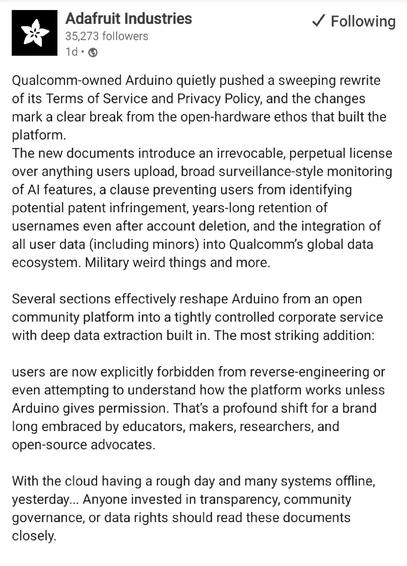

We’ve heard some questions and concerns following our recent Terms of Service and Privacy Policy updates. We are thankful our community cares enough to engage with us and we believe transparency and open dialogue are foundational to Arduino. Let us be absolutely clear: we have been open-source long before it was fashionable. We’re not going […]
@herzog
Problem is, this is totally short-sighted.
The market today is not at all what it was when arduino came out.
Back then it was alone and a revolution. Since then, Arduino's been living on its goodwill.
Which they have just squandered hopelessly. And today, there are enough viable alternative so they can disappear completely, nobody will care.
This is GIF all over again...
@herzog There's some info on the open source wifi stack at https://esp32-open-mac.be/posts/ This stack is pretty cool, because it would allow the complete elimination of all closed-source code from software built for the ESP32. Already they can avoid calling into closed source binaries after the point where the radio has gone through one-time init.
As for resources on getting started with rust on arduinos, I'm not quite there yet. :P
@herzog Here is Arduino's response:
https://blog.arduino.cc/2025/11/21/the-arduino-terms-of-service-and-privacy-policy-update-setting-the-record-straight/
I don't know if the situation is as cut-and-dried as it is claimed. I did a half-assed search through their Terms and Conditions and what is in the Adafruit post doesn't jump out at me. For instance, the only military thing I saw was a prohibition on its use by the military, a prohibition of its use if the end product will be used by the military (such as building UAVs), and calls out specific countries where one has to certify they are not a "military end user" as defined in the terms. These things all sound like good things, I would argue, if one is concerned about the building of cheap autonomous drones used in battle.
It would be helpful if Adafruit provided a bit more specificity. I didn't bother looking at the Arduino Privacy Policy. It would really be helpful when these things are updated if one could compare the new with the old side-by-side.
One thing that certainly jumps out and hits you in the face, and I don't know if this was there before, but right off the start they say you have to agree to arbitration for disputes. It is a big section before the terms even are laid out, then repeated in the arbitration section. That, clearly, is very important to them.
We’ve heard some questions and concerns following our recent Terms of Service and Privacy Policy updates. We are thankful our community cares enough to engage with us and we believe transparency and open dialogue are foundational to Arduino. Let us be absolutely clear: we have been open-source long before it was fashionable. We’re not going […]
@herzog @arduino I've been using an Eclipse plugin for ESP development for a while now. Eclipse handles bigger projects (more files, really, and git integration) better than Arduino IDE ever did. Arduino was good to learn on though I've never used an actual Arduino hardware. ATTiny, Teensy, ESP* have always been a better fit for me.
The point is: we have options. Lots of them.
@herzog Maybe give PlatformIO a try. https://platformio.org/
You can have it in VS Code as an IDE, which I believe the latest Arduino IDE is based on (though I haven’t tried it, I use PlatformIO in the command line because I’m a Huge Nerd With Habits.)
It supports Arduino and ESP32 boards, among others, and for the ESP32 you can choose either the ESP-IDF or the Arduino framework.
Also, buy Arduino clones by Joy-It or from AliExpress. That’s what everyone does anyway, Arduinos are overpriced.
 Sriram "sri" Ramkrishna - 😼
 Club de TéléMatique
 jeancf
 Ölbaum
 mmu_man
 adlerweb // BitBastelei
 Nick Poole
 Mercutio
 ShutterBugged
 MvRiederberg
 Dave
Dave Dani (she/her)
 fedithom
 🇳🇿
🇳🇿  💉*9 Roger