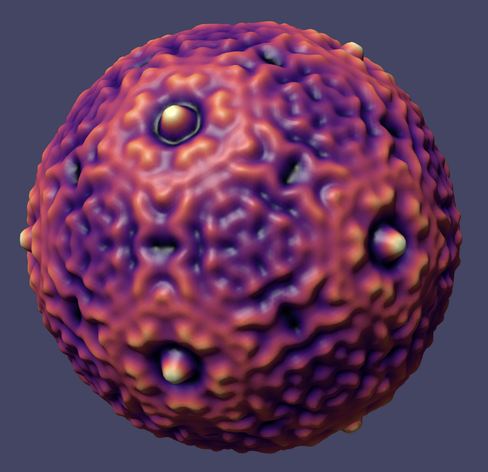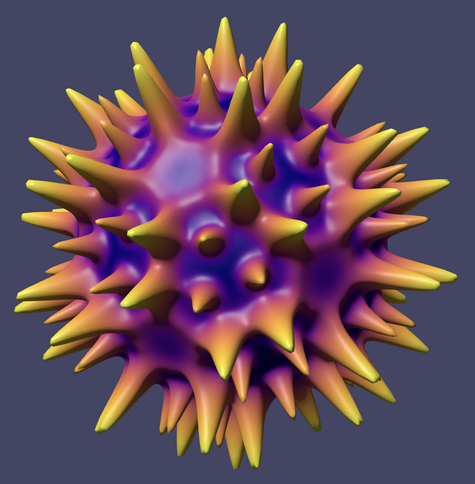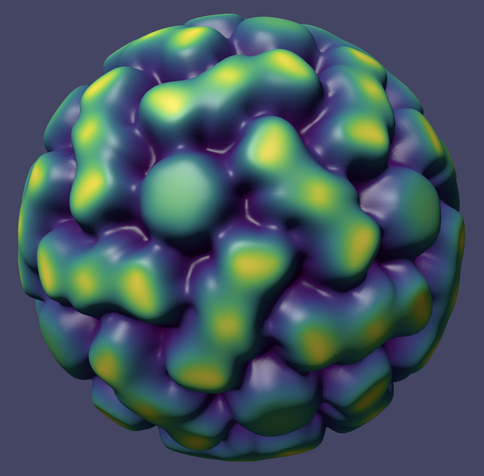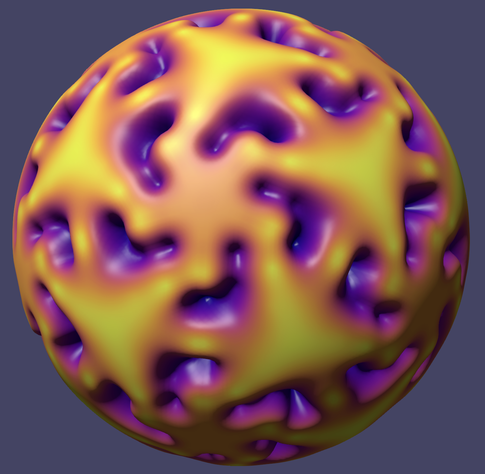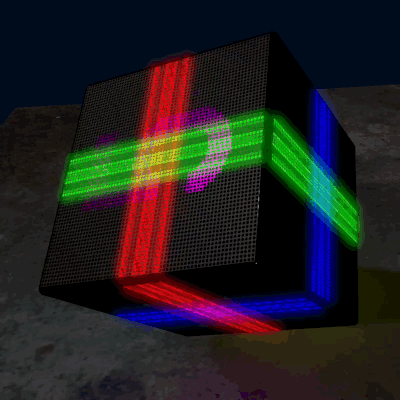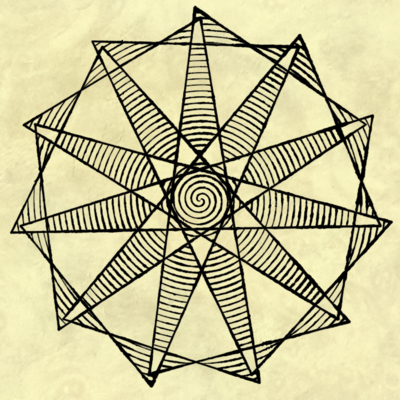
Testing out some new (to me) methods to make interesting patterns on spheres, and I am glad to report the math is mathing OK
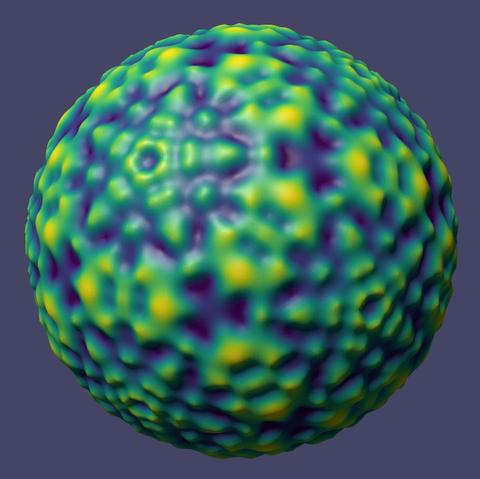
Same idea, slightly different generation technique
Another day, another orb
The orbs will continue until morale improves
etc.
@matt_zucker Can you say something about your generation algorithms or how you're rendering these?
@kbob more or less what Matthew Arcus said here: https://mathstodon.xyz/@matthewarcus/115575497397803602 – I start with an icosahedron, subdivide to make a bunch of tiny triangles projected out to a sphere, and then define a discrete height displacement function over the fundamental domain (a single triangle of the icosahedron). The function is defined to be symmetric over the triangle. (cont'd...)
@kbob
Currently I have two ways of generating smooth periodic functions. Both involve evaluating the discrete Laplacian of the function. One method generates uniform random function values at every mesh point (respecting symmetry), and then smooths by subtracting out the Laplacian. The other method generates random function values at a subset of mesh points and then finds the smoothest (w.r.t. Laplacian) way to fill in between them. (cont'd...)

@kbob In both cases I'm also enforcing that the derivative of the function equals zero across the boundary of the fundamental domain. So it's continuous both in value and in derivative on the triangle borders.

The height displacements are put through a non-linear transformation (e.g. f(x) = x^2) before rendering.

tl;dr I am basically solving the heat equation on a spherical triangle with interesting boundary conditions. I'm gearing up to solve some more interesting differential equations soon.

@matt_zucker Okay, now my brain hurts. That was the desired outcome, thanks. 🤯

How are you making the height displacement function? Is it a spline surface?

@kbob nope just a triangle mesh created by displacing vertices away from a sphere
@matt_zucker @kbob Aha, nice. I had missed the smoothness over the fundamental region boundary (my example just uses a texture for the displacement map, with no such smoothness guarantee).
@matthewarcus @matt_zucker Is the vertex grid regular, or do you perturb it?
@kbob @matthewarcus apply a height displacement to a regular triangulation of the sphere
@matt_zucker Nice! I'm guessing this is a Wythoff construction plus some bump mapping, maybe something like this (adapting a Shadertoy I wrote a while ago):