 zedgeist
Worst rule ever
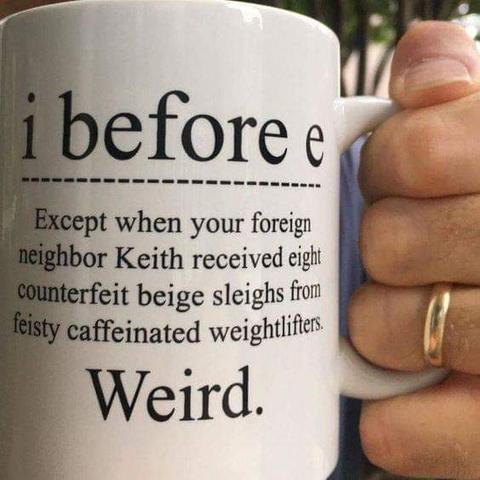
Rules for English that aren’t absolute.
I before e except after c. Which obviously is not totally accurate.
I before E except after C
And when sounding like A as in neighbor and weigh
And on weekends and holidays and all throughout May
And you’ll always be wrong no matter WHAT YOU SAY
You got me curious, so I checked it.
I downloaded this wordlist with 479k words, and used find+replace to count four strings: cie, cei, ie, ei. Here’s the result:
ie vs. 5649 (25%) eicie (74%) vs. 302 cei (26%)So the basic rule (i before e) holds some merit, but the “except after c” part is bullshit - it’s practically the same distribution.
Of course, this takes all words as equiprobable; results would be different if including the odds of a word appearing in the text into the maths.
Of course, this takes all words as equiprobable; results would be different if including the odds of a word appearing in the text into the maths.
I feel like it works more like 90% of the time when it comes up, so maybe this. And could it be that the words where “ie” appears are more ambiguous somehow, like don’t fit neatly into some existing pattern?
I don’t remember the “after c” bit ever being of use, though, so that part totally makes sense.
Edit: For an example, I’d never forget the spelling of “either”, because it’s so common and initial letters are more memorable. But, “piece” is tricky - “peice” is my first instinct, and I literally say “i before e” in my head when I write it now.
I thought it was specifically about words with long e sounds? So “Keith” would be an exception (but it’s a name and those are always weird - though “weird” itself is a better example), but most of the stuff on the mug it never meant to apply to. And overall for long e sounds it applies far more often than not. Ultimately english spelling will always be a clusterfuck though.
I sure wish people would stop spelling wiener as weiner. The city is called Wien ffs.
 Lvxferre [he/him]