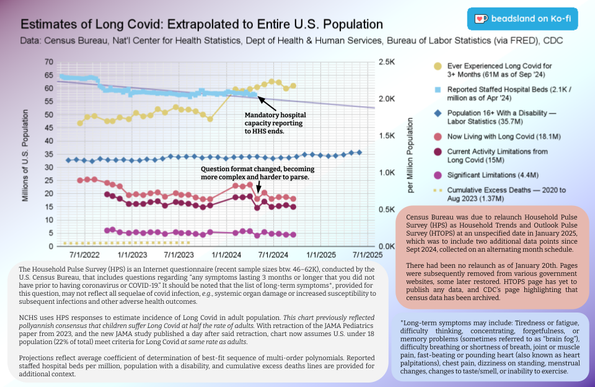
NCHS estimates of #LongCovid—based on Household Pulse Survey.

Census never published data for October and December of last year, after posting that they were "transitioning" to longitudinal data collection. To be clear, that was under the prior administration.

Hospital capacity data was ended under prior administration. Only Federal Reserve disability data continues to update.

#ThisIsOurPolio #CountLongCovid #CovidIsNotOver #MassDisablingEvent

[This is first toot of periodically refreshed thread, providing various dataviz of ongoing #pandemic.]

Last period:
https://hcommons.social/@beadsland/114162964718293255
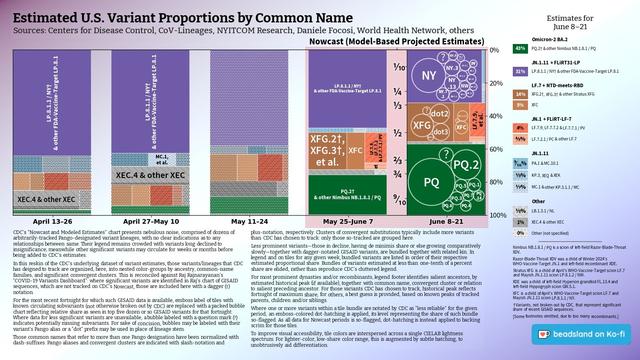
Raj's dashboard, last updated July 3, showed PQ.2 as standout child of Nimbus NB.1.8.1 / PQ; Stratus XFG in competition with kids XFG.2 and XFG.3; and LP.8.1 long ago overshadowed by LP.8.1.1/ NY.

FDA vaccine target LP.8.1, dominant since March, plateaued in April. June saw Nimbus NB.1.8.1 / PQ, scion of "razor-blade throat" XDV, push LP.8.1 out of majority.

#CDC's most recent Friday dataset, updated Tuesday June 24, showed Nimbus taking plurality, with Stratus XFG family also gaining share.

Despite notice of moving to "longer reporting periods", for reason of "low number of sequences being reported" (see dot-hatching in below chart reflecting"less reliable" data), now three-weeks old dataset was still for periods two-weeks each.

#ThisIsOurPolio #variants #CovidIsNotOver #dataviz #datavis

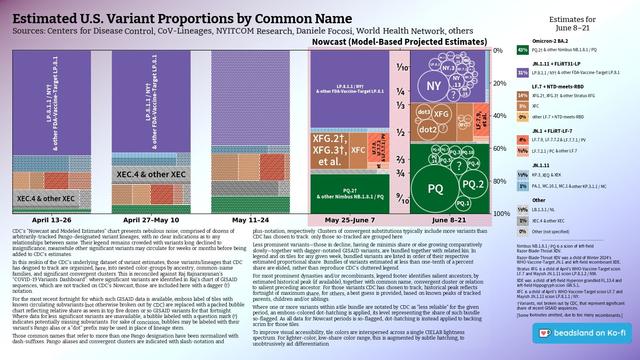
Raj's dashboard, updated this morning, shows PQ.2 as standout child of Nimbus NB.1.8.1 / PQ; Stratus XFG overtaken by child XFG.2; and LP.8.1 long ago overshadowed by LP.8.1.1/ NY.

FDA vaccine target LP.8.1, dominant since March, plateaued in April. June saw Nimbus NB.1.8.1 / PQ, scion of "razor-blade throat" XDV, push LP.8.1 out of majority.

#CDC's most recent Friday dataset, updated Tuesday June 24, showed Nimbus taking plurality, with Stratus XFG family also gaining share.

Despite notice of moving to "longer reporting periods", for reason of "low number of sequences being reported" (see dot-hatching in below chart reflecting"less reliable" data), now three-weeks old dataset was still for periods two-weeks each.

#ThisIsOurPolio #variants #CovidIsNotOver #dataviz #datavis

Is has been all but a month since #CDC last provided updated variant proportions Nowcast estimates.

Not simply because of the current administration. They don't have the data. They rely on state health authorities to provide that data:

https://aus.social/@mike_honey_/114878987678249752

No data, nothing to model estimates on.

Data started becoming harder to come by under the prior administration. After that president declared our "independence" from the virus.

Science is and always has been political.

Mike Honey (@[email protected])

Attached: 1 image Sample data is lagging and patchy recently, apart from California, New York, Colorado and Maryland. 🧵

Aus.Social

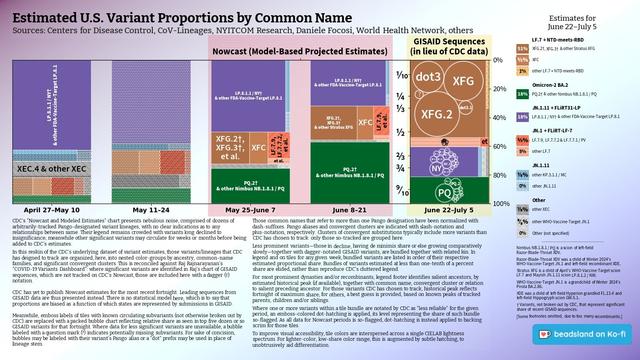
Raj's dashboard, updated Sunday, shows PQ.2 as standout child of Nimbus NB.1.8.1 / PQ; Stratus XFG overtaken by child XFG.2; and LP.8.1 long ago overshadowed by LP.8.1.1/ NY.

GISAID data for the most recent fortnight is dominated by submissions from New York, followed by Florida.

#CDC's most recent Friday dataset, updated Tuesday June 24, showed Nimbus taking plurality, with Stratus XFG family also gaining share.

FDA vaccine target LP.8.1, dominant since March, plateaued in April. June saw Nimbus NB.1.8.1 / PQ, scion of "razor-blade throat" XDV, push LP.8.1 out of majority.

[Edited to remove erroneous sequence counts.]

#ThisIsOurPolio #variants #CovidIsNotOver #dataviz #datavis

Raj's dashboard, updated this morning, shows Stratus XFG overtaken by child XFG.2; PQ.2 as standout child of Nimbus NB.1.8.1 / PQ; and LP.8.1 long ago overshadowed by LP.8.1.1/ NY.

GISAID data for the most recent fortnight is dominated by submissions from New York (217 sequences), followed by California (137), Colorado (81), and Virginia (35).

#CDC's most recent Friday dataset, updated Tuesday June 24, showed Nimbus taking plurality, with Stratus XFG family also gaining share.

FDA vaccine target LP.8.1, dominant since March, plateaued in April. June saw Nimbus NB.1.8.1 / PQ, scion of "razor-blade throat" XDV, push LP.8.1 out of majority.

[Edited to correct sequence counts.]

#ThisIsOurPolio #variants #CovidIsNotOver #dataviz #datavis

Another three hundred lines for #AnnoPlot #dataviz project since last round of work in June:

https://hcommons.social/@beadsland/114788341947558989

Work in July focused on:

• streamline variants #datavis alt-text generation
• extensive refactoring across multiple annoplot and tiop modules
• build out option for using GISAID for tree chart, in lieu of recent estimates
• prototype dynamic offsets for flanking artists

With other tasks including:

• refine flattening of variants lineages
• resume TODO tracking
• tweak log messages in various methods
• tweak title adornment overhang
• tweak legend to better accommodate footnotes
• address data import issues
• tweak inclusion of ancestor variants on legend
• conform throughout to non-specific reporting periods
• add option for dropping most recent period
• migrate hatchmask suppression for scrim periods
• bugfixing of paragraph artist
• copy editing and revisions of captions
• tweak captions to better reflect runtime options
• tweak emboss edge collision detection

Raj's dashboard, updated yesterday, shows Stratus XFG overtaken by child XFG.2; PQ.2 as standout child of Nimbus NB.1.8.1 / PQ; and LP.8.1 long ago overshadowed by LP.8.1.1/ NY.

GISAID data for the most recent fortnight is dominated by submissions from California (245 sequences—up 108 from ten days prior), followed by New York (227—ten more), Colorado (97—sixteen more), and Virginia (35).

#CDC's most recent Friday dataset, updated Tuesday June 24, showed Nimbus taking plurality, with Stratus XFG family also gaining share.

FDA vaccine target LP.8.1, dominant since March, plateaued in April. June saw Nimbus NB.1.8.1 / PQ, scion of "razor-blade throat" XDV, push LP.8.1 out of majority.

[Edited to correct sequence counts.]

#ThisIsOurPolio #variants #CovidIsNotOver #dataviz #datavis

Raj's dashboard, updated yesterday, shows Stratus XFG overtaken by child XFG.2, as XFG.3 has spawned a child.

GISAID data for the most recent fortnight is dominated by submissions from California (328 sequences), followed by New York (234), Colorado (81), and New Jersey (53).

#CDC's most recent Friday dataset, updated June 24, showed Nimbus NB.1.8.1 / PQ taking plurality, with Stratus XFG family also gaining share.

Weaker showing for Nimbus in GISAID data reflects the fact that much available data is from New York. Were it not for California data, Nimbus would be barely evident.

[Edited to correct sequence counts.]

#ThisIsOurPolio #variants #CovidIsNotOver #dataviz #datavis

Raj's dashboard, updated yesterday, shows Stratus XFG in close competition with two if its children, as XFG.3 has spawned a child of its own.

GISAID data for the most recent fortnight is dominated by submissions from New York (149 sequences), followed by California (97), Colorado (66), and Illinois (41).

#CDC's most recent Friday dataset, updated June 24, showed Nimbus NB.1.8.1 / PQ taking plurality, with Stratus XFG family also gaining share.

Weaker showing for Nimbus in GISAID data reflects the fact that much available data is from New York. Were it not for California data, Nimbus would be barely evident.

#ThisIsOurPolio #variants #CovidIsNotOver #dataviz #datavis

Another four hundred lines for #AnnoPlot #dataviz project since last round of work in July:

https://hcommons.social/@beadsland/114969608143508746

Work in August focused on:

• preliminary integration of adornments flank prototype
• tweak emboss hemming
• bugfixes, semantics, linting, error checking, and logging tweaks
• extensive previously deferred refactoring
• correctly format warnings captured by chirp
• rework alt-text for dominant families

In absence of CDC estimates:

• expand and debug proxy GISAID tooling into subsequent periods
• break out diversified branches in proxy columns
• rework of scrims and scrim titles, legend title and inner tick labels

Also, with regards to devpie #datavis:

• resolve collisions for wedge auto text
• smaller text treatments for wedge emboss
• resolve edge cases and improving efficiency
• add shell scripts to line tallies
• rework to determine cutoff, smoosh and slice wedges dynamically
• option to specify day count

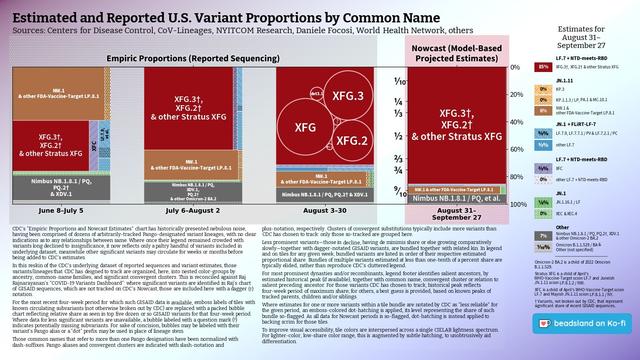
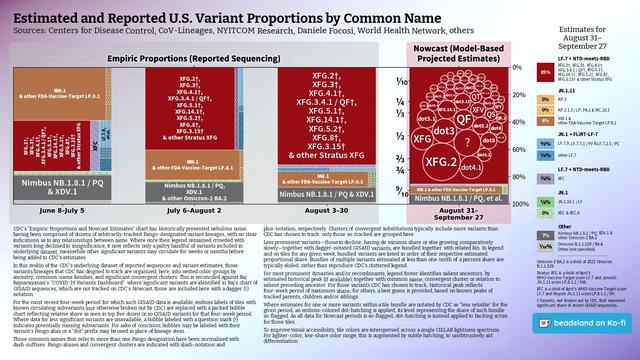
#CDC's most recent Tuesday dataset, updated Thursday, shows tightly-knit Stratus XFG family dominating, with Nimbus NB.1.8.1 / PQ in second place at around one-seventh share.

Note that, in absence of robust data from states, CDC has given up modeling historical estimates, instead giving only shares of reported sequences.

Raj's dashboard, updated Friday, shows Stratus XFG in close competition with two if its children, as XFG.3 has spawned a child of its own.

GISAID data for the most recent four week period is dominated by submissions from California (803 sequences), followed by New York (392), Colorado (295), and Texas (213).

#ThisIsOurPolio #variants #CovidIsNotOver #dataviz #datavis

Interesting (sic) pattern am seeing on #CDC website.

In my browser, have visited the following URL:

covid.cdc.gov/covid-data-tracker/#variant-proportions

…so many times, that need only type "prop" for it to appear as first suggestion in my URL bar.

Yet, now, when select this URL, get redirected to:

covid.cdc.gov/covid-data-tracker/#datatracker-home

Yet this only happens upon first visit to site in a new tab. If again select the same URL, get redirected on second attempt to:

www.cdc.gov/covid/php/variants/variants-and-genomic-surveillance.html

Which, to be clear, would suggest the referrer (the page one was on before going to the next link) is being taken into account to determine whether to obfuscate (datatracker-home) or redirect (variants-and-genomic-surveillance) access to variants proportions data.

If you're already on the site, internal links to the old URL still work. But if you're arriving from elsewhere, you're presented with a generic landing page as if data is gone.

In other news, CDC has updated what much of the rest of what remains of covid data tracking (after prior administration dismantled most all of it) to use Microsoft BI, with no apparent method for downloading the data that underlies said charts.

Microsoft BI is a system, popular before now among state and local public health officials, that specifically operates to frustrate access to data, rendering all text and tables as a jigsaw of embedded graphical elements.

Raj's dashboard, updated yesterday, shows Stratus XFG pulling ahead in competition with its two children, even as XFG.3 has spawned a child of its own.

GISAID data for the most recent four week period is dominated by submissions from Colorado (327 sequences), followed by California (297), Utah (160), and New York (129).

#CDC's most recent Tuesday dataset, updated end of August, shows tightly-knit Stratus XFG family dominating, with Nimbus NB.1.8.1 / PQ in second place at around one-seventh share.

Note that, in absence of robust data from states, CDC has given up modeling historical estimates, instead giving only shares of reported sequences.

#ThisIsOurPolio #variants #CovidIsNotOver #dataviz #datavis

Took it easy this month, recovering from seasonal booster. Thus, only a hundred more lines for #AnnoPlot #dataviz project since last round of work in August:

https://hcommons.social/@beadsland/115123231252276843

Work in September focused on:

* clarification of winter ancestries in legend footnotes
* restoring variant peak tracking from biweekly CDC data
* some more previously deferred refactoring
* preliminary work to allow for partial variants #datavis orchard chart bar between periods
* tweaking utility script to accommodate legacy variant namespace clash
* debugging and conforming usage
* clarification of language in caption

#CDC's most dataset, updated Friday, shows tightly-knit Stratus XFG family dominating, with Nimbus NB.1.8.1 / PQ in second place, down to one-fourteenth share, this nearly neck-in-neck with FDA Vaccine Target LP.8.1 (or its family line) at one-seventeenth share.

Note that, in absence of robust data from states, CDC has given up modeling historical estimates, instead giving only shares of reported sequences.

Raj's dashboard, last updated over two weeks ago, shows Stratus XFG pulling ahead in competition with its two children, even as XFG.3 has spawned a child of its own.

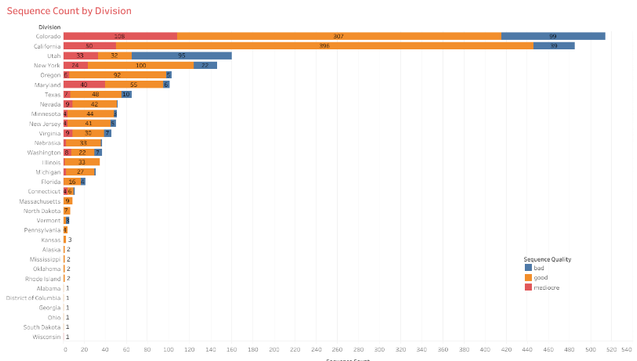
GISAID data for the most recent four week period is dominated by submissions from Colorado (514 sequences), followed by California (485), Utah (160), and New York (146).

#ThisIsOurPolio #variants #CovidIsNotOver #dataviz #datavis

Looking a Raj's variants dashboard…

For August, Colorado (with a population of 6 million) was the source of more variant sequences to GISAID than California (with six-and-a-half times the population).

Colorado sourced three-and-a-half times as many sequences to GISAID as did New York, despite New York having over three times the population of Colorado.

Meanwhile, Utah, with a population of only three-and-a-half million, provided more sequences than dozens of states with larger populations, including not only New York, but such other Democrat trifecta states as Oregon, Maryland, New Jersey, Washington, Illinois, Connecticut and Massachusetts—all with larger populations than Utah.

GISAID, here, is a proxy for data being received by the #CDC. They've switched to "empiric proportions" reporting because they don't have enough data to build historical models from.

This being a problem that started during prior administration, when CDC would regularly publish regional maps with no data.

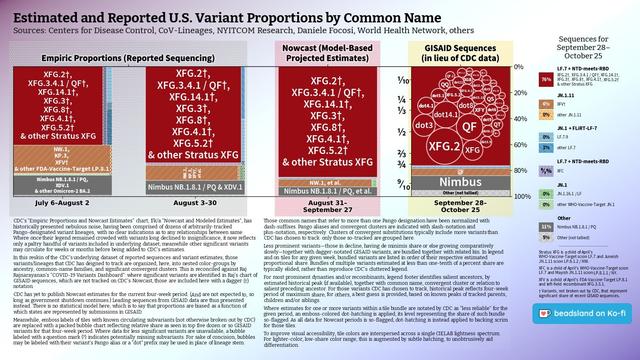
Raj's dashboard, updated yesterday, shows Stratus wildly diversified, having spawned multiple third-generation pango aliases and descendant recombinants. This after months of data suggesting XFG evolution had been stagnant.

GISAID data for the most recent three-week-and-change period is dominated by submissions from New York (178 sequences), followed by Colorado (137), Oregon (77), Nebraska (58), and Minnesota (39).

Despite profound diversification of XFG, CDC has yet to break out estimates for any of its subvariants.

#CDC's most recent dataset, updated Sept 26, showed Stratus XFG family dominating, with Nimbus NB.1.8.1 / PQ in second place, down to one-fourteenth share, this nearly neck-in-neck with FDA Vaccine Target LP.8.1 (or its family line) at one-seventeenth share.

Note that, in absence of robust data from states, CDC has given up modeling historical estimates, instead giving only shares of reported sequences.

#ThisIsOurPolio #variants #CovidIsNotOver #dataviz #datavis

Raj's dashboard, updated yesterday, shows Stratus wildly diversified, having spawned multiple third-generation pango aliases & descendant recombinants. This after months of data suggesting XFG evolution had been stagnant.

GISAID data for the most recent three-week-and-change period is dominated by submissions from New York (127 sequences), followed by Connecticut (19), Oregon (17), and California (14)—paltry all round.

Despite profound diversification of XFG, CDC has yet to break out estimates for any of its subvariants.

#CDC's most recent dataset, updated Sept 26, showed Stratus XFG family dominating, with Nimbus NB.1.8.1 / PQ in second place, down to one-fourteenth share, this nearly neck-in-neck with FDA Vaccine Target LP.8.1 (or its family line) at one-seventeenth share.

Note that, in absence of robust data from states, CDC has given up modeling historical estimates, instead giving only shares of reported sequences.

#ThisIsOurPolio #variants #CovidIsNotOver #dataviz #datavis

#Annoplot #dataviz development has been temporarily suspended as of October, after only about fifty lines added since last round of work in September:

https://hcommons.social/@beadsland/115295487903892225

Work in first week of October focused on:

* support for #datavis of partial periods of GISAID data
* tweaks to scrim and suds implementations
* revisions to captions to reflect current events

Work in first week of November focused on development of Buoy, a tool for floating self-boosted posts periodically, as a function of other posting behavior:

https://hcommons.social/@beadsland/115522549953210771

This added about 400 lines, plus another 50 lines to duplicate existing hotmods library:

https://hcommons.social/@beadsland/115522621038530696

Raj's dashboard, updated today, shows Stratus wildly diversified, having spawned multiple third-generation pango aliases & descendant recombinants (incl much of Other on this chart). Previous data had suggested XFG was stagnant.

GISAID data for the latter two-weeks-and-change of the most recent period is dominated by submissions from California (120 sequences), followed by New York (87), Minnesota (49), and Colorado (36)—paltry all round.

Despite profound diversification of XFG, CDC had yet to break out estimates for any of its subvariants.

#CDC's most recent dataset, updated Sept 26, showed Stratus XFG family dominating, with Nimbus NB.1.8.1 / PQ in second place, down to one-fourteenth share, this nearly neck-in-neck with FDA Vaccine Target LP.8.1 at one-seventeenth share.

Note that, in absence of robust data from states, CDC has given up modeling historical estimates, instead giving only shares of reported sequences.

#ThisIsOurPolio #variants #CovidIsNotOver #dataviz #datavis