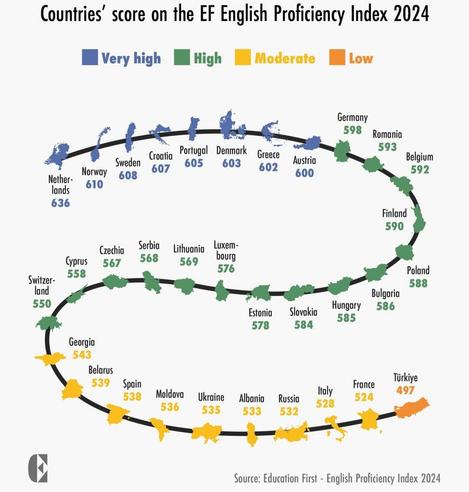
Europe's English Skills

https://jlai.lu/post/28459209

What’s the source for this, what does this numbers mean and how do they got these numbers, just curious
EF English Proficiency Index - Wikipedia

The EF EPI 2024 edition was calculated using test data from 2.1 million test takers in 2023. The test takers were self-selected.

Self-selected. Meh …

Just for fun I wonder where England and the USA would be on this list…
The only people who are likely to take such a test in an anglophone country are immigrants …
If you immigrate as an English speaker to Canada you have to take an English proficiency test even if it is your first language.

I’m guessing you could take French as well, regardless of where you’re going, right? Language equality is serious business.

Yes, unnecessary documentation is very our style. And no guarantee you won’t have to do it again for some other entity. Somehow we’re still one of the easiest destinations to immigrate to.

I’m an immigrant in Germany, and they offered me an integration course when I got my spousal visa. I’ve taught those classes for the same city. They did waive my language requirement because of my master’s degree in German though, so that was nice and unexpected.
On behalf of Germans, sorry for that. It’s hard to go against the rightwing propaganda machine, but lots of people are trying.

They did waive my language requirement because of my master’s degree in German

Yes, we believe in degrees.

To be fair, it’s a master’s in German language education, so it should really apply to the integration course as well (it’s basically a language class that focuses on things like siezten/dutzen, bureaucratic language, holidays, navigating the workplace and shared housing, and cultural quirks like not jaywalking and quiet sundays).
There is a lot of very similar vibes between the Canadian and German government, I’ve noticed. They even both love faxes the same.

Germany finally got rid of faxes in the government recently.

But many of our health insurance companies still use them

Yes, I think you just have to show proficiency in one of the official languages.

I can’t comment for the whole Anglosphere and I certainly won’t comment on NI, Wales, and Scotland, but for England:

Pick any point on the map and move in any direction. As you move, if the average wage increases, English proficiency increases and vice versa.

I’d say at the lowest level equivalent is France and the highest level equivalent is Denmark.

I have a hard time believing that there are regions in England where native English speakers are on the English proficiency level of France. Unless you classify any dialect as “bad English”.

You haven’t been to enough regions of England mate. I’m only slightly joking when I say it can get bad. Not “it’s a difficult to understand dialect” but “how the hell did you even make it through the state school system?” bad. Genuinely some of the first generation immigrants speak better English than some of the locals.

Source: grew up in one of these regions.

I mean, the King’s English is technically a dialect too. It’s just the one on top.
Yes, that’s what a dialect is. Well, thanks for clearing up what you meant.
Bad native language is when you can’t express a thought better than a 10 y.o. kid. Small vocabulary, …
Thanks. I was seriously wondering about Italy and Turkey, but that explains it.
If they don’t immigrate, they might still take the test for domestic purposes like proving their ability to deal with tourists or other international customers to their employers. But the test takers are definitely self-selecting, some rural greatgrandmother who barely learnt to read her native language isn’t taking that test.
I wouldn’t expect Scandinavian countries to move much. Most of them learn it to fluency as part of primary education.

England: 1st place

USA: 7th place

  • England
  • Ireland
  • Australia
  • New Zealand
  • Bahamas
  • Nigeria
  • USA
  • Checks out.

    There’s a related joke, about the general language skills of populations: the Luxembourgish speak four languages, the Swiss speak three languages, the Swedish speak two languages, the English speak one language and the US-americans speak half a language.
    I am fully expecting England to not be at the top. Especially if written skills are measured.

    I find that broken English is easier to understand, compared to the time I talked to a Londoner in the bus, I could understand him but my travel buddy had no idea.

    Accents can be rough on tourists.

    It’s known that two non-native English speakers can understand each other more easily than a non-native speaker and a native speaker. The non-native speakers are better at deciphering incorrect use of the language than the native speaker who has stricter expectations.

    I wonder what the numbers look like between English first language ‘with no second language experience’ versus ‘some or fluent post-childhood learning second language experience’.

    I’ve been told im awful to practice English with because i just understand. But i have teen/adult learning experience with two other languages.

    I think it has a significant impact, yes. When you understand how different grammatical structures in other languages behave, and if you are even familiar with some of the words from other languages, understanding the speaker’s incorrect English (or other language they are trying to speak with you) becomes much easier. 👍
    Yeah i think just having experience with a different grammar at all forces you to be more flexible. When you only talk to other english speakers as a first language, the rules are somewhat rigid in the sense that everyone’s interpretation assumes your intent aligns with what is spoken. If that’s your only experience you might try to apply that assumption with non-native speakers. So I’m suggesting regardless of your knowledge of any particular other language, having learned some of any secondary language in practice forces you to re-evaluate the rigidity of those social rules and think more critically about what an English learner is trying to say.
    Exactly, it increases the plasticity of your understanding. Widens your ability to error correct on your own, and understand despite incorrect use.

    At work I had to speak my english slow and deliberate with french people when in international meetings, or they would not understand.

    The interesting part is that when doing so I picked up the “french accent” in my own English 😅.

    I fully expected England to be in the lowest color and am disappointed that they aren’t on the list at all.
    In coastal Turkey when I visited, there were English speakers everywhere. I’m sure as you head east that peters out
    Back in the 2010s, Egypt’s tourist cities became a popular destination for Russians, and in just a few years all the hotel staff and street vendors switched from speaking English to everyone speaking Russian. It was very impressive as to what the promise of money can do.
    What is the point of depicting data in this manner? The spatial coordinates have no meaning

    The countries are ordered on the bend line according to their rank, so the 1-dimensional spatial coordinate system describing this line does have meaning.

    This somwhat unusual representation has the advantage that they managed to represent all datapoints with a well readable font on a graphic that fits well even on a phone’s screen, and it’s sort of eye-catching.

    It’s pretty unintuitive, though. I had to actually read and analyse it rather than just view it.

    Why not just use a coloured map instead? Presumably that would fit in roughly the same aspect ratio.
    Seems made for mobile.

    Missed the chance to reverse the color scale and have orange for the Netherlands.

    en.wikipedia.org/wiki/William_III_of_England

    William III of England - Wikipedia

    Was curious how Belgium would score by language region.

    Seems the Flemish part scores higher than The Netherlands while Wallonia drags everything down.

    French speakers being French speakers. Case in point: France scores lower than fucking Russia

    This explains why French people are always speaking French in game chat in Rocket League as if French is the Lingua Franca lmfao so silly.

    Every time they utilize the chat it’s also to be unprovokedly toxic which is another mystery. Maybe they’re just that unhappy? Something bad in the water?

    Lingua Franca

    I wheezed

    French used to be the lingua franca of diplomacy for hundreds of years, actually. It was replaced by English only fairly recently.
    That’s the joke! ^^
    Toutes mes éxcuses
    Fairly unsurprising. English is literally harder if your native language is a romance language than if it is a germanic language. Same is true for germanic native speakers who try to learn a romance language.
    Except Flemish people tend to speak good French while people from Walloon barely speak Dutch. I agree with your statement in general, but in the case of Belgium there’s a lot more to it than that.

    As a native English speaker, I don’t know the language rules in English, I merely speak the language. I suppose the idea is that I can think with the same grammer in English as I can in Dutch or German (except when I can’t) than with romance languages.

    But at the same time, I feel like the Spanish language, is a fairly easy language for non native speakers to learn. It’s phonetical, it’s logical, it doesn’t have ridiculous numbers or times for the clock.

    But at the same time, I feel like the Spanish language, is a fairly easy language for non native speakers to learn. It’s phonetical, it’s logical, it doesn’t have ridiculous numbers or times for the clock.

    I tried learning Spanish in school for about six years. IDK, maybe other languages would be even harder, but I found it pretty hard, especially understanding spoken Spanish.

    It’s hard to believe Germany is so high on the list. I visit regularly and even worked there for a while, where are all the fluent English speakers hiding?
    Same with Austria. As a Dane living in Austria, it feels like nobody here has even half-decent English skills. It’s horrible, and I blame generations of dubbed TV and movies.
    I’m also confused. Maybe they just don’t want to talk, that’s the best explanation I have.
    I don’t know what study these numbers are based on, but many of them only assess certain (typically younger) age groups. In my experience, the people coming out of school today in Germany are often quite good in English.
    Maybe English proficiency across the world isn’t as high as the internet would have you believe.

    The EF English Proficiency Index (EF EPI) attempts to rank countries by the equity of English language skills amongst those adults who took the EF test. It is the product of EF Education First, an international education company, and draws its conclusions from data collected via English tests available for free over the internet. The index is an online survey first published in 2011based on test data from 1.7 million test takers. The most recent edition was released in November 2023.

    Wikipedia.org

    So the data is not representative for the entire population of a country.

    EF English Proficiency Index - Wikipedia

    Really? Nearly everyone I met there spoke excellent English…