An analysis of a rock sampled by NASA's #Perseverance #Mars rover last year called “Sapphire Canyon” will be discussed in a press conference at the top of the hour: https://www.youtube.com/watch?v=-StZggK4hhA - it was collected in July 2024 from a set of rocky outcrops on the edges of Neretva Vallis, a river valley carved by water rushing into #Jezero Crater long ago.
NASA to Share Details of New Perseverance Mars Rover Finding

YouTube
The #Perseverance press conference panel consists of 5 NASA managers and 1 Mars researcher - so the topic is likely some follow-up to "the
discovery of a potential #biosignature" in an outcrop reported earlier this year in https://ntrs.nasa.gov/api/citations/20250001217/downloads/Hurowitz%20et%20al%20LPSC.pdf while the specific rock to be discussed today was shown in April in https://science.nasa.gov/resource/meet-the-mars-samples-sapphire-canyon-sample-25/ and mentioned in August in https://www.eurekalert.org/news-releases/1094171 and the O-PTIR #spectroscopy method to hunt for microbial markers was discussed in March in https://www.u-tokyo.ac.jp/focus/en/press/z0508_00392.html
Redox-driven mineral and organic associations in Jezero Crater, #Mars: https://www.nature.com/articles/s41586-025-09413-0 -> "Here we report a detailed geological, petrographic and geochemical survey of these rocks and show that organic-carbon-bearing mudstones in the Bright Angel formation contain submillimetre-scale nodules and millimetre-scale reaction fronts enriched in ferrous iron phosphate and sulfide minerals, likely vivianite and greigite, respectively. This organic carbon appears to have participated in post-depositional redox reactions that produced the observed iron-phosphate and iron-sulfide minerals. Geological context and petrography indicate that these reactions occurred at low temperatures. Within this context, we review the various pathways by which redox reactions that involve organic matter can produce the observed suite of iron-, sulfur- and phosphorus-bearing minerals in laboratory and natural environments on Earth. Ultimately, we conclude that analysis of the core sample collected from this unit using high-sensitivity instrumentation on Earth will enable the measurements required to determine the origin of the minerals, organics and textures it contains."

Redox-driven mineral and organic associations in Jezero Crater, Mars - Nature

A geological, petrographic and geochemical survey of distinctive mudstone and conglomerate outcrops of the Bright Angel formation on Mars reveals textures, chemical and mineral characteristics, and organic signatures that warrant consideration as potential biosignatures.

Nature
An earlier video about the #Mars rock Sapphire Canyon: https://www.youtube.com/watch?v=9bLhVJKoIOg. And a press release from today: https://www.jpl.nasa.gov/news/nasa-says-mars-rover-discovered-potential-biosignature-last-year/. And a thread about the ongoing press conference: https://x.com/SpaceflightNow/status/1965794069042634837
Meet the Mars Samples: Sapphire Canyon (Sample 25)

YouTube

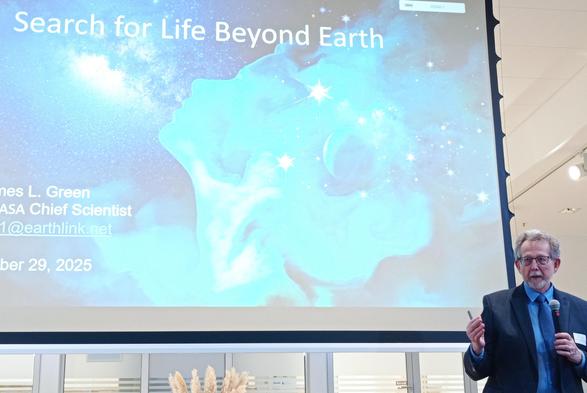
Interesting corollary to the #Perseverance discovery in the Bright Angel formation on #Mars making headlines 1 1/2 months ago: at a public talk in Bochum as part of a mathematics outreach event - https://www.mathematik.de/dmv/gauss-vorlesungen -> https://transfer.ruhr-uni-bochum.de/de/gauss-in-bochum - former NASA Chief Scientist James Green (https://en.wikipedia.org/wiki/James_L._Green) gave the new paper a 4 on the 7 step Confidence of #Life Detection scale https://en.wikipedia.org/wiki/Confidence_of_Life_Detection_Scale. That is unless someone figures out how to make the features and minerals Percy found abiologically without heat, then it would drop to 3. If on the other hand the respective sample makes it back to Earth after all in some #MarsSampleReturnMission the rating could jump up to 5 or 6 after lab analysis.

Green also remarked that the sample tubes dropped by Percy are up for grabs for *any* spacefaring nation capable of doing a MSRM - including China though they don't plan to go after the Percy samples with their upcoming #Tianwen3 mission (https://en.wikipedia.org/wiki/Tianwen-3) as far as he has heard. And regardless of where they'll get their own samples they could advance the case for life, perhaps even extant, on Mars a lot - which Green feels has been all but made in the past decades of Mars research anyway. Oh, and he also thinks terraforming Mars is quite viable ...