
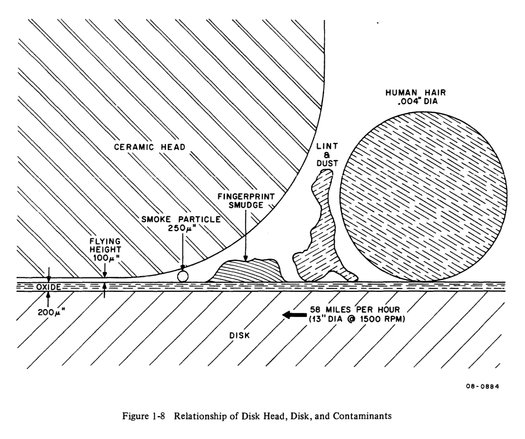
Some neat info about 70s hard drive contaminants.

From the DEC RK05 disk drive maintenance manual (DEC-00-HRK05-C-D)
#retrocomputing #dec

@altomare oh to be a disk lint speeding by at 58 miles per hour. 
@altomare missed opportunity: bug for scale
@ltning
That's Book 2.
The entirety of Book 2.
@altomare

@altomare

This is directly related to the chapter of "the book I can't talk about it until it is done" that I was writing today!

I'm getting so close to being done it's making me nervous.

@futurebird @altomare great news!
I will read anything and everything you write. Even without any ants in it!
@altomare 'micro inches' is a new measurement on me, but also dang
@PetraOleum @altomare a clear concession to the metric system. It should have been 12^-3 inch.
@ubik @altomare the gap should be 26/256th of an inch, following the usual power-of-two system they use
@altomare of note is that those aren't microns in the dimensions there--people outside of very particular fields might not be familiar with the microinch or ฮผ" (yes the symbol is a travesty), but those are indeed given in ฮผ", not ฮผm. So even smaller than you might think on first read!
-F
@altomare I 100% remember seeing this diagram somewhere Back In The Day. I don't think I was looking in that DEC manual, I think someone showed it to me.
@altomare (Best guess--it was my dad, and he was showing me some piece of internal General Electric training material that had plagiarized it.)

@altomare

I've known about this, but have never seen this chart before.

That's amazing.

@altomare

A copy of that chart was pinned to my office wall *mumble* decades ago.

The RK05 was a 2.5MB single platter disk cartridge about 18" across, and yeah, they crashed a lot.

https://en.wikipedia.org/wiki/RK05

@zl2tod

That thing looks like a Roomba if it existed in the 1970s.

@altomare

@altomare I like how they mentioned a smoke particle because there were undoubtedly people smoking around open hard drives in the 70s.
@altomare How did it ever work?!?

@TracyTThomas

With great caution and a high failure rate, I'm sure.

Everybody migrated to the modern disk-sealed-in-drive style pretty much as soon as it became commercially feasible. Removable hard disks were pretty much extinct by the 1990s.

SyQuest and Iomega did make a few more removable HDDs in the 1990s and 2000s, but they were unreliable and generally flopped in the market.

Removable HDDs only truly succeeded when the entire drive was made removable (i.e. USB HDDs).

@altomare

@argv_minus_one @altomare I was thinking maybe really good error correction was key. But I wonder if that would have worked if the error was something physically blocking the head movement.

@TracyTThomas

Yeah, error correction isn't going to help much when a hair wedges itself under the head. That'll cause a head crash.

@altomare

@altomare @RussSharek they mean "micro inch", don't they? my dreams will be haunted by diagrams with micro inches...
@altomare Modern, super-high-density drives use helium partly because helium atoms are smaller than everything else in air (including hydrogen molecules, H_2).
@altomare When I was at HP, I heard lore from back in the days when you could smoke in the office. Some guy notorious for smoking cigars walked up to one of the early Winchester drives and exhaled smoke from his cigar into the cabinet. The drive failed.
@zoowar @altomare @soviut
In the computer lab back in 1980, I remember one of the techs there who would always smoke in the lab. Her supervisor told her it would damage the hard drives. She insisted that the drive's air filter would remove the smoke particles. Somehow she was allowed to continue smoking. I don't know if they had any drive failures.
@captainbara @zoowar @altomare Funny they were concerned more with drive health than her health.
@soviut at the time nobody really believed that cigarettes were dangerous.

@collette I think that was mostly willful ignorance; smokers were addicted so they turned a blind eye to the negative health effects.

The term "smokers cough" has existed as long as cigarettes have. While the cancer link came later, it was still pretty obvious that smoking had detrimental health effects.

@altomare The outer rim of a modern 3.5" 7200RPM disk travels at about 75 MPH relative to the heads. A fancy 10,000 RPM data-center drive would be about 104 MPH.
@altomare
We had this diagram in the first facility I worked in
@altomare
Note that the important thing here is the smoke particles. If you are a sysop and you're in charge of the computer room, and especially if you are changing the disk packs, DO NOT SMOKE. If you smell of smoke, it b real bad, man!
@altomare Meanwhile Americans use anything but the metric system. Micro inches?
@chris @altomare you've used thous in machining for centuries

@altomare We had some RK05s on some of our Unix machines at SDC in the mid 1970s. We never had a failure. But they were not used very much - we mostly used RP04 (and later, RP05/6) drives.

My wife sold RK05s (and PDP-8s) when she worked at DEC.

@altomare Ahhh, reminds me of diagnosing a bad fiber link to a piece of dandruff exactly covering the 50 micron core on a multimode LC connector.
@altomare it's in inches... I want a banana for scale ๐Ÿ˜ธ
@altomare based on that diagram would you say this RK05 DECpack platter is out of spec?
@altomare on modern sealed drives, the firmware still has to deal with imperfectly flat disks. It uses head temperature to build a map of microscopically small bumps and distortions, and adjusts the fly-height dynamically to float above them.
@AbramKedge do you have links where I can read up more about this? Sounds like a very interesting subject
@altomare I wonder what the numbers for modern disks are like.
@altomare For many years I was an on-site engineer at a manufacturing business for my sins.
I still remember the Monday morning I turned up for work to find 3 CDC 300 MB drives down and an unbootable system.
The operator had found it unbootable when they arrived so had taken the disk pack out of the primary drive and tried it in 2 others after switching the drive IDs.
Result was 3 crashed disk drives which to eventually repair exhausted the company's Europe wide stock of disk drive heads.๐Ÿ˜ฎ
@uk_csi @altomare I recall my boss doing something similar and trashing two disks and two drives instead of just one.
@altomare And yet... I once hand-aligned an RK-05 platter. I loosened the six screws at the hub, slid the platter a little bit, retightened them, and iterated until the read errors stopped. No clean room, no mad skillz, just good luck.
@kbob I hope I'll have your luck. I was reading this documentation because I might be able to get a PDP8/E with a TU56 tape drive and a RK05. I don't think the rusty hard drive will ever work again but one can hope.
@altomare @kbob I think it more likely that the hard drive will work again than the tape drive. It may need a bit of #PercussiveMaintenance to get it spinning.
@altomare I had a ~3 GiB hard drive in the iMac G3 era that I ran for months with the cover off, no issues. The spinning disk generated a wind. Showed it off to friends. So weird
@altomare this was up on the wall at my first real computer job in the late 70s, courtesy of a DEC engineer. A couple of years later, different job, and they decided to have the disks cleaned. My response was WTF, but it wasn't up to me. A few days after the clean, I came into the office to find one of the drives was screeching, and there were a lot of magnetic flakes everywhere. That drive had crashed quite horribly. Amazingly, the idiots who had insisted on the cleaning talked their way out of responsibility.
@altomare somewhere I read that if you scaled the read/write head up to the size of a jumbo jet, it would be doing Mach2, 2metres above the surface of a cornfield, counting individual stalks as it flew over.

@grant_h @altomare Relatedly: I love how physics does not scale like that.

Some things in this universe are fractal: you look at them in the small and they recapitulate patterns in the large. Physics is not. What's going on at atomic scale is wildly different from what's going on at human-scale and that's wildly different from what's going on at planetary scale.

Honestly, it's surprising there's as much similarity at the scale of a solar system and the scale of a galaxy as there is (and even there: all of a sudden dark matter and dark energy pop up).

@grant_h @altomare while this may have been true at one point, i regret to inform you that - if a read/write head was the size of a jumbo jet - it would be moving at about mach 1953 [or around 0.22% the speed of light] about 4 thou [which is around the width of a human hair] above the platonic ideal of a cornfield with almost preciously equally tall corn

proof is below [i hope i didnt screw up my math cause that would make me look silly]

keep in mind in this scenario the plane is essentially the disk as it is the one generating the primary rotational movement, of course this would require you to imagine the entire cornfield moving any time we actually want to use the actuator arm [now the actuation field]

so yeah ive not done the math on retro hardware but for modern hardware its a bit different

-carrie
@aperture @altomare LOL. I did wonder about 'modern' disks. Thanks for running the numbers. Someone here mentions using Helium because the molecules are smaller, which kind of emphasises the point.
@grant_h @altomare ehe no problem :3

it is, a lot less tangible of an example than yours but also a little more terrifying to imagine so it works out

-carrie
@altomare
so weird to see inches being used in this context

@altomare

Intriguing: assuming the standard 7200 RPM 3.5 in disk most common for large internal hard drives, the edge should be a little slower than this -- about 37mph.

I wonder if the "flying height" has changed at all?

Can definitely see why these things are assembled and repaired in cleanrooms!

@TerryHancock They're not. RK05 is a drive with a 13" removable disk platter in a housing with a lid that opens. My first professional employment used two of these drives on a PDP11/34
@altomare Wait, a technical document, using micro inch as units? ๐Ÿ˜ณ
@altomare Hard drives are technologically so much more impressive than SSDs imo