 fossilesque
i enjoy high fructose corn syrup too
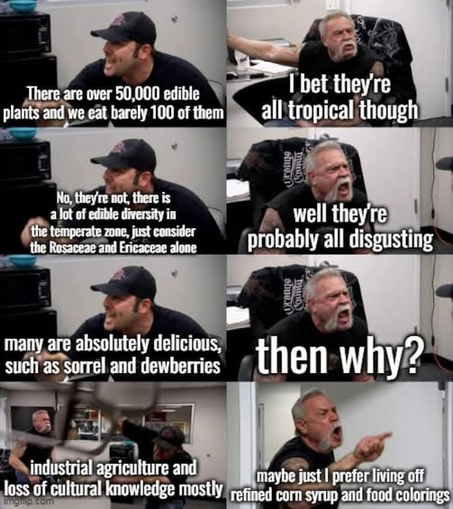
I harvest stinging nettle to use as a spinach replacement
I’m going to try to make maple syrup from big leaf maples this year too!
How do they taste? Do they not, uh, sting with the little spikes?
I got then popping up all around.
If you cook them they stop stinging.
My mother makes pasta with them too, puts them in the dough.
How to harvest, dry, and make tea with nettles:
If you have arthritis or hayfever they’ve been shown to help with that. Science has confirmed the old wives tales traditional herbal remedy works for this one. Not as effectively as modern medicine of course but if it’s all you can afford, or whatever, then something is better than nothing.
I mean there probably are lots of reasons why we farm only certain plants.
For example dewberries have short harvest window and as far as i know they need to be hand picked.
Or why don’t we use all our technological, scientific and research knowledge to good use and engineer fruits and vegetables that can grow in less hospitable environments and can grow larger yields, have a longer growing season and have plenty of nutritional value.
Instead, we use all our knowledge and ability to build bigger, faster, more deadly weapons of war or AI that can micromonitor everyone’s lives or create slop and porn.
golden rice
Golden rice is an example of a GMO that’s actually beneficial to humanity, or would be; anti-GMO sentiment has kept it from being grown in any significant amounts.
It’s tweaked to produce vitamin A, which rice normally does not; deficiency is a common problem in places where the poor get most of their calories from rice
Hi, I’m engaged to someone who studies chickpea and other legumes. Shitloads of money goes into agriculture every year and from my understanding, what you’re describing is being done by some brilliant people (I’m a bit biased). However there’s so many concerns around GMOs doing damage to the environment that it is tightly regulated. Doubly also, Americans don’t have the same ready access to grocery stores that other first world countries have.
Plus the equivalent of flat earthers exist that believe that GMOs will kill us all and we need to go back to eating only what nature created (somewhat hyperbole, there are valid concerns but people have been irrational).
An example is that chickpea and other legumes reintroduces nitrogen into soil after it the soil loses vitality, which makes chickpea a good intermediate crop that can be grown in between others. Its high in nutrients. So yeah, stop eating corn and eat legumes.
(I’m not the molecular biologist so if I got stuff wrong, sorry, I will pay more attention when my partner speaks)
I remember reading years ago that a vegetarian diet is far more economical and sustainable than a meat based diet. Which is why I lowered my meat consumption years ago. I still eat meat, just not as much as I once did when I was younger.
Even if humanity didn’t cultivate new vegetables and fruits, the produce we have now is more than enough to feed the planet. I think I remember that it takes just a few acres of grown produce to feed one person per year if they ate a vegetarian diet … whereas it takes ten times more land area to feed a single cow to feed that one person for a year in meat and vegetables.
I try to eat my legumes, especially lentils, since they are high in protein … but by far the greatest benefit that a vegetarian diet provides is the health benefits from the consumption of fiber alone. Full vegetarian or high vegetarian diets all around are far healthier and sustainable for humanity and the environment.
I hate that i cant find anywhere studies that takes the manure used as a fertilizer account in their calculations. Atleast where i live 100% of the manure from the animals is used as a fertilizer on farms and store bought fertilizers are just supplement. Most countries cant produce fertilizer enough for their agricultural need and need to buy it from outside.
I would love some real research wich would be better for the enivorent. Stop meat produsing completelly or scale it down so farms get still some benefits like fertilizer and biogas for the vehicles, but people would not eat food on every meal.
There is one thing that people miss about that whole “10 acres to feed one cow” statement. Yep, it can take that much land. But what doesn’t get said is that one cow can take advantage of land that is unsuitable to grow crops on like tomatoes, peppers, and onions.
In the US, California produces more fresh produce every year than any other state can. But it comes at a high cost of farming land that really isn’t naturally suitable for growing those vegetables. Farmers need to pump millions of gallons of water on those acres to get those crops to grow. This in turn puts pressure on the supply of water to everyone else in the state. And much of this farmland had all it could do to grow grass in some years originally.
Aquifers are going starting to go dry because of this. The vast Ogilala aquifer that supplies water to almost all of the US west is starting to go dry. Because we now are farming land that probably be best left to growing grasses for cattle, sheep, or goats rather than tomatoes or soybeans.
The other research I remember from my reading about this subject years ago was the efficiency of industrial farming. Per acre, industrial farming produces very low or minimal yields … whereas an acre that is tended, micromanaged and monitored by small scale farmers has much high yields. It meant that the only way for industrial farms to be able to produce large amounts of produce is to farm huge acreages in order to make up for the losses or inefficiencies.
One of the reasons why the Californian desert is drying up is that industrial farming is so inefficient that in order to sustain itself as a business model is for it grow ever larger and more invasive … it needs more land and more water in order for it to continually grow as a business. It’s not a way of farming that is meant to produce food efficiently for people … it’s a type of farming that is meant to produce profit, money and control for a corporation.
It’s feeding a monolithic corporation … it’s not feeding people.
All our world problems including global warming, food production, water supply are manageable and can be dealt with to help people in very efficient and possible ways … all of it is hindered and complicated by the fact that corporations sit in opposition to all of it because of their ever wanting need to turn a profit, even if it means destroying the environment and everyone who lives in that environment.
Im not geneticist, but i grew up on a farm. I always grind my teeth when people talk about miragle plants with high yields.
The plants need to get their energy and nutritions from somewhere. If you just create gmo plant that can absorb nutrition better from soil it also means you need to fertilize that soil that much more and make the crop rotation that much faster, or risk making the fields arid.
But plants that survive larger temperature shifts, more extreme weathers and pest might be necessary for us in the not so far future. Lets just hope in the future those are used for humanitys betterment and not making rich richer.
About shelf life:
There’s this weird little apple tree, Prime Rouge. Every two years, he’s choke full (the other empty) of perfectly formed, perfectly red apples, optical flaws are rare. They are already edible in summer but get really succulent taste and a white flesh about two months later. The best apple breed i know, in texture, taste and look.
Buut they only keep about two months max, unlike the other breeds you have in your supermarket.
Hey, there’s some of that in my garden!
It’s growing right next to some giant hogweed though.
To clarify, when knowone says “that’s not a fun time” they don’t mean “oh it tastes bad”. They mean it’s really not a fun time, avoid going anywhere near giant hogweed!
en.wikipedia.org/wiki/Heracleum_mantegazzianum
NSFL (if you’re squeemish):
Tap for spoileren.wikipedia.org/wiki/Phototoxicity en.wikipedia.org/wiki/Phytophotodermatitis
Resist cultivation or have some other undesirable properties. Often low yield, short harvest, low yield, difficult picking or transporting.
A favorite example of mine: oak’s acorns are sometimes edible. Roughly one in ten oaks produce edible acorns. They are indistinguishable from inedible ones unless you try them out - but inedible ones are fairly poisonous. The gene for edible acorns is recessive and it takes at least a decade before you know if a newly planted oak produces edible acorns or not, with a 10% probability of the former. It is just practically impossible to select for this criterion. Thus, we don’t eat acorns.
Often low yield, short harvest, low yield, difficult picking or transporting.
And let’s not forget, low yield.
Let us not!
Low yield due to overly specific conditions that are hardly met
Low yield due to short production window
Low yield due to long growth time
Low yield just because
Acorns are like the easiest thing to forage, though.
They are high in tannins, which your body is pretty good at processing in reasonable quantities (they’re in tea, coffee, and wine), but many acorns DO have unreasonable quantities of them and they can cause organ damage. Luckily, tannins are water soluble, so you just need to crack them open and soak them in water for a few days, then rinse and they’re safe to eat.
 ieatpwns
 Montagge
 RedSnt ♾️🦋♂️👓🖥️
 irelephant [he/him]
 B-TR3E
 🇰 🌀 🇱 🇦 🇳 🇦 🇰 🇮
  xep
xep bleistift2
 IninewCrow
 vaultdweller013
 小莱卡
小莱卡 JoshCodes
 RavingGrob
 flora_explora
 Gladaed
 infinitesunrise
 ComradeSharkfucker