Though I have no doubt that Tim Berners-Lee understands thermodynamics waaaay better and more intimately than I do, I think he’s ignoring the nature of thermodynamic systems that Tim Garrett has expressed.

The more energy in a system the more there is massive inequality in it. And inequality breeds the dynamics we see on the web today. A more equitable web and/or AI may require that they be *smaller*

https://www.theguardian.com/technology/2025/sep/28/why-i-gave-the-world-wide-web-away-for-free

Why I gave the world wide web away for free

My vision was based on sharing, not exploitation – and here’s why it’s still worth fighting for

The Guardian

…Here’s the bit from 17 months ago where I heard Tim Garrett, Professor of Atmospheric Physics at The University of Utah, talk about power laws and the energy in systems.

Some transcription excerpts follow.

(from 1:04:44) https://youtu.be/M01Q3ZR-Mzs?t=3884

The Thermodynamics of Degrowth | Tim Garrett

YouTube

…Tim Garrett begins by prefacing with:

“We’ll always have this power law. But it raises an interesting question. We can start thinking about trying to make predictions. I mean, as a scientist, you know, scientists make predictions. Most of the time, of course, they’re totally wrong. But, you know, we try to make predictions.”

Before going on to say…

…“If we are looking at a crisis, a world in which we collectively become somewhat more impoverished – one where either we can’t access the energy that makes us rich because climate change is making it harder,
or because we can’t access the energy that makes us rich because it’s just not there as much as it used to be, because we’ve depleted the reserves –

in that world where things are in a phase of decline or perhaps even collapse, does the world become socially more egalitarian?…

…“If it was the wealth that made us less egalitarian in the first place, on the flip side, do we become more egalitarian as we become poorer?

And I’m not sure because I think the phase of growth is different than the phase of decline.

I’m sure there are plenty of people who could address this question more competently than I am. But I think it’s a valuable question, a valid question to look at…

…“I think also you could ask the question of things like renewables. Well, we could say renewables are wonderful for perhaps for saving us from climate change … but they are also new sources of energy.

And if energy is plausibly tied to inequality, because you can’t have inequality without there being a large amount of energy to go around, then are our new sources of energy, like renewables, really just pushing us further apart?…

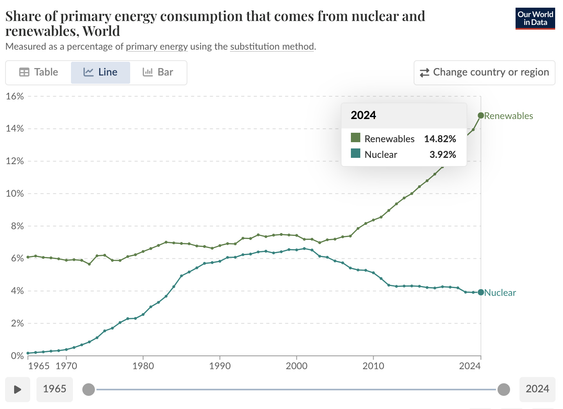
…Rachel (host) in reply: “I mean, at the moment, they are, right? I think renewables are, you know, sort of 2%* of global energy production added on top of an increasing production and consumption of fossil fuels. The more we have access to, the more that we use.”

[*see replies below re 2%]

Tim: “The thing is, is that I think there are many analogs. Like I can think of many analogs in the atmosphere…

Renewables in Electricity Production | Statistics Map by Region | Enerdata

Renewables in electricity production. Enerdata provides analysis on renewables in Electricity Production. Free energy renewable statistics.

@RDBinns I updated the post above to acknowledge that it was the host, Rachel, saying that. I don’t know where she gets that figure from and, looking at OWID, it seems way off.

They seem to have it at about 15% of primary energy consumption last year: https://ourworldindata.org/grapher/renewable-share-energy

But this doesn’t change the broader question Tim is considering.

@urlyman thanks! Agreed, doesn't affect the point being made