 ipconf
Well well well.
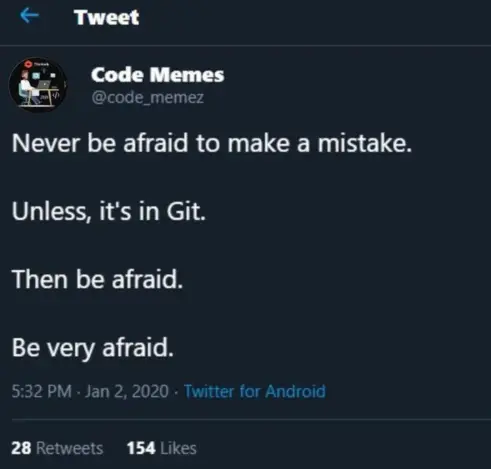
I’ve had juniors who didn’t believe this, so just to say it: If you know what you’re doing, practically any Git problem is recoverable.
The one major exception is if you delete your local changes before committing them.
Yeah.But many of them are extremely annoying. Specifically screwing up rebase. It is recoverable, but very annoying.
That said I have seen juniors make two other common mistakes.
I’m fed up with these two. Yesterday I had to cherry-pick to solve a combination of these two.
So this workflow is needed if you are working on a public, i.e. multiple devs collaborating on a single branch, scenario. But it is much better to avoid this as much as possible. Usually it is a ‘scoping’ issue, where you create a branch that is too broad. For example ‘api-for-frontend’, which is a massive thing.
In our org we prefer to delete the branch after merge. In a way it says ‘this branch is closed’. This is to encourage devs to define smaller and more logically scoped branches.
I want to take this opportunity to say that, branch is just a label on a commit, with some additional functions. Once you start focus on commits and lineage of the commits, then branches become some what irrelevant.