'Prussian blue' is a crystal so blue you can't accurately show it on most computer screens, since they can only display a limited region of color space. Its structure is really cool. It's a cubical lattice made of iron atoms, each surrounded by 6 cyanides - carbon and nitrogen. But let Sean Silver explain it:

"The modern way of manufacturing the pigment involves synthesizing it directly from some form of hexacyanoferrate; hexacyanoferrate is one iron atom bound with six cyanide molecules radiating equidistantly from it, like the tiny metal doodads scooped up in the children’s game called “jacks.” These are snapped into a theoretically endless lattice, the point of each hexacynoferrate compound lining up with a point of another, which are locked into place by iron ions with a different charge. So: if we were to describe what we saw along any single axis, we would see iron(II), cyanide, iron(III), cyanide, iron(II), and so on.

Neither of the precursors to Prussian Blue is blue. And, though the very word “cyanide” comes from the Greek word meaning “blue,” this proves to be a backformation from Prussian Blue; in roughly 1750, cyanide was isolated as its own (deadly) compound by cracking it out of the pigment, and named “blue” despite the fact that it is nearly colorless. Hexacyanoferrate therefore has the very word “blue” in its name, though, by itself, it is hardly blue at all.

Understanding the color of Prussian Blue requires a short detour. I have become interested, lately, in situations where a whole is different from the sum of its parts – and that is the case with Prussian Blue, where blueness is an emergent effect of combination."

https://sites.rutgers.edu/motley-emblem/prussian-blue/

(1/n)

Sean Silver explains how Prussian blue works:

"The iron in Prussian Blue is in two different oxidation states – which is to say, has two different numbers of electrons. As iron(II), it has given up two electrons, and is a dark brown color. Iron(III) [where it's given up 3 electrons] is rust-red, precisely because rust is mostly composed of iron in that third oxidation state.

The ability of iron easily to switch between oxidation states happens to be what makes it crucial to blood – and makes blood visibly different when oxygenated. When the iron(II) in hemoglobin forms a bond with oxygen, it gives up an electron to become iron(III); it changes its oxidation state, and becomes bright red. That same compound will later give up its oxygen to a cell which needs it, reclaiming its electron and reverting to duller, darker color gained from iron(II).

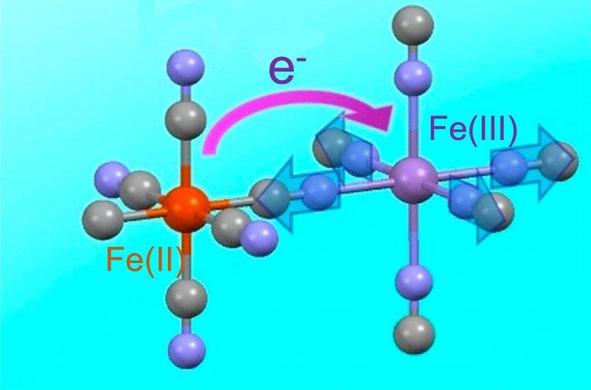
The blueness only happens when both ions are locked in close proximity, from a special process called intervalence charge transfer. When hit with light of the right wavelength, some of the iron(II) ions throw off an electron, which is captured by a neighboring iron(III). Though the individual atoms stay locked in the lattice, the ions switch places, one shedding an electron, which the other gains. Because the compound absorbs only the precise orange wavelength that triggers the charge transfer, it reflects everything else. In white light, our eyes register the sum of the reflection as blue."

The picture shows how it works. But I don't quite get it: some irons touch 6 carbons and others touch 6 nitrogens. Is that why some are iron(II) and some are iron(III)? If no atoms move in this "intervalence charge transfer", that can't be right.

(2/n)

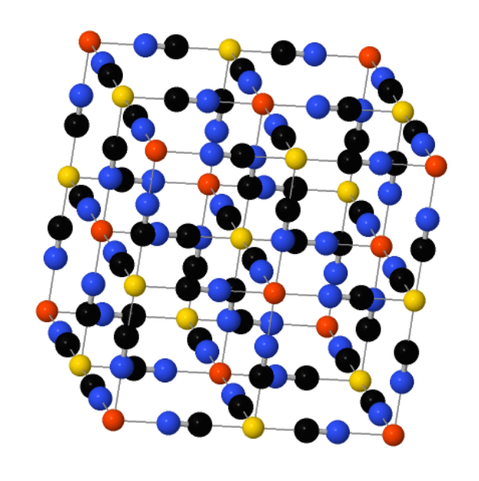
Here's Prussian blue in all its crystalline glory!

Iron(III) is red.
Iron(II) is yellow.
Carbon is black.
Nitrogen is blue.

The red balls sit at every other vertex in a cubic lattice. What do you call that pattern? I forget!

The yellow balls also sit at every other vertex of the cubic lattice.

Along each edge there's a blue ball and a red ball.

You can rotate this image and play around with it in other ways at ChemTube 3d:

http://www.chemtube3d.com/ss-prublu/

(3/n)

@johncarlosbaez
Iron(III) is red.
Nitrogen is blue.
Many-body quantum mechanics is hard,
so colors are too