'Prussian blue' is a crystal so blue you can't accurately show it on most computer screens, since they can only display a limited region of color space. Its structure is really cool. It's a cubical lattice made of iron atoms, each surrounded by 6 cyanides - carbon and nitrogen. But let Sean Silver explain it:

"The modern way of manufacturing the pigment involves synthesizing it directly from some form of hexacyanoferrate; hexacyanoferrate is one iron atom bound with six cyanide molecules radiating equidistantly from it, like the tiny metal doodads scooped up in the children’s game called “jacks.” These are snapped into a theoretically endless lattice, the point of each hexacynoferrate compound lining up with a point of another, which are locked into place by iron ions with a different charge. So: if we were to describe what we saw along any single axis, we would see iron(II), cyanide, iron(III), cyanide, iron(II), and so on.

Neither of the precursors to Prussian Blue is blue. And, though the very word “cyanide” comes from the Greek word meaning “blue,” this proves to be a backformation from Prussian Blue; in roughly 1750, cyanide was isolated as its own (deadly) compound by cracking it out of the pigment, and named “blue” despite the fact that it is nearly colorless. Hexacyanoferrate therefore has the very word “blue” in its name, though, by itself, it is hardly blue at all.

Understanding the color of Prussian Blue requires a short detour. I have become interested, lately, in situations where a whole is different from the sum of its parts – and that is the case with Prussian Blue, where blueness is an emergent effect of combination."

https://sites.rutgers.edu/motley-emblem/prussian-blue/

(1/n)

Sean Silver explains how Prussian blue works:

"The iron in Prussian Blue is in two different oxidation states – which is to say, has two different numbers of electrons. As iron(II), it has given up two electrons, and is a dark brown color. Iron(III) [where it's given up 3 electrons] is rust-red, precisely because rust is mostly composed of iron in that third oxidation state.

The ability of iron easily to switch between oxidation states happens to be what makes it crucial to blood – and makes blood visibly different when oxygenated. When the iron(II) in hemoglobin forms a bond with oxygen, it gives up an electron to become iron(III); it changes its oxidation state, and becomes bright red. That same compound will later give up its oxygen to a cell which needs it, reclaiming its electron and reverting to duller, darker color gained from iron(II).

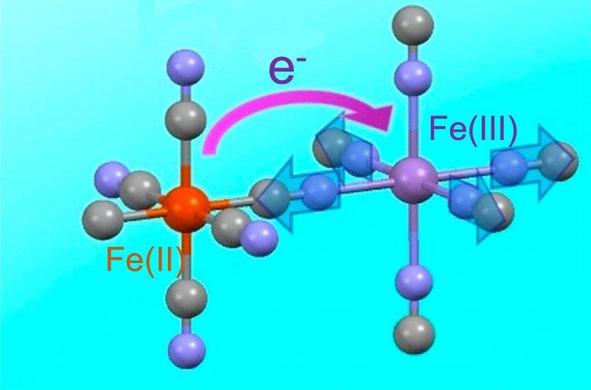
The blueness only happens when both ions are locked in close proximity, from a special process called intervalence charge transfer. When hit with light of the right wavelength, some of the iron(II) ions throw off an electron, which is captured by a neighboring iron(III). Though the individual atoms stay locked in the lattice, the ions switch places, one shedding an electron, which the other gains. Because the compound absorbs only the precise orange wavelength that triggers the charge transfer, it reflects everything else. In white light, our eyes register the sum of the reflection as blue."

The picture shows how it works. But I don't quite get it: some irons touch 6 carbons and others touch 6 nitrogens. Is that why some are iron(II) and some are iron(III)? If no atoms move in this "intervalence charge transfer", that can't be right.

(2/n)

Here's Prussian blue in all its crystalline glory!

Iron(III) is red.
Iron(II) is yellow.
Carbon is black.
Nitrogen is blue.

The red balls sit at every other vertex in a cubic lattice. What do you call that pattern? I forget!

The yellow balls also sit at every other vertex of the cubic lattice.

Along each edge there's a blue ball and a red ball.

You can rotate this image and play around with it in other ways at ChemTube 3d:

http://www.chemtube3d.com/ss-prublu/

(3/n)

@johncarlosbaez
Iron(III) is red.
Nitrogen is blue.
Many-body quantum mechanics is hard,
so colors are too

@johncarlosbaez It's called a face-centred cubic lattice.

In the cyanide ion, the N is a bit more attractive for the valence electrons (its nucleus is a bit more positive), so the ion is a bit polar (an electric dipole). The more negative pole is »better« facing the Fe III ions, i. e. it is the configuration with lower energy.

If you kick an eletron from the Fe II to the Fe III ions, thus making the former into Fe III and the latter into Fe II, the new state's energy is a bit higher.

@johncarlosbaez The difference is that the slightly polar CN- now is facing the »wrong« direction.

The difference in energy between the two states corresponds to a photon of a certain wavelength (E = h ν), which can thus be »absorbed« in this state change.

The absorbed energy can afterwards be dissipated through re-emitting just the same photon, or by different means, e. g. rotating CN- ions (thus creating rotational excitations, which you can see as heat or infrared radiation).

@johncarlosbaez https://youtu.be/okpmqN9jVQQ here’s a random little song from an obscure band to finish the thread, it mentions prussian blue :3
Charming Disaster - Paris Green

YouTube
@byte @johncarlosbaez Paris green and its toxic (yet beautifully green) brethren are why we now have things like the Poison Book Project (https://sites.udel.edu/poisonbookproject/), since these dyes did get used a fair bit for book covers, doubly serving as color and deterrent for potentially-damaging insects.
Home | Poison Book Project

Learn why emerald green is our favorite color — at a cost. The Poison Book Project is an interdisciplinary research initiative at Winterthur...

@johncarlosbaez

I understand how the two valences of iron give rise to the two different colours (dull brown and bright red) of blood. But then you say that when the two are in close proximity, this can look blue, and I'm half expecting you to say that this is why veins look blue through the skin. But that seems like a little too much; it's just a coincidence, right?

@TobyBartels - wow, interesting - I really have no idea! Let's see if I can look up something about "blue blood".

This article says it's not the blood itself that's blue:

"It is true that veins, which are sometimes visible through the skin, may look bluish. Why should this be so? Click here if you want the full story. But the short of it is this: It has to do with the way tissue absorbs, scatters and reflects light. (I think this also explains why your lips look blue when you get cold.) But if you were to open one of your veins, or cut your lip, even when you're cold, there'd be nothing blue at all about the liquid that would pour forth.

Maybe it is the fact that veins look bluish that explains the myth that blood is blue as it flows through the veins?"

(The link at "click here" is broken.)

https://www.npr.org/sections/13.7/2017/02/03/513003105/why-do-many-think-human-blood-is-sometimes-blue

@johncarlosbaez @TobyBartels

Somewhat relevant but still unsatisfying explanation of blue veins. I’m still missing the part of the explanation that says why veins should ever reemit more short wavelength photons than long.

http://www.abc.net.au/science/articles/2014/11/04/4120712.htm

Why do veins look blue?

Blood is red, but thanks to physics, chemistry and industrial relations, veins can look blue, explains Dr Karl.

@johncarlosbaez @TobyBartels

To be perfectly honest, I don't find this paper very convincing. Their argument hinges on some pretty dodgy perceptual modelling.

@johncarlosbaez @TobyBartels

Some experiments using my own colour photo editing app. The app isolated different hues. Here I’ve isolated only the orange hue. You can clearly see the veins as bluish despite the fact that no pixel in the image is physically emitting predominantly short wavelength light.

@TonyVladusich @TobyBartels - yes! So you think it's a matter of contrast with the rest of the skin?

@johncarlosbaez @TobyBartels

It's looking that way (pun intended), yeah. This one is going into my book, I think! I remember my high school biology teacher making the claim that venal blood is blue and I've never been convinced one way or another. I think this demonstration probably settles the issue though.

We need a phlebotomist who’s good enough to draw venous blood without exposing it to any air & contrast it with arterial blood?

I find it easy to believe oxygen-depleted blood turns blue because I’ve seen anoxic *soils* so gleyed that they were about the shade of a robin’s egg. They turned grey as we watched, after we brought up the core.

@TonyVladusich @johncarlosbaez @TobyBartels

@clew @TonyVladusich @TobyBartels - what does "gleyed" mean?

Oxygen-depleted iron-rich soils turn a funny greyish color, that’s gleying.

There’s other effects, but we can easily see the color. You don’t want anoxic soil if you’re building a septic field, for instance.

@johncarlosbaez @TonyVladusich @TobyBartels

@clew @johncarlosbaez @TobyBartels

So gleyed soil appears grey not blue?

It goes through a range of colors as the overall redox state changes. Rust, brownish rust, dull brown, grayish brown, gray, greenish gray, bluish gray, and — after possibly 10000 years in oxygen-poor glacial meltwater, in the core I saw — robins egg blue.

There’s an official US color handbook for soils, so that they can be compared more objectively.The blue corner stands out among pages and pages of sienna and rust and khaki and tilthy chocolate.

@TonyVladusich @johncarlosbaez @TobyBartels

@clew @johncarlosbaez @TobyBartels

So if we store blood in an oxygen rich environment that somehow does not degrade biological samples we can prove that blood can indeed appear blue?! Et viola!

@TonyVladusich The veins are blue because they haven't received any oxygen nor air into them yet :)

@wlumley

I think you just blue yourself there Will

@TonyVladusich @wlumley they’re blue because they are sad :(
@huwr @TonyVladusich @wlumley will’s are blue because he bleeds for the bank
@jelly @TonyVladusich @wlumley I thought it was he ate too may blueberries
@huwr @TonyVladusich @wlumley those weren't blueberries, they were blue peanut m&m’s

@johncarlosbaez

It's a magnet below around 5 K.

@pewnack - neat!

@johncarlosbaez

There's a huge series of Prussian Blue analogues that exhibit ferromagnetism or ferrimagnetism at mostly sub Liq Nitrogen temps. However some non-stoichiometric Vanadium based analogues have Tc values that are quite high. From memory they're around room temp. Considering my knowledge is 20 years out of date there's prob been more advances.

@pewnack - that's really cool. I will look into Prussian blue analogues.

What does it mean to say something like that is non-stoichiometric?

@johncarlosbaez

It means that the formula has fractions of elements. In this case sometimes there are holes where the Fe or V should be (balanced by Na or C's or whatever) but they're not periodic.

@pewnack - Thanks! According to Wikipedia, even real-world Prussian Blue is nonstoichiometric because there are random vacanicies.

"One-fourth of the sites of Fe(CN)₆ subunits (supposedly at random) are vacant (empty), leaving three such groups on average per unit cell. The empty nitrogen sites are filled with water molecules instead, which are coordinated to Fe(III)."

@johncarlosbaez @pewnack one very interesting analogue is the drug sodium nitroprusside (https://en.wikipedia.org/wiki/Sodium_nitroprusside), which is used in emergency situations that require lowering a person's blood pressure very quickly. A neat resource for looking up crystal structures of these beasties is the CSD, e.g. https://www.ccdc.cam.ac.uk/structures/Search?Ccdcid=DOJJAP05
Sodium nitroprusside - Wikipedia