 iokevins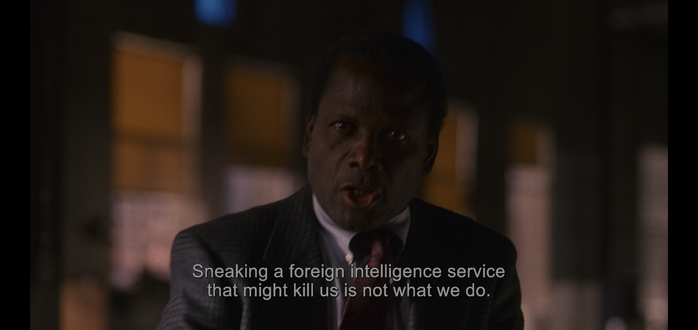
"Yeah, I liked it too. One thing I remember is every time we turned around it meant lighting a football field, so things took a little longer than I anticipated frequently."
"You still apologizing for that, huh John?" (teasingly)
"No, I was trying to blame [production designer] Patrizia." (laughs)
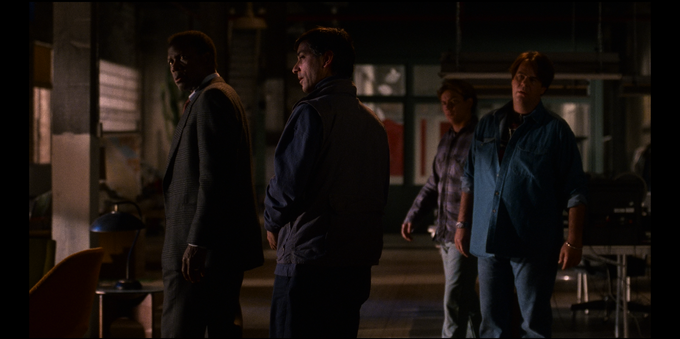
"This was a beautiful location. It was a private school in Pasadena, I think."
"Uh huh"
"And we had found a wonderful young piano prodigy to...who was really playing, and she was wonderful." 🎹
Note: As he enters, Marty holds a rectangular gift with a red ribbon behind his back (possibly chocolates). The final edit of this scene does not show him attempting to give it to Liz, but we do briefly catch a glimpse of it on the piano as they subsequently walk around the room.
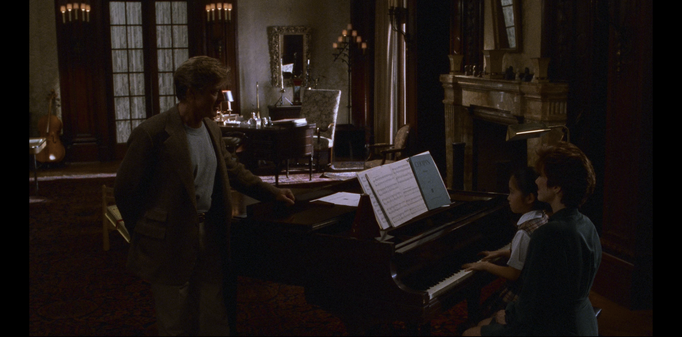
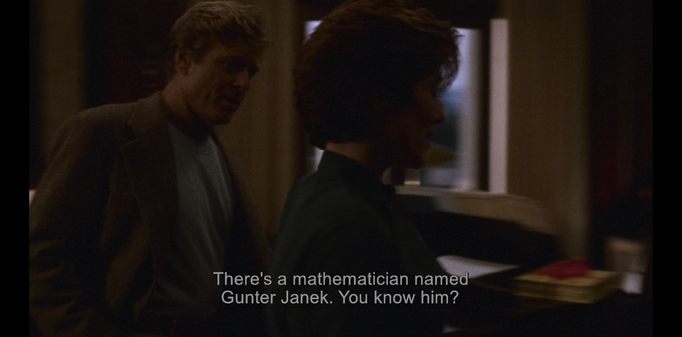
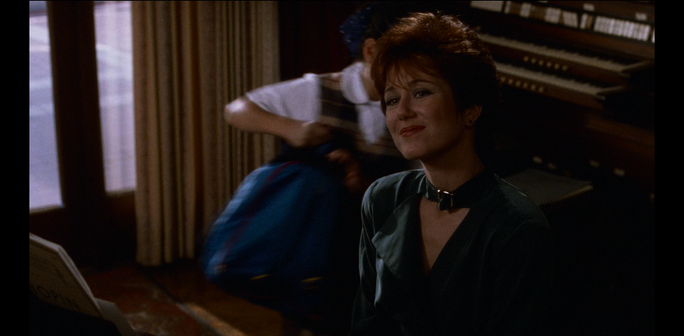
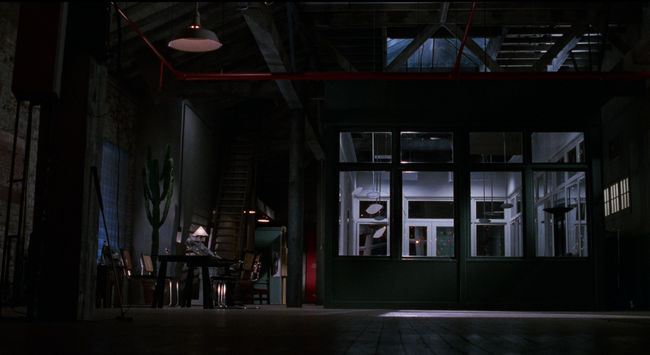
"That door in the background as I recall we had a very hard time getting permission to put lights back there."
"Some reason we weren't allowed to see into that room or light it, and now I don't recall what it was that...."
"I think there was a religious--it was a chapel."
"Exactly. Yeah, that's right, you're right. It was a little chapel and they didn't want us to shoot it."
(continued)
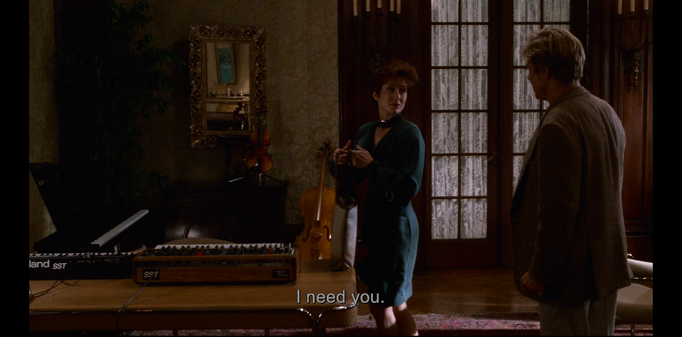
"How did we get the lights back there?"
"I think in the end they allowed us to put one in if we did a couple Hail Marys." (laughs)
"If we promised to lead a good life."
"That's right. I'd rather light at 2K than curse the darkness." (laughing)
Note: I believe John is talking about the wattage of the lighting here (viz., 2000 W, or 2kW).
The Pasadena school appears to have been the Mayfield Senior School of the Holy Child Jesus, a "a girls' college preparatory high school".
I was unable to find a photo of the chapel through the doors after a brief search. It seems the administration has remodeled parts of the school in the ensuing years.
"The mirror on the back was actually angled."
"I think we tipped it up or down it was actually something I remember going to see a mansion in Newport, Rhode Island once where they said it was once considered impolite to have a mirror on the wall that reflected people, so they intentionally tipped them up to show the ceilings and stuff, and I always remembered that--and a common movie trick now."
"We were shooting I think wardrobe tests on this actor. We were shooting tests on the projection."
"The projection, yeah."
"And somebody walked in front of the projector with a white shirt and we looked at each other and said 'That's what the actor is gonna wear.'"
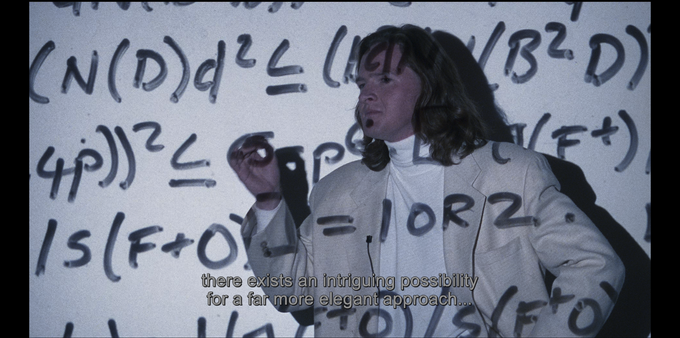
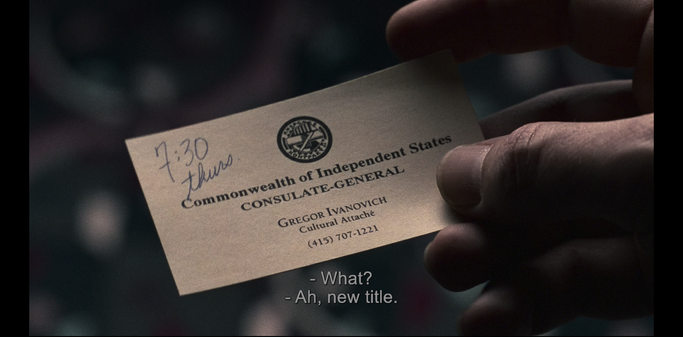
"And here we have the great George Hearn, just before his Broadway-starring appearance in Sunset Boulevard. He's a wonderful actor, great musical, comedy, and dramatic actor, who had such a great time playing an expansive Russian diplomat. While we were shooting this movie the Soviet Union collapsed and consequently the business card that we had prepared for him which said, you know, 'Consular Official USSR' had to be redone ..."
(continued)
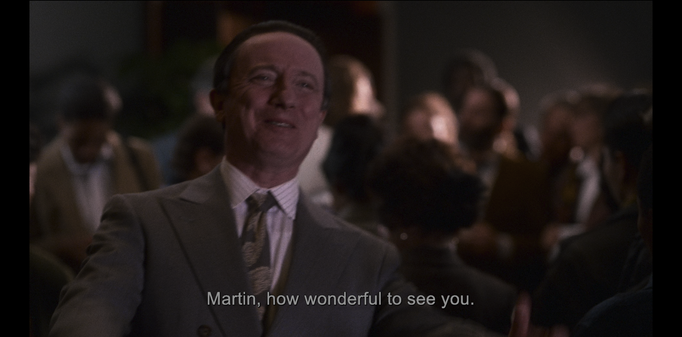
"... and we put in its place 'Commonwealth of Independent States' which is what they called the USSR for about a minute and a half before even that broke up."
Note: I've tried unsuccessfully to identify the logo on the business card 🤔 Anyone know what it is? It is not the main logo the Commonwealth adopted.
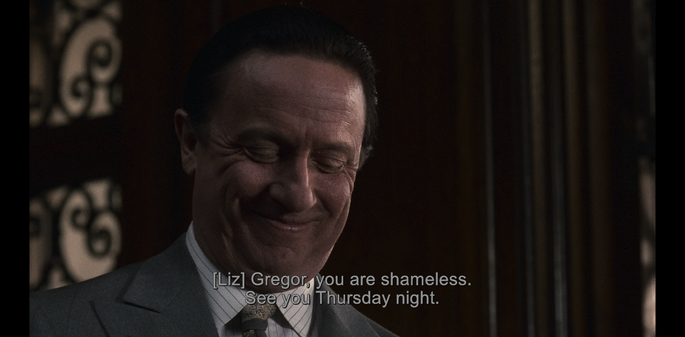
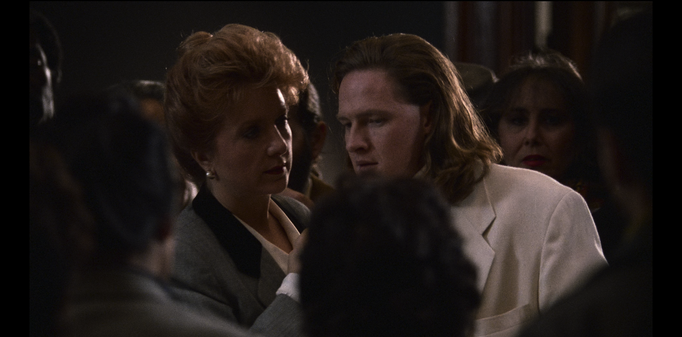
"The woman who approaches Janek is Lee Garlington who has so far been in all 3 of my movies. She is sort of my good luck charm."
"Yeah we went out onto a rooftop in West LA where we had the Sneakers van parked opposite the building where Janek's window is seen. And that's actually Dan Akroyd on the scaffolding out there with a shotgun mic."
"Didn't that van have to get taken up there by a crane or some complicated challenge like that?"
"Absolutely right. We had to crane the van up onto the roof. Because it wasn't actually I think a parking roof."
(continued)
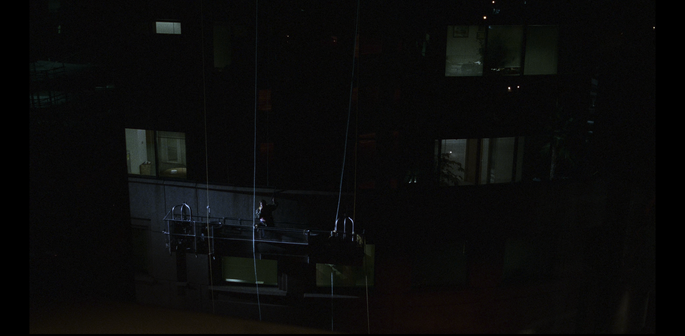
"Right, and then we had to work the schedule around it because we needed the van really soon afterwards but it took a couple of days to get it all off or something."
"Right."
"This is one of those complicated scenes where John and I are on a rooftop across an alleyway from this office. The actors playing Janek and Rhyzkov are in an office and the only way to speak to them really is over a walkie-talkie, so it's actually sort of comp-- it's so difficult to really get the performance you want from somebody ..."
(continued)
and they were, they were wonderful but it would just--it would take too long for me to like go downstairs, walk into their building, take the elevator up, run into the set, and back again."
"And I remember we used a very long lens; it was very slow and this building--as most modern office buildings do--had very heavily-tinted glass so there's an incredible amount of light in that office..."
"It was hot."
"...to even see anything."
(continued)
"It's another reason I didn't run in there." (laughing)
"The actors were frying in there."
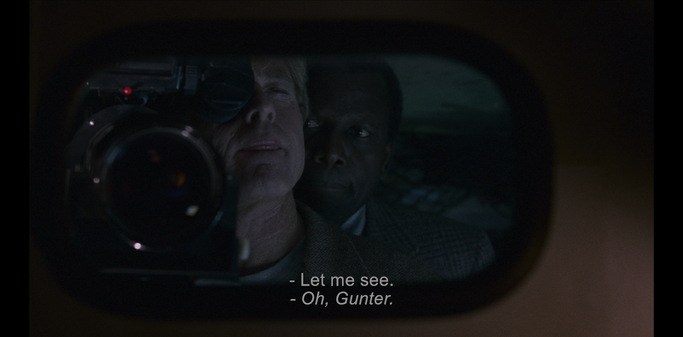
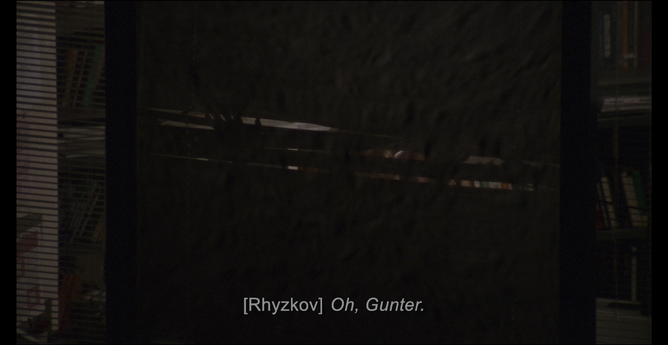
"And one of my favorite accidents in the movie is what happens when the curtains are closed and it's something that we saw happen that they close the curtains and bumped up against them and it made this remarkable pattern that--I remember at the time that we all just laughed hysterically, we thought it was the funniest thing we'd ever seen."
"I think you didn't say cut for awhile because we just kept watching the blinds pulsating."
"We let the scene go on and on and on." (laughing)
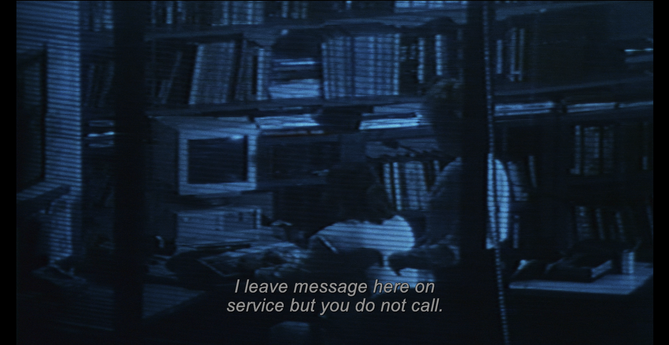
"Walter Parkes, Larry Lasker, and I wrote this screenplay over the course of about 8 years. I think it was from about 1981 to '89 or so, and um, this was one of the scenes that we spent a lot of time getting right and it was one of the most fun scenes to write because it's all about the repetition of the sound--"I leave message here on service"--that the audience isn't supposed to be concentrating on. The idea is to give them visual things to be looking at, and other concepts ...."
(continued)
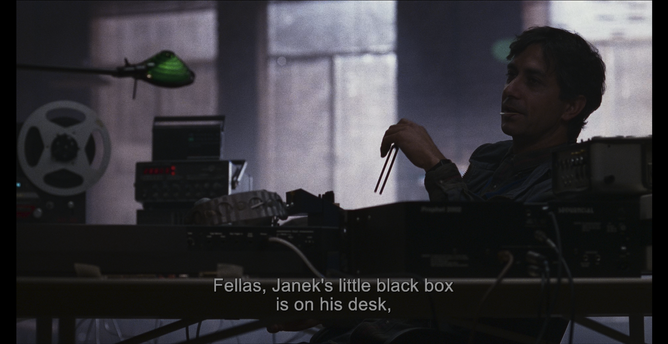
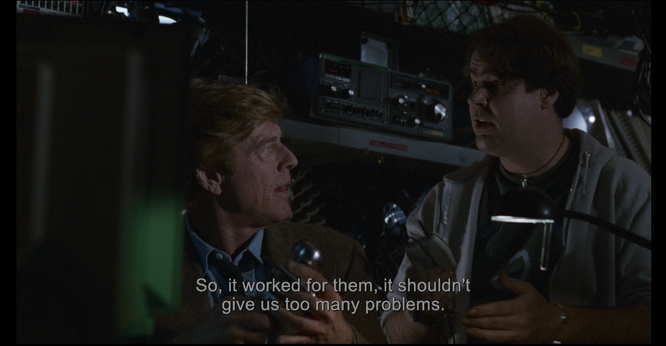

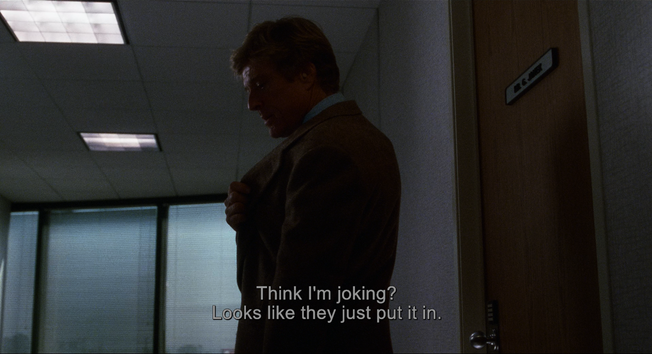
"That little shot there I remember being a horror show because this van interior was...existed as a set but in that shot you see three of the walls."
"Right"
"And it's sort of working in a submarine, trying to figure out how to get the camera in there with the actors because it's only a few feet wide, the available walking space."
"How did you?"
"I don't remember now how we did that thing, I just remember it took forever. I don't know if we flew a wall or if we just had a little sled dolly."
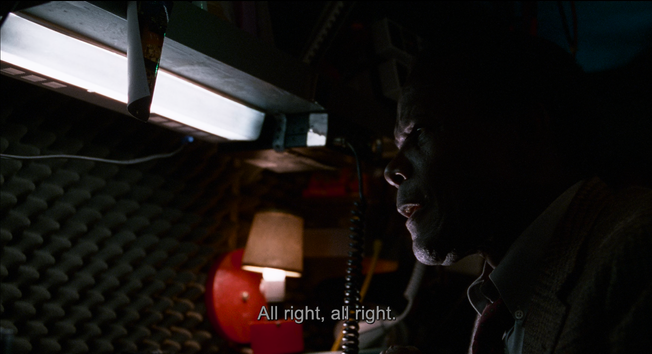
"And if you look on the office building roof across the street you'll see the van. It was very expensive to get that up there. We want you all to see it." (laughs)
"And I think it's up on blocks because that wall actually blocked most of it, so it had to be raised."
"Right"
"I remember people coming to you and showing you chip design options for quite a while and I don't remember the rejects very well."
"Rejects didn't look very special and finally Ken Pepiot designed this one which was sort of silver-plated and really beautiful and really stood out."
Note: Ken Pepiot is credited as special effects coordinator.

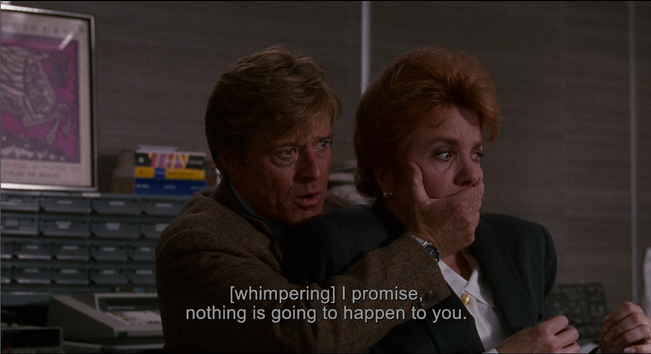
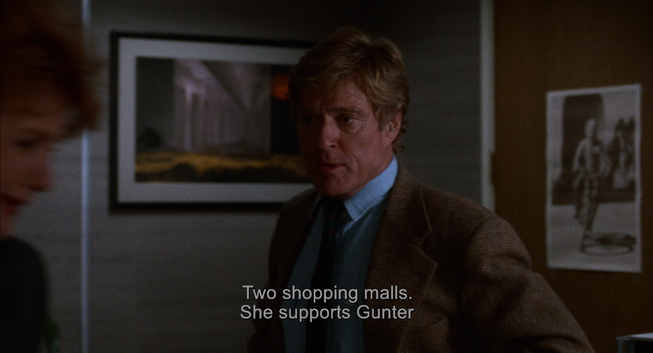
"And now Bob pours on the charm."
"I don't think any audience in any movie theatre ever heard Bob's line, 'Give him ... help.'" (laughs)
"The laughter kind of covered up the next ten seconds."
"We struggled to get the van in this shot, as I recall. We had to get very low."
"Yeah, which we tried to avoid generally."
"Right"
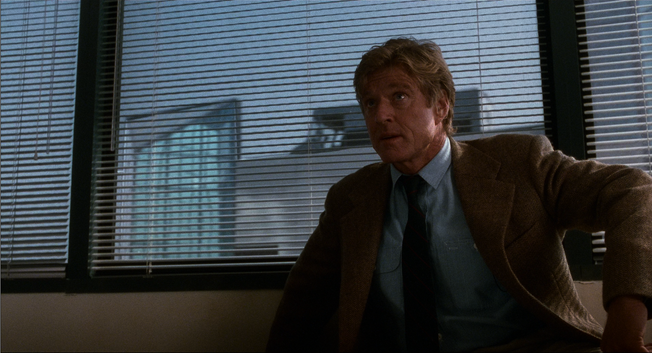
"And this was great fun. We were shooting a party sequence and realized we didn't have any party. We had a lot of people talking. So very late one night, I think I said to you, 'Pick a spot where I can just put them and we'll jump-cut them dancing with each other', and you sort of lit a little area and we told everybody without any advance warning you're going to dance and they all danced differently."
(Continued...)
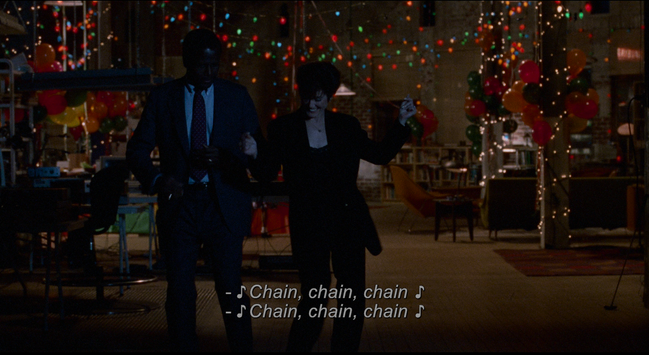
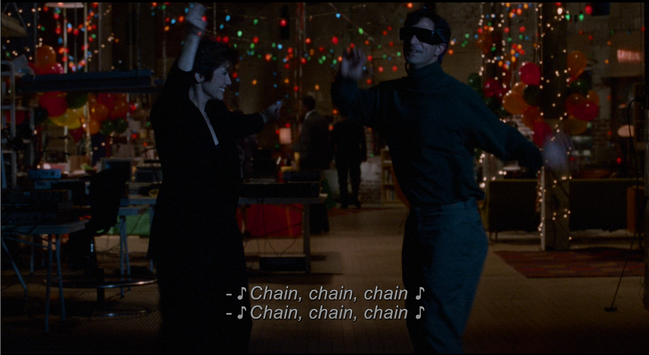
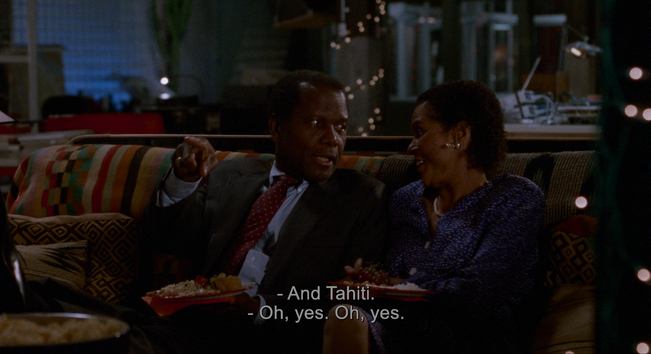
"This is one of those scenes where the set and the size of the cast made it take a longer than everybody thought. You know I was thinking on paper it's just a few pages, or....
- RIght.
And then when you actually start dealing with this many people in a scene and that big a space it's...
- It takes forever to light it.
Forever, yeah.
And coverage, you know, every time somebody's talking you've got to get all these reaction shots of the others."
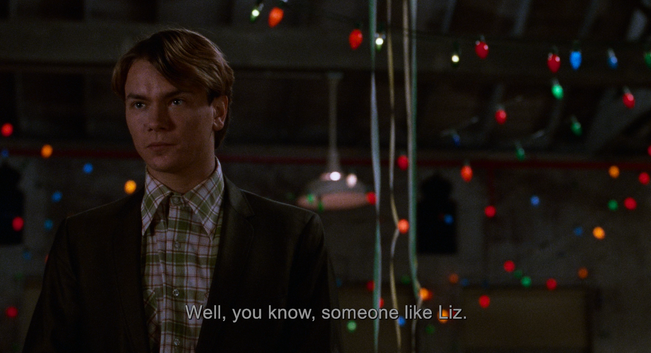
"As I recall it was scheduled for about 4 days and it took nine.
- Yeah
And the way that we reported to the studio was after you finished a sequence you reported whether you were on schedule or off and we didn't have to report until the end of that nine days that we had just gone five days over so the executives went to bed that night thinking we were on schedule and when they woke up the next morning we were five days over schedule. That got their attention."
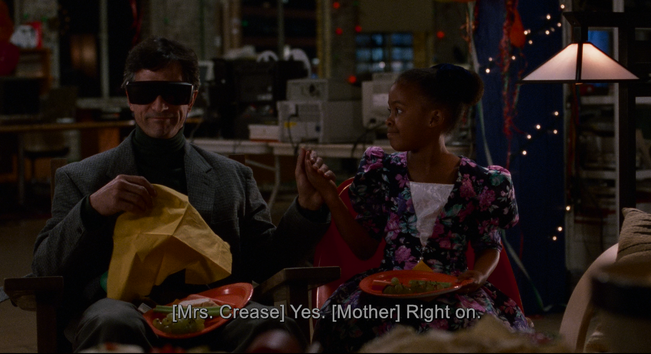
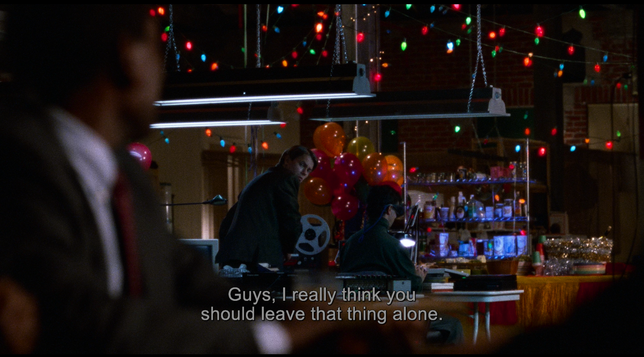
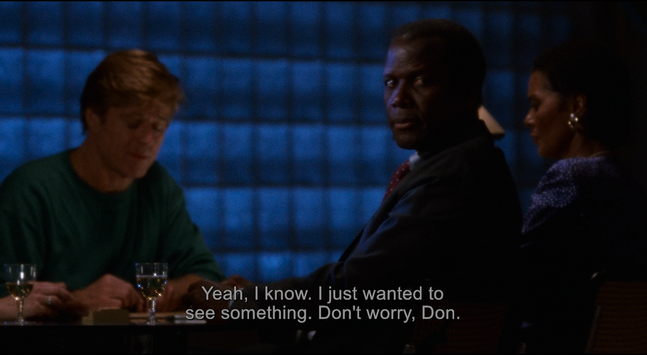
"Another part of the set that I really loved was those glass bricks. You were able to put that blue light behind it.
- Yeah. They were pretty spot."
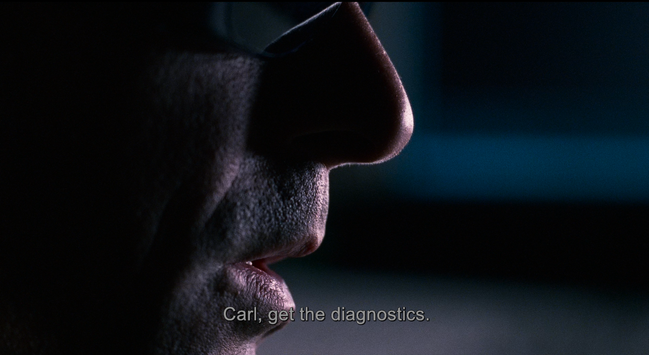
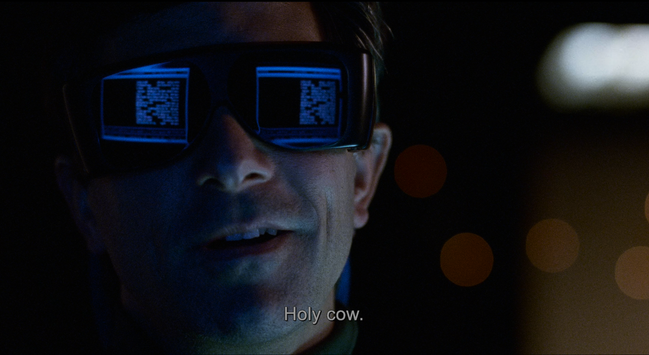
"We're coming up to a shot now, the shot in which the computer graphics are reflected off of David's dark sunglasses, was an incredibly difficult shot to get. And as I recall we tried it once, we hired a company that said, 'Oh yeah, we know how to do this.' And they--what did they do? They took down the back wall of the set and ....
- It was done as a projection and they took the material we wanted reflected and they projected it and we kept saying 'It looks awfully dark.' (continued)
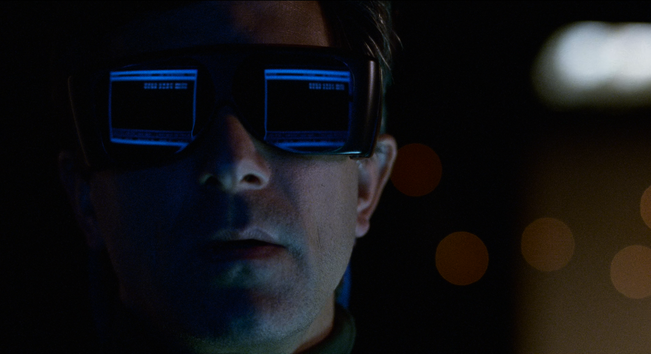
"And they said, 'No, this is gonna work great.' And then we went to the dailies and the reflection was too dark, you couldn't read it at all. So then we came back and we just put it on two really big monitors and reflected one monitor in each side of his eyeglasses and that, the low-technology version was better than the high-tech version.
- I seem to recall we spent about a half day on the high-tech version, with no results."
"He's a really accommodating actor I think and really interested in every part of how the movie is made and ....
- Right
- And was always enthusiastic about any technical request that we had done.
- Right
- What Phil?
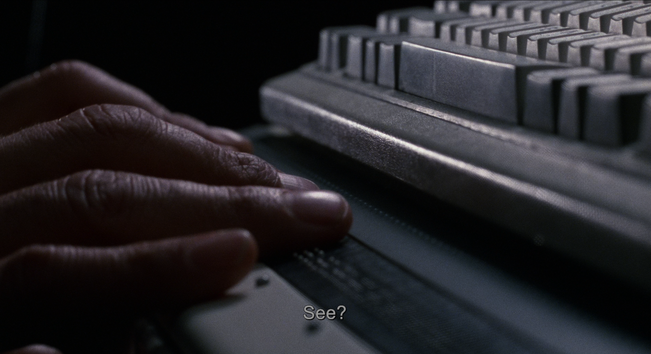
- Before we started shooting he actually spent some time at a school for the blind and tried to pick up as much as he could about what it's like to be blind and then when we were shooting in this set in the Lair in-between takes you would see..." (continued)
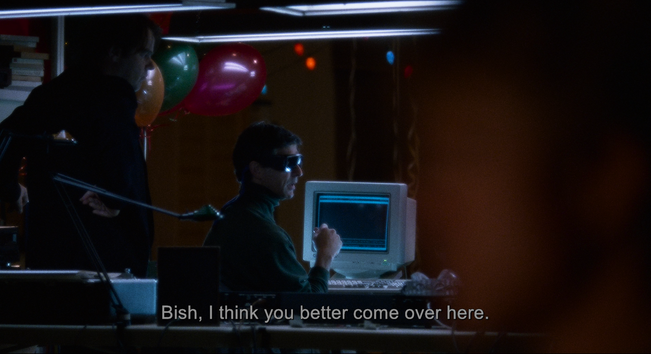
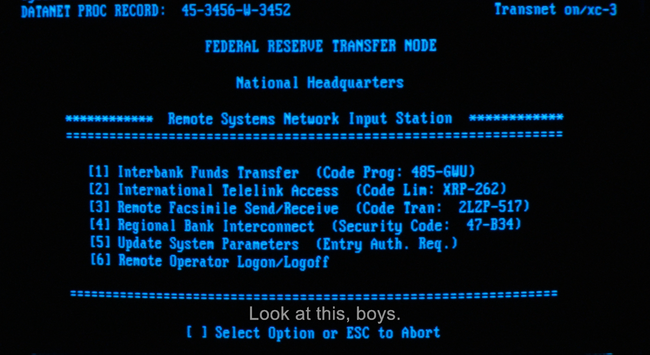
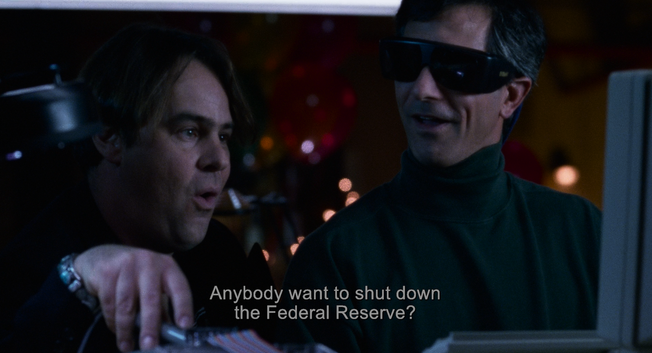
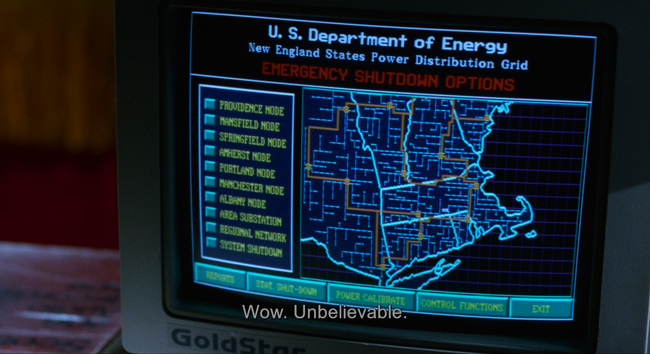
"While we were shooting the film, Universal was bought by the Matsushita Corporation of Japan and we did get some inquiries as to why we were showing GoldStar monitors which is a Korean company. I seem to recall ducking that question. (laughs)
We were instructed, however, not to show any Sony monitors because Sony had just bought Columbia Studios."
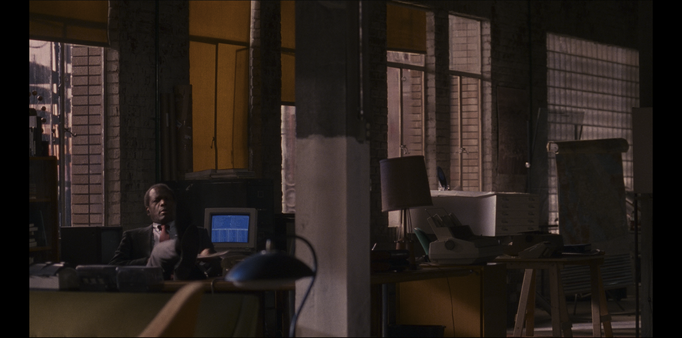
"Now we had this thing that we did on this film a lot that we call "the power pan". You want to describe that?
- It's a way to get energy into a shot instantly by using a long lens on somebody when they're walking quickly across a big open space like the loft and the Lair really lent itself to that, to power panning, because there was so much room for people to walk through. And it just immediately sort of amped things up a little bit to use like at least a 100mm lens on ... (continued)