TOPIC> Our Solar System

2025 September 14

Planets of the Solar System: Tilts and Spins
* Video Credit: NASA
https://www.nasa.gov/
* Animation: James O'Donoghue (U. Reading)
https://bsky.app/profile/interplanetary.bsky.social
https://www.reading.ac.uk/meteorology/

Explanation:
How does your favorite planet spin? Does it spin rapidly around a nearly vertical axis, or horizontally, or backwards? The featured video animates NASA images of all eight planets in our Solar System to show them spinning side-by-side for an easy comparison. In the time-lapse video, a day on Earth -- one Earth rotation -- takes just a few seconds. Jupiter rotates the fastest, while Venus spins not only the slowest (can you see it?), but backwards. The inner rocky planets across the top underwent dramatic spin-altering collisions during the early days of the Solar System. Why planets spin and tilt as they do remains a topic of research with much insight gained from modern computer modeling and the recent discovery and analysis of hundreds of exoplanets: planets orbiting other stars.

https://apod.nasa.gov/apod/ap250914.html

#space #planets #solarsystem #astrophotography #photography #nature #science #astronomy #physics #NASA #ESA #education
2018 October 28

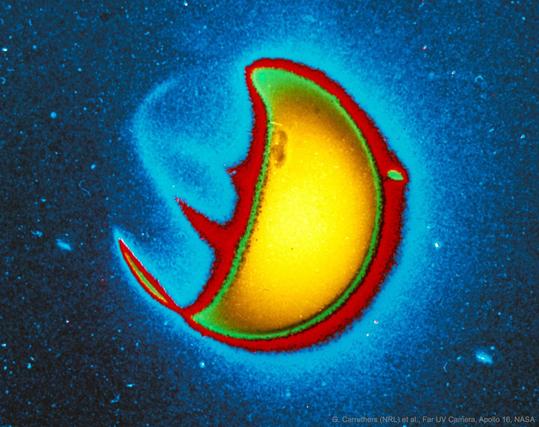
Ultraviolet Earth from an Observatory on the Moon
* Image Credit: G. Carruthers (NRL) et al., Far UV Camera, Apollo 16, NASA
https://en.wikipedia.org/wiki/George_Robert_Carruthers
https://www.nrl.navy.mil/
https://www.nasa.gov/image-article/looking-back-dr-george-carruthers-apollo-16-far-ultraviolet-camera-spectrograph/
https://www.nasa.gov/missions/apollo/apollo-16-mission-details/
https://english.nao.cas.cn/Research2015/rp2015/201701/t20170120_173602.html

Explanation:
Which planet is this? Earth. The featured false color picture shows how the Earth shines in ultraviolet (UV) light. The image is historic because it was taken from the surface of the Moon by humanity's first lunar observatory. (Another is operating now.) Although very little UV light is transmitted through the Earth's atmosphere, what sunlight does make it through might cause a sunburn. The part of the Earth facing the Sun reflects much UV light, but perhaps more interesting is the side facing away from the Sun. Here bands of UV emission are the result of auroras and are caused by charged particles expelled by the Sun. Other planets showing auroras in the UV include Mars, Saturn, Jupiter, and Uranus.
https://commons.wikimedia.org/wiki/File:Earth_in_ultraviolet_from_the_Moon_(S72-40821).jpg
https://science.nasa.gov/ems/10_ultravioletwaves/
https://en.wikipedia.org/wiki/Ultraviolet
https://solar-center.stanford.edu/about/uvlight.html
https://www.forbes.com/sites/startswithabang/2018/10/25/why-dont-we-put-a-space-telescope-on-the-moon/

+ Global Aurora at Mars:
https://apod.nasa.gov/apod/ap171006.html
+ Aurora around Saturn's North Pole:
https://apod.nasa.gov/apod/ap180903.html
+ Aurorae on Jupiter:
https://apod.nasa.gov/apod/ap160711.html
+ Hubble Spots Auroras on Uranus:
https://science.nasa.gov/missions/hubble/hubble-spots-auroras-on-uranus/

https://apod.nasa.gov/apod/ap181028.html

#space #planets #solarsystem #astrophotography #photography #nature #science #astronomy #physics #NASA #ESA #education
2026 May 6

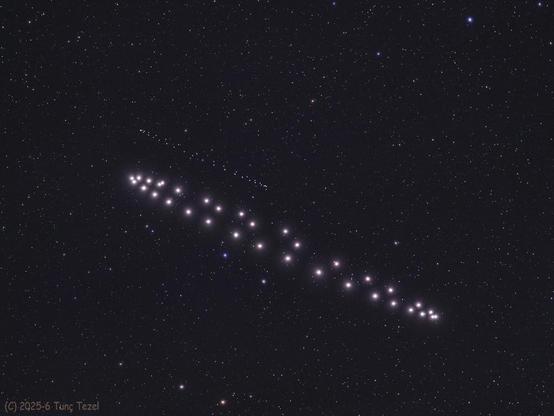
The Retrograde Dance of Saturn and Neptune
* Image Credit & Copyright: Tunç Tezel (TWAN)
https://twanight.org/profile/tunc-tezel/
* Text: Keighley Rockcliffe (NASA GSFC, UMBC CSST, CRESST II)
https://kerockcliffe.com/

Explanation:
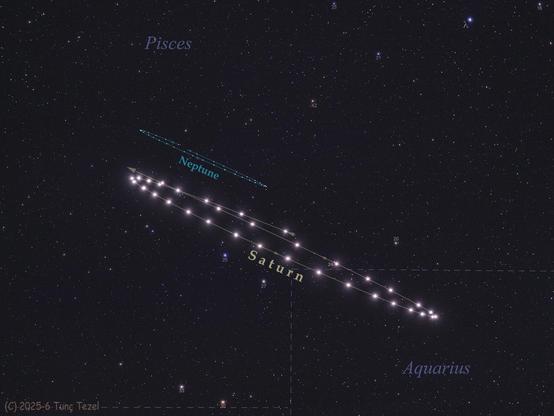
What does it mean for Saturn and Neptune to be in retrograde? Featured is a composite of images taken over 34 nights from May 2025 to February 2026 tracing Saturn (brighter, foreground) and Neptune (dimmer, background). Over that time, the two planets exhibited retrograde motion, meaning they appeared to move backward in the sky. This apparent backwards motion occurs when Earth overtakes the slower outer planets as they orbit the Sun. Imagine the Solar System is a running track. Earth "runs" faster along the inside of the track compared to the outer planets. As Earth approaches, aligns, and then "laps" the outer planets, they change position from ahead to behind from the Earth's perspective. This perspective shift is what causes the outer planets to change position in the night sky. An animation corresponding to today’s image shows Saturn and Neptune’s months-long dance across the northern night sky. Saturn stepped from the Pisces constellation into Aquarius and back again while Neptune remained in Pisces. This is the closest Saturn and Neptune have been in the sky since their last conjunction in 1989.
https://science.nasa.gov/saturn/
https://science.nasa.gov/neptune/
https://apod.nasa.gov/apod/ap250530.html
https://youtu.be/1nVSzzYCAYk?si=I-42YO6rHQZ9CuNV&t=124
https://vimeo.com/1177973763
https://noirlab.edu/public/education/constellations/pisces/
https://noirlab.edu/public/education/constellations/aquarius/
https://earthsky.org/astronomy-essentials/what-is-a-conjunction/

https://apod.nasa.gov/apod/ap260506.html

#space #planets #solarsystem #astrophotography #photography #nature #science #astronomy #physics #NASA #ESA #education

.. annotated version of previous image.

2026 May 6

The Retrograde Dance of Saturn and Neptune
* Image Credit & Copyright: Tunç Tezel (TWAN)

Please see the explanation in previous post for more detailed information.

https://apod.nasa.gov/apod/ap260506.html

#space #planets #solarsystem #astrophotography #photography #nature #science #astronomy #physics #NASA #ESA #education