 fossilesque
yeah everything is probably made of like, idk, earth water, fire and air or something idrk
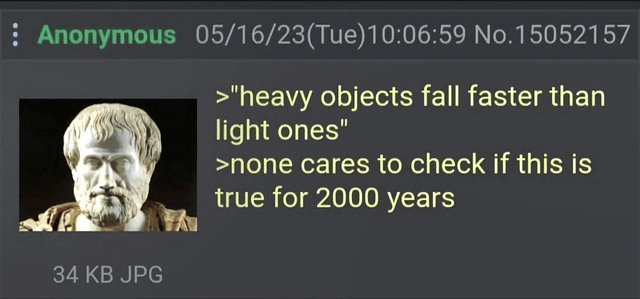
yeah everything is probably made of like, idk, earth water, fire and air or something idrk
That’s clever, it would eliminate aerodynamism as a factor.
However results would still vary, because hollowing out the metal ball increases its buoyancy (see Archimedes’ principle).
They would have the same coefficient of drag, correct, but the air resistance would end up having more effect on the lighter mass of the hollow sphere, so it would be slightly slower to fall.
Archimedes principle here is accounted for in the different weights. Everything that you can put on a scale is already being acted on by Archimedes principle in air.
No, mass or weight of an object is irrelevant, in one of the jurney to the Moon, astronauts demostrate it with an hammer and a feather on the moon that both fellt at the same speed. It exist one gravity aceleration, on earth is 9,82 ms², which is the force of acceleration which experiment any object on Earth, the only difference which can slow it down is the resistant of air, this can be different in each object, but without atmosphere there is nothing which slow down the acceleration of the object, it’s irrelevant the material, weight, mass or form. Basic physic

Therefore the more massive object hits first.
Only technically. The effect you’re describing is so minute that it’s insignificant.
It’s like pointing out that the Great Pyramids of Giza are so massive that time moves 1 billionth slower for the surrounding objects. It’s neat that the effect is potentially measurable, but noone is going to be adjusting their clocks to account for it
Your analogy doesn’t hold up, because factors get ignored in physics discussion all the time. Whem was the last time you’ve see a question in a dynamics class that didn’t ignore air resistance for the sake of simplicity?
The effect you’re describing is orders of magnitude smaller than that. I doubt the change would even register in a double floating-point variable if you did the calculations in Matlab
Sad to see people trying to correct you here, maybe I can help explain.
Gravitational force between two objects is GMmr^2, for dropping objects on the Earth (or Moon) we ignore the mass of the object we’re dropping because it’s practically insignificant, but if your experiment really was perfectly accurate then the observed rate would be extremely slightly different as the heavier of the two objects being dropped is also pulling the Earth up towards it a bit more than the lighter object. If the person performing the experiment is standing on the Earth (or just using the Earth as their reference frame) they would see this as the heavier object falling faster.
R^2 is on the bottom.
That nifty gravitational law gives you the force of gravity on an object, not the acceleration. Force also equals mass times the resultant acceleration, right? So Fg1 = m1A1 = GMm1/r^2 and Fg2 = m2A2 = GMm2/r^2. m1 and m2 are present on both sides of those equations, respectively, so they cancel, and you get A1 = GM/r^2 and A2 = GM/r^2, which are identical. The mass of an object affects the force of gravity, but when you look at acceleration the mass terms cancel out.
 Zerush
 multifariace
 ryannathans
 Cryptagionismisogynist