 fossilesque
yeah everything is probably made of like, idk, earth water, fire and air or something idrk
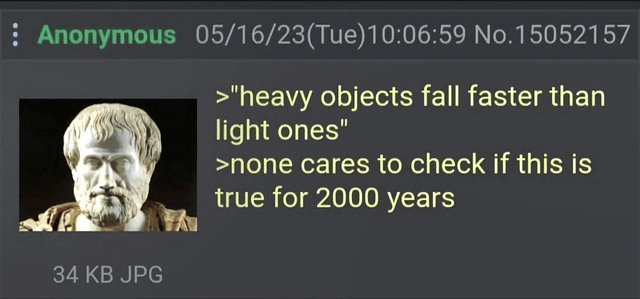
yeah everything is probably made of like, idk, earth water, fire and air or something idrk
I mean, yes and no.
en.wikipedia.org/wiki/Terminal_velocity#Physics
Heavier objects have a higher “max speed” that they can fall at, compared to lighter objects. The acceleration to that relative speed is constant though. More or less.
IE : While a bowling ball and a ping pong ball might start falling at the same initial rate, eventually the bowling ball will fall faster.
That’s not because of weight though. That’s just one thing being affected more by air resistance. In a vacuum, there would be no difference. In fact, they did just that during the Apollo 15 mission on the moon using a feather and a hammer:
Hey buddy! I came to post that video!
I know what is happening. I know why it is happening. My brain is still screaming at the feather to slow down.
…wikimedia.org/…/File:Apollo_15_feather_and_hamme…
Without the m as the browser will decide for itself if it needs the mobile version.
The acceleration to that relative speed is constant though. More or less.
It's not. Air resistance will affect lighter objects more due to Newton's second law and the square-cube law, resulting in heavier objects accelerating faster than light ones. Only at the initial instant, where there is no air resistance due to the speed being 0, will two objects of different weight be subject to the same downward acceleration.
en.wikipedia.org/wiki/Equivalence_principle
Without the m as the browser will decide for itself if it needs the mobile version.
I always do this.
Except of course when I don’t.
Not at all. Our air is made up of physical objects (molecules of oxygen and nitrogen, mostly). Things with more mass, more quickly knock those out of the way.
For a demonstration you can see and more easily wrap your head around, take something just barely heavier than water, and a similarly sized heavy rock and drop them in a pool. You’ll see how much quicker the rock gets to the bottom, because it displaces the water so much faster. Our atmosphere is the exact same.
The acceleration will be 1G minus drag. The Earth is sufficiently larger than anything one would drop off a tower so the weight of the dropped thing doesn’t matter at all
How does your model of the universe explain the hammer and feather dropped on the moon by Apollo 15’s David Scott landed at the same time?
Ed. There is an effect of buoyancy that will make denser things fall faster. It becomes noticeable in distances where the dropped items reach terminal velocity or on more dense media where buoyancy is more significant.
In air over short distances buoyancy is negligible, in vacuum there is none
The Earth is sufficiently larger than anything one would drop off a tower that the weight of the dropped thing doesn’t matter at all
F=ma.
Two items of the same shape will have the same amount of air resistance. If they have significantly different masses, the two object experience commensurately different accelerations (or reduction in acceleration), even if the force is the same.
If you take a balloon full of tetrahexofluroride (a gas 6x the density of air) and a chuck of iron the exact same size and shape and throw them off a building, I guarantee the iron chunk will hit first.
How does your model of the universe explain the hammer and feather dropped on the moon by Apollo 15’s David Scott landed at the same time?
It’s called a vacuum, which is famous for not having air resistance. Y’know, the thing we’re talking about?
You are wrong. Falling in a medium is slowed by buoyancy and drag
F=ma has nothing to do with it
buoyancy and drag
F=ma has nothing to do with it
Motherfucker, do you seriously not understand that buoyancy and drag are fucking forces?!?!
Sit your Dunning-Kruger ass down
en.wikipedia.org/wiki/Dunning–Kruger_effect
Without the m as the browser will decide for itself if it needs the mobile version.
minus drag
On Earth, this is the part that makes it so that objects do not fall at the same speed.
on the moon
This is the type of experiment they could not do 2000 years ago.
minus drag
On Earth, this is the part that makes it so that objects do not fall at the same speed.
That is incorrect. Drag affects both equally. The difference is caused by buoyancy, less dense objects feel more buoyancy
Buoyancy is functionally irrelevant here. Buoyancy in air effectively subtracts 1.3kg per cubic meter of each substance: The mass of the volume of air displaced by the object.
The part you are not understanding: Drag applies the same force to both objects. Gravity applies the same acceleration to each object.
Their problem was that they weren’t able to say why, and no one replying to me was able to do more than say they’re right, I’m wrong. See my edit. I added a correction after looking up drag equations for myself and finding that buoyancy was a factor
Also, thank you for replying civilly
They did. You didn’t understand what they said.
Two items of the same shape will have the same amount of air resistance. If they have significantly different masses, the two object experience commensurately different accelerations (or reduction in acceleration), even if the force is the same.
The “same force” they are talking about is drag. The two objects are the same size and shape. At the same velocity, drag affects them both equally, applying an equal, upward force against both objects.
Gravity (in a vacuum) accelerates both objects equally. But they have differing masses. F=MA. F/M = A. A is equal for both objects. Because acceleration is equal, the “force” on each object is not: the force must be proportional to its mass: The high mass object must be experiencing high force; the low-mass object must be experiencing low force.
Subtract the “same force” of drag from the downward force on both objects, and the net force on each object is no longer proportional to the mass of each object. Consequently, the high-mass object accelerates in atmosphere faster than the low-mass object. The high-mass object has a higher terminal velocity; the low-mass object has a lower terminal velocity.
For the purposes of this experiment, buoyancy is functionally irrelevant. The effect of buoyancy is to subtract a fixed mass from each object: A mass equivalent to the mass of air displaced by the object. Effectively, buoyancy slightly reduces the density of both objects. The actual difference in the densities of the two objects is far greater than the slight change due to buoyancy in air, so buoyancy is not a significant factor.
They could just drop an empty bs filled wine bottle.
Maybe fill it with mercury (but don’t drink it)
Nope, denser objects fall faster than less dense ones (through the air).
Technically it’s objects with a higher mass-to-drag ratio, but most of the time it’s close enough
The thing that always gets me about the renaissance is Galileo:
He did those experiments with things falling down? Measuring speed?
Yeah. Without a clock.
The theory for how to build those came later, based on what Galileo did.
Man, being a cop must have sucked before they invented time.
Officer: do you know how fast you were going?
Lord: No, do you?
Officers: grumbles you’re free to go.
Carriage pulls away
Officer ClocknTime: For now, for now.
 Skullgrid
 rockerface🇺🇦
 bizarroland
 Empricorn
 Of the Air (cele/celes)
 Cryptagionismisogynist
 Dasus
Dasus Iheartcheese
 thanksforallthefish
 OpenStars
 missingno

 Rivalarrival
 BeigeAgenda
 Carl [he/him]
 plinky [he/him]
 Blackmist