TOPIC> Comets

2025 September 16

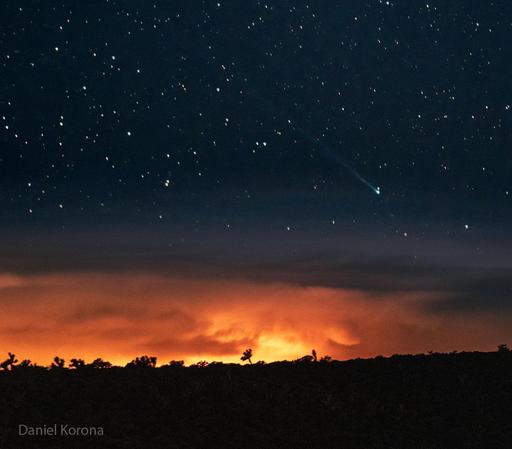
New Comet SWAN25B over Mexico
* Image Credit & Copyright: Daniel Korona

Explanation:
A newly discovered comet is already visible with binoculars. The comet, C/2025 R2 (SWAN) and nicknamed SWAN25B, is brightening significantly as it emerges from the Sun's direction and might soon become visible on your smartphone -- if not your eyes. Although the brightnesses of comets are notoriously hard to predict, many comets appear brighter as they approach the Earth, with SWAN25B reaching only a quarter of the Earth-Sun distance near October 19. Nighttime skygazers will also be watching for a SWAN25B-spawned meteor shower around October 5 when our Earth passes through the plane of the comet's orbit. The unexpectedly bright comet was discovered by an amateur astronomer in images of the SWAN instrument on NASA's SOHO satellite. The comet is currently best observed in southern skies but is slowly moving north. The featured image was captured at sunset three days ago just above the western horizon in Zacatecas, Mexico.

https://earthsky.org/space/new-comet-swan25b-2025/
https://soho.nascom.nasa.gov/data/summary/swan/
https://soho.nascom.nasa.gov/about/about.html

https://apod.nasa.gov/apod/ap250916.html

#space #comets #astrophotography #photography #science #astronomy #nature #NASA #ESA #education
2025 September 18

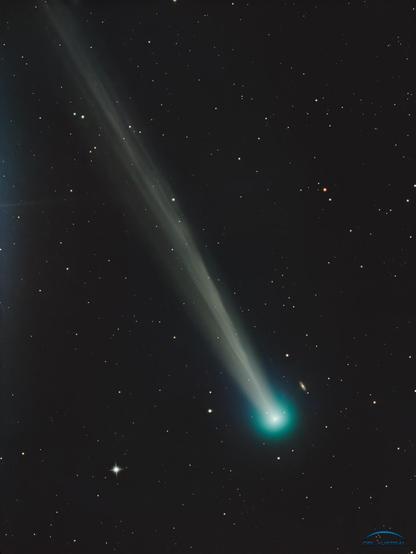
Comet C/2025 R2 (SWAN)
* Image Credit & Copyright: Team Ciel Austral
https://www.cielaustral.com/

Explanation:
A new visitor from the outer Solar System, comet C/2025 R2 (SWAN) also known as SWAN25B was only discovered late last week, on September 11. That's just day before the comet reached perihelion, its closest approach to the Sun. First spotted by Vladimir Bezugly in images from the SWAN instrument on the sun-staring SOHO spacecraft, the comet was surprisingly bright but understandably difficult to see against the Sun's glare. Still close to the Sun on the sky, the greenish coma and tail of C/2025 R2 (SWAN) are captured in this telescopic snapshot from September 17. Spica, alpha star of the constellation Virgo, shines just beyond the upper left edge of the frame while the comet is about 6.5 light-minutes from planet Earth. Near the western horizon after sunset and slightly easier to see in binoculars from the southern hemisphere, this comet SWAN will pass near Zubenelgenubi, alpha star of Libra, on October 2. C/2025 R2 (SWAN) is scheduled to make its closest approach to our fair planet around October 20.
https://app.astrobin.com/i/i5qsgj
https://earthsky.org/space/new-comet-swan25b-2025/
https://cobs.si/obs_list?id=2659
https://en.wikipedia.org/wiki/C/2025_R2_(SWAN)#Observational_history

https://spaceplace.nasa.gov/comets/en/
https://science.nasa.gov/mission/soho/

https://apod.nasa.gov/apod/ap250918.html

#space #comets #astrophotography #photography #science #astronomy #nature #NASA #ESA #education
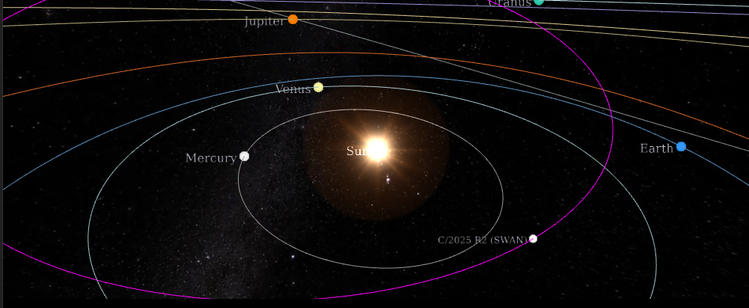
Comet C/2025 R2 (SWAN) Orbit | 3D Solar System Viewer | TheSkyLive

Visualization of the orbit of Comet C/2025 R2 (SWAN) in an interactive 3D Solar System viewer and simulator.

Comet C/2025 R2 (SWAN)

Below the horizon. Rise: 9:47 | Tran: 14:46 | Set: 19:44
Alt: -29.26° Az: 70.51° Direction: East-North-East

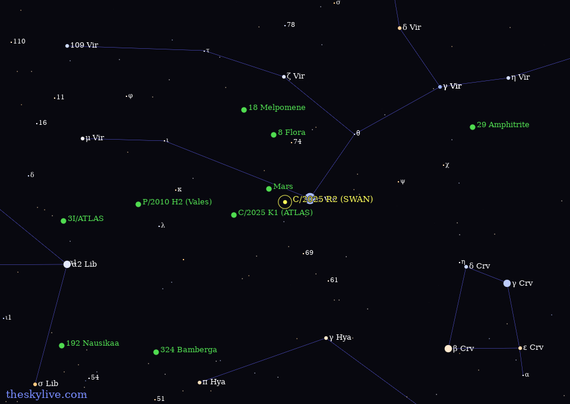
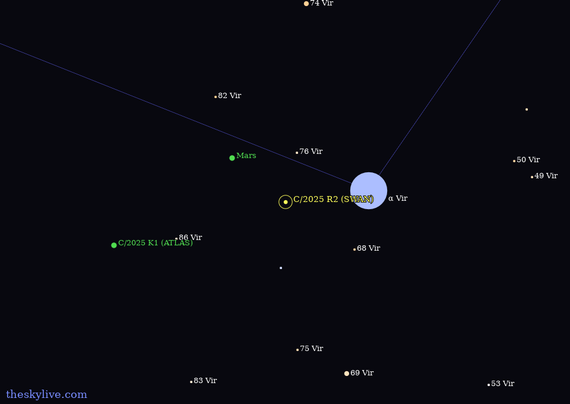
Comet C/2025 R2 (SWAN) is in the constellation of Virgo, at a distance of 117,117,474.3 kilometers from Earth. The current Right Ascension is 13h 35m 39s and the Declination is -11° 36’ 24” (apparent coordinates). The latest observed magnitude of comet C/2025 R2 (SWAN) is 7.3 (data provided by COBS).

* URL'S associated with the images:
1. to 2. https://theskylive.com/planetarium?obj=c2025r2
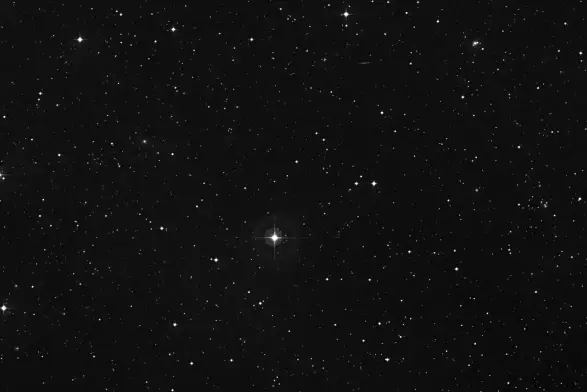
3. 5. 6. https://theskylive.com/c2025r2-tracker
4. https://theskylive.com/3dsolarsystem?obj=c2025r2

On this website you can follow the current data of the comet live:
https://theskylive.com/c2025r2-info

CREDIT
TheSkyLive.com
----

From Wikipedia, the free encyclopedia:

C/2025 R2 (SWAN)

C/2025 R2 (SWAN), formerly known as SWAN25B, is a non-periodic comet discovered on 11 September 2025 by Vladimir Bezugly through SWAN imagery. As of 17 September 2025, the comet has an apparent magnitude of +6.9 with a solar elongation of 30 degrees and is observable near the star Spica in 50 mm (2.0 in) binoculars. It is better seen from the Southern hemisphere.

Observational history

The comet was first spotted in images from the SWAN instrument onboard the Solar and Heliospheric Observatory (SOHO) by amateur astronomer Vladimir Bezugly on 11 September 2025. The presence of the comet was confirmed by other amateur astronomers, having an estimated magnitude of 7.4 and featuring a tail about 2 degrees long. The comet upon discovery was located in the constellation of Virgo and it was better seen from the southern hemisphere as it was higher in the sky after sunset.
[...]

Please read more in next post.

Text Credits:
Contributors to Wikimedia projects

#space #comets #astrophotography #photography #science #astronomy #nature #NASA #ESA #education

@grobi I should definitely add this to @teskooano - I've been behind adding new things and this one looks interesting