
One of the fun/annoying things about starting a pinball museum is the number of historical rabbit holes that I get caught up in. Today it's how this 1936 pinball machine led me to what looks like an MLM scheme from the 1920s and 1930s. A scam that still works today! 🧵
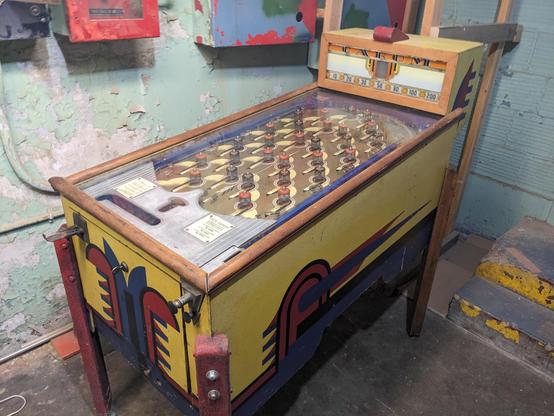
Bally's Carom was part of the wave of pinball-ish machines that started in 1931, but they quickly veered into what at the time was legal ambiguity, but today is clearly seen as a gambling machine. Here's the Carom schematic, which makes clear that the operator can set the payout odds. Gambling! 100% gambling! 2/

@williampietri that score projection unit is adorable

also, the odds unit is an air dashpot relay?! freaking cool.

@williampietri how did the payout work, did it just kick out the coins lined up on this thing? https://www.ipdb.org/showpic.pl?id=458&picno=25688
Internet Pinball Machine Database: Bally 'Carom' Images

Pictures, documents, manufacturing data, ratings, comments, features, and history for Bally 'Carom' pinball machine.

@vxo That is an excellent question, but I don't know yet. That thing matches a hole in the top that lets you see the coins recently played. I suspect that was either about letting the operator validate that people weren't putting in slugs or letting the marks see that there was real money to be won.

The payout motor itself is lower down than that, but I haven't had a chance to look at it in detail.

@williampietri I keep also wondering what is referred to as a Variator here.

That's a fun word I don't see used often enough. The only other place I see it commonly used is to refer to the variable "diameter" engine pulley on scooters and ATVs using a rubber belt CVT

I stuck diameter in quotes because it's not the overall diameter, but the diameter of the contact patch with the belt that is varied by having one side of the biconic pulley slide in and out

@vxo The guy sending me the circuit diagram also asked about the variator! If you want to join our volunteer discord let me know; you obviously have knowledge we don't, and it would be a good way to keep up on our discoveries.
@williampietri Yeah I would like to. It sounds fascinating