
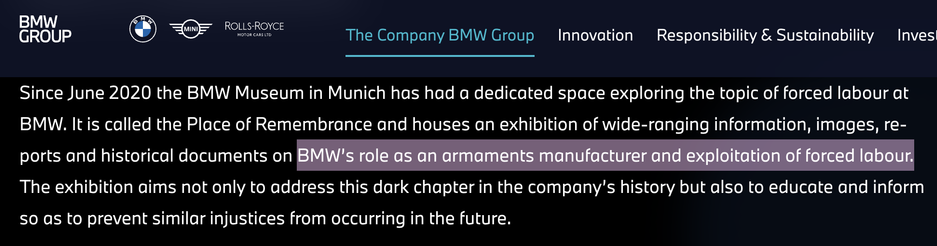
Every company that has ever been involved with fascism, slavery, or exploitation of labor should have open statements like this on their website

But I'm impressed that BMW is this blunt about it — and has actual pictures of Dachau
https://www.bmwgroup.com/en/company/history/BMW-during-the-era-of-national-socialism.html

@saraislet The VW website is very bad in this respect. Here is a quote from the VW corporate history page, translated by me:

[1/2] The search for viable solutions for small cars was on during the 1930s. But the public awareness of cheap People's Cars (lit. Volkswagen) didn't lower the high lifetime costs yet, which prevented mass proliferation of cars.

(I edited this and deleted some replies because I messed up the threading)

@saraislet [2/2] The newly appointed Reich Chancellor Adolf Hitler, in announcing state subsidies for the car industry quickly in 1933 at the International Car and Motorbike Convention in Berlin, didn't just react to an industrial-political atmosphere for the creation of jobs, but also turned the motorization of the masses into social-utopian government policy.
1904 bis 1933 – Vom automobilen Traum zur Volkswagen-Idee

Automobile stellten zu Beginn des 20. Jahrhunderts unter den Fortbewegungsmitteln noch die große Ausnahme dar. Kaum 16.000 Automobile gab es 1910 im Deutschen Reich. Den einen diente es als abenteuerliches Sportgerät, anderen zu Repräsentationszwecken. Autos blieben den Schönen und Reichen vorbehalten: Kaiser Wilhelm II. nutzte ebenso wie Stahlmagnaten und Bankiers handgefertigte Automobile von Benz, Daimler oder Glaser. Eine Vielzahl von Automobilmarken belieferte einen sehr überschaubaren Luxusmarkt.

Volkswagen Group