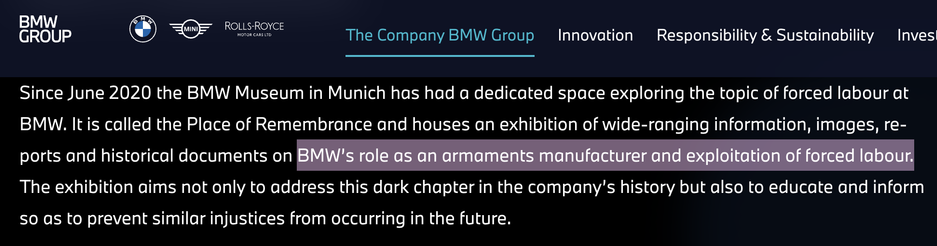
Every company that has ever been involved with fascism, slavery, or exploitation of labor should have open statements like this on their website

But I'm impressed that BMW is this blunt about it — and has actual pictures of Dachau
https://www.bmwgroup.com/en/company/history/BMW-during-the-era-of-national-socialism.html

@saraislet This was a somber place to visit and learn about Germany during this era: https://en.wikipedia.org/wiki/Documentation_Center_Nazi_Party_Rally_Grounds
Documentation Center Nazi Party Rally Grounds - Wikipedia

@saraislet tbf, I think it took them almost 80years and lots of rightful bullying by researchers and the public ^^'
@ljrk yeah, it's not great that and how it happened, but it is important that they did it, when so many companies refuse to acknowledge similar in the slightest
@saraislet @ljrk the whole "reward the behaviour you want, and don't berate them for how long it took" doesn't -exactly- apply when it's a company instead of a human but it's still a relevant paradigm
@http_error_418 @saraislet @ljrk
Yeah, agree, has to be modified for corporate entities, but still applies in various ways.
@saraislet @ljrk I work around the corner from a Dr Oetker office... Bet they have nothing published about herr doktor....
@ColmDonoghue @ljrk 😳 I didn't know they've been around that long
@saraislet @ColmDonoghue There's a German Verein called "Die Familienunternehmer" which sounds really cute and small but is mostly a powerhouse of the biggest German companies since many of them are "Familienunternehmen". And the list of members could almost as well serve as a "companies/families who got wealthy under the 3rd Reich and are still powerful" list.
@saraislet Oh absolutely, it's good that it's there either way – it's just who can take credit/props for this and it's certainly not /them/.
@saraislet IBM could learn a lot from BMW in this respect
Levka (@[email protected])

Attached: 1 image IBM and the Holocaust, by Edwin Black https://www.goodreads.com/book/show/48838.IBM_and_the_Holocaust

kolektiva.social

@scavello @saraislet

Yeah I.B.M. could have an exhibit to show all the progress they've made over the last century.

1930s: Supplied punch cards to help the Nazis categorize citizens, identify Jews and other minorities, and catalog they're internment in concentration camps

Now: Develops and maintains Israel's computerized national population registry which includes addresses and information on Palestinian residents in Gaza, the West Bank, and other occupied territories.

#IBM #genocide

@scavello @saraislet

1930s: Manufactured guns for the Nazis

Now: Provides I.T. services to Israel's military regional logistics centers and collaborates on R&D work with the Israeli military

@saraislet It's important to remember that such transparency about their role in WW2 is often something that was mandated at the end of WW2 for the company to be able to continue to exist.

Do not assume that german companies' openness is from actual guilt rather than existential necessity.

@CryogenicIce9 The US government has never done nor been forced to do anything like that, and it shows
Levka (@[email protected])

Attached: 1 image Blowback, by Christopher Simpson https://www.goodreads.com/book/show/440627.Blowback

kolektiva.social
@LevZadov @CryogenicIce9 that's the opposite of accountability

@saraislet @CryogenicIce9

It gets worse, as the rest of the thread illustrates all too well.

https://kolektiva.social/@LevZadov/110626267515269280

Levka (@[email protected])

Attached: 1 image The Art of War, by Sun Tzu https://www.goodreads.com/book/show/10534.The_Art_of_War

kolektiva.social

@saraislet The VW website is very bad in this respect. Here is a quote from the VW corporate history page, translated by me:

[1/2] The search for viable solutions for small cars was on during the 1930s. But the public awareness of cheap People's Cars (lit. Volkswagen) didn't lower the high lifetime costs yet, which prevented mass proliferation of cars.

(I edited this and deleted some replies because I messed up the threading)

@saraislet [2/2] The newly appointed Reich Chancellor Adolf Hitler, in announcing state subsidies for the car industry quickly in 1933 at the International Car and Motorbike Convention in Berlin, didn't just react to an industrial-political atmosphere for the creation of jobs, but also turned the motorization of the masses into social-utopian government policy.
1904 bis 1933 – Vom automobilen Traum zur Volkswagen-Idee

Automobile stellten zu Beginn des 20. Jahrhunderts unter den Fortbewegungsmitteln noch die große Ausnahme dar. Kaum 16.000 Automobile gab es 1910 im Deutschen Reich. Den einen diente es als abenteuerliches Sportgerät, anderen zu Repräsentationszwecken. Autos blieben den Schönen und Reichen vorbehalten: Kaiser Wilhelm II. nutzte ebenso wie Stahlmagnaten und Bankiers handgefertigte Automobile von Benz, Daimler oder Glaser. Eine Vielzahl von Automobilmarken belieferte einen sehr überschaubaren Luxusmarkt.

Volkswagen Group
@saraislet Pardon me for suggesting that every company with this kind of history should no longer exist as a company, other than as a workers’ collective.
“Still profiting” is quite the Nazi legacy.
@saraislet Hmmmm wait a sec, gotta check Doktor Oetker's website…