
Explain!! 😻😆

OK! Here it is:

The Japanese text (ネコ飛出し注意) translates to “Watch out for jumping cats” or more literally “Caution: Cats dashing out”.

It’s a local road sign sometimes put up in Japanese neighborhoods where there are many stray or outdoor cats. The flying-cat graphics are just a playful way to show that cats might suddenly run across the street, so drivers should slow down and be careful.
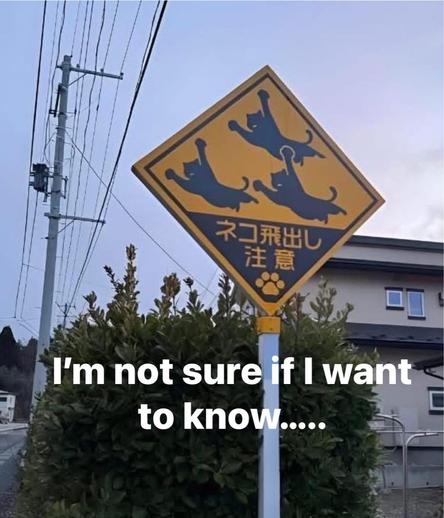
@streetartutopia Thanks, but why are the cats spelled ネコ instead of 猫? And why does the sign use katakana just for this word?

@haupz

Looking it up, I see
there's a usage note related to this at
https://en.wiktionary.org/wiki/猫

And I notice Japanese Wikipedia uses katakana for the corresponding page title.

I see this question has been asked in other forms in various places (such as Reddit) but not very clearly answered, as to what the range of usage actually is, in any of the places I found it..

猫 - Wiktionary, the free dictionary

Wiktionary
@glc @haupz Allow me: 'cat' is a pretty good example for when and why to use the different writing systems. As for names of all animals (and plants, by the way), whenever used taxonomically, it'll be ネコ in katakana. Officially (as per Ministry of Education) it makes these terms stand out in dictionary entries: you immediately know it refers to a species, as opposed to places or people. Using it on traffic signs serves the same purpose of drawing special attention. In colloquial or literary use it'll be 猫 all the time - except in books written for children below the age bracket for that particular kanji proficiency, but then it's ねこ in hiragana, not katakana.
@oya3un @glc Very insightful, thank you!