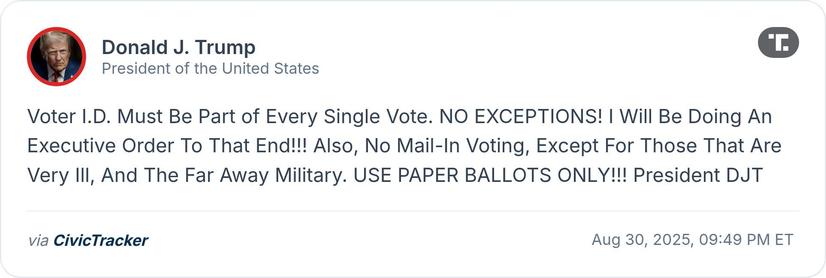
Just for the record, Trump can’t do this. The Constitution is very clear that the “times, places, and manner“ of elections for federal office are determined by individual states (though can be altered by Congress).

The president simply has no role in US elections (except to sign into law or veto whatever election-related bills that congress might pass).

@mattblaze Throw into the brew the situation a few years ago when states tried to require that presidential candidates publish tax returns and were shot down by courts saying that states can not modify the requirements to hold office.

Although that is not directly germane to the voter ID situation, it does reflect a policy that when it comes to election stuff, the Constitution occupies almost the entire space leaving little room for additional Federal or state regulation.

With regard to voter ID - that is an issue that is hard to oppose because it is not irrational. I believe the D's would be better off not opposing voter ID but, instead, using those resources to make sure that every likely D voter has a proper voter ID.

@karlauerbach @mattblaze Providing IDs to every voter is a really hard problem. But the Supreme Court has upheld the right of states to require it.

@SteveBellovin @mattblaze I am far from having expertise in the art of issuing IDs. So I do not understand when you say "Providing IDs to every voter is a really hard problem."

??

(I do remember back when Dave Kaufman and I were trying to figure out operating system access control matrices that we always seemed to back into the question of "how do we know who the actor is?" [Especially when a person or thing was acting as an agent with delegated authorities from another.])

I also keep bumping into the old national ID card issue - and the fears that a person could be "vanished" by a government agency. But then again, we seem to be moving pretty close to a national ID card with things like SecureID driver's licenses.

@karlauerbach @SteveBellovin @mattblaze Are you assuming everyone has a driving license? That's not a sensible assumption.

@oclsc @SteveBellovin @mattblaze I am not making that assumption. My comment about SecureID is intended to reflect that national ID cards are sneaking up on us.

BTW, as far as I know, many (perhaps most?) will issue ID cards to those who can't get (or do not want) a driver's license. I'm not sure whether there is a SecureID version of those.

@karlauerbach @SteveBellovin @mattblaze In my salad days, when I lived in the States and the President was a B-list actor with dementia, it was a real nuisance not to have a photo ID, eg when paying by cheque (remember that?). I had a non-driver ID from California DMV for a while, but that seemed stupid. Then I attended a conference in Toronto so I got a passport, and thereafter carried that.

But in recent decades I can hardly remember being asked for ID except when crossing borders or checking into US hotels. (The latter seems new since the Reagan years--maybe it started after 9/11?)

One exception is when voting in Canada but the requirements are quite loose--provincial health card and a utility bill will do. Another recent one: when I signed my will, lawyer wanted to see ID for obvious reasons. I still had my decades-old, rather ratty Canadian citizenship card in my wallet, and that was enough. If I'd known she was going to ask I'd have brought my passport.

But the need now is annual or less, not daily.

@oclsc @karlauerbach @SteveBellovin @mattblaze I've always been asked to present my passport checking into a foreign hotel, and in the countries I've visited hoteliers are required to record the identity of all guests, as a part of a more general civil registration system, even if someone else is paying. (Longer term visitors/renters must register with the local police.)
@wollman @oclsc @karlauerbach @SteveBellovin The problem with generalizing from things like this ("I need an ID to check in to a hotel, why not to vote?") is that the effects depend on different things. The fact that hotel guests (a demographic that doesn't include everyone eligible to vote in the US) generally have ID doesn't mean all voters do or easily could obtain one. And adding a requirement without considering those who might be disenfranchised by it changes the electorate.
@wollman @oclsc @karlauerbach @SteveBellovin I don't think anyone has a problem with the goal of positively identifying voters. The question is how to do so *in our existing environment* without disenfranchising people.
@wollman @oclsc @karlauerbach @SteveBellovin In most European countries, there are national ID cards and current registries of citizens and residents. The US is unusual in not having either. Not only is there no single universal ID that all citizens can be assumed to have, there's no organic list of voters - we have to explicitly register to vote, as a separate act from other civic functions.
@mattblaze @oclsc @karlauerbach @SteveBellovin yes, I am aware of all of these things, I was responding to Norman's post about where he has needed to present ID recently. (Which is not much different from my own.) Happy to remove you from the subthread if that is your preference.
@wollman @oclsc @karlauerbach @SteveBellovin No worries. I'm just pointing out that extrapolating from this for election purposes isn't easy.