
862 new Crystallography Open Database entries were added to
CrystalWorks during July
This brought the total to 526,886

There is open access to the CrystalWorks implemention of the COD via the server at Daresbury.
Those at a UK acacemic institution can also register as a user and also access the ICSD and Cambridge database via CrystalWorks

πŸ”—the CrystalWorks homepage: https://cds.dl.ac.uk/
πŸ”—for further COD details: https://cds.dl.ac.uk/cgi-bin/news/disp?COD
πŸ”—for general details: https://cds.dl.ac.uk/cgi-bin/news/disp?cworks
Homepage

If eligible you can register via the CrystalWorks homepage. If you are already a registered user, you may find you have to reset your password if you have not done so recently.

Anybody is free to access the Crystallographic Open Database.
There are also a number of other open crystal structure based pages. These include the #365Minerals and #Crystallography365 collections.

πŸ”—the CrystalWorks homepage: https://cds.dl.ac.uk/
πŸ”—open access CrystalWorks pages: https://cds.dl.ac.uk/cgi-bin/cw_page/link_to_cworks.html

Homepage

The #365Minerals collect, in particular, is worth checking out

https://techhub.social/@cds_daresbury/113370262159652783

cds_daresbury (@[email protected])

As it is now the first day of 2025 it is a good time to review the full 365Minerals collection produced by Nadine Gabriel and implemented by CrystalWorks site at Daresbury https://cds.dl.ac.uk/cgi-bin/cw_page/examples_rocks.html

TechHub

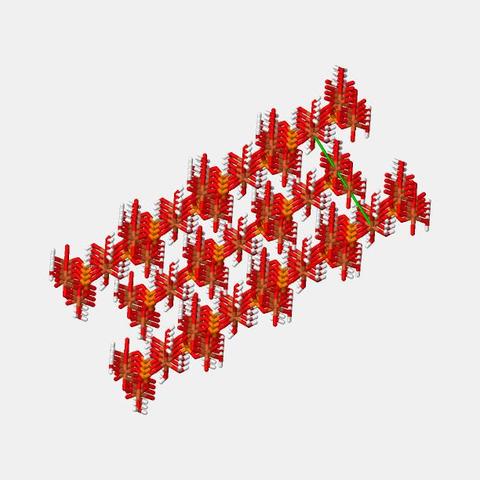
The #365Minerals entry for today (2nd August) is Vivianite, a particular favorite. Amongst other things it is found on corpses in iron coffins and also tends to block the valves in sewage treatment plants.

πŸ”— https://www.mindat.org/loc-241890.html

The layers in Vivianite are build from Fe3(PO4)2.8H2O units (with ferrous iron). Recently there have been reports of sucessful exfoliation producing "Vivianene"

Here links to a couple of arXiv papers


πŸ”—https://doi.org/10.48550/arXiv.2505.05282

πŸ”—https://doi.org/10.48550/arXiv.2502.00813

Electronic and Optical Properties of the Recently Synthesized 2D Vivianites (Vivianenes): Insights from First-Principles Calculations

Vivianite (Fe$_3$(PO$_4$)$_2$8H$_2$O) is a naturally occurring layered material with significant environmental and technological relevance. This work presents a comprehensive theoretical investigation of its two-dimensional (2D) counterpart, Vivianene, focusing on its structural, electronic, and optical properties. Using density functional theory (DFT) calculations and ab initio molecular dynamics (AIMD) simulations, we evaluate its thermodynamic stability, band structure, density of states, and optical response. Our results confirm that Vivianene retains the main structural features of bulk Vivianite while exhibiting enhanced thermodynamic stability at room temperature. The electronic structure analysis reveals an indirect bandgap of 3.03 eV for Vivianene, which is slightly lower than the 3.21 eV observed for bulk Vivianite, deviating from the expected quantum confinement trend in 2D materials. The projected density of states (PDOS) analysis indicates that Fe d orbitals predominantly contribute to the valence and conduction bands. Optical calculations demonstrate that Vivianene exhibits a higher optical band gap (3.6 eV) than bulk Vivianite (3.2 eV), with significant absorption in the ultraviolet region. The refractive index and reflectivity analyses suggest that most of the incident light is absorbed rather than reflected, reinforcing its potential for optoelectronic applications. These findings provide valuable insights into the fundamental properties of Vivianene and highlight its potential for advanced applications in sensing, optoelectronics, and energy-related technologies.

arXiv.org

A feature of most samples of Vivianite is its blue colour. This has been attributed to the presence of ferric impurities - pure synthetic ferrous samples are colourless.

πŸ”— https://www.mindat.org/min-4194.html

The #365Minerals entry for today (3rd August) is Millerite ( Ξ²-NiS)

πŸ”— https://cds.dl.ac.uk/cgi-bin/cw_page/examples_rocks.html

Actually the Ξ±-NiS dimorph is also included in the CrystalWorks list. But this form is in fact the rare, recently identified mineral Crowningshieldite.

The Ξ± and Ξ² form are also given as the 20th July entry in the #Crystallography365 collection "Nickel sulfide: a smashing crystal structure"

πŸ”— https://cds.dl.ac.uk/cgi-bin/cw_page/examples_365.html

Both are worth checking out

365Minerals