The next main things to do are building out an audio subsystem for the program so you can hear the patch, and then there's some important stuff missing from the editor like being able to place new tiles.
One of the things I'm really excited about with the design of the compiler is if you modify a patch while it is running, the oscillators don't reset, so you should be able to make a program while performing it :3
I got the audio hooked up to it and everything seems to work right :3
I am now the operator, with my virtual calculator.
the screen shot doesn't show off how cool this is, because when you're using this to edit constants in the patch, it'll update their values as you input expressions (so, every time you press equals or input a second operator) and so you can hear the change to the patch as you are doing math
I don't feel like being mad at linux right now, so I'm gonna figure out how to record this another time
I've got this hooked up to my audio convolver (a simple slow morphing fm patch convolved with the sound of a metal water bottle with a little bit of water in it being perturbed) and it sounds mesmerizing. Mym described it as "birds in a pinball machine" :3
I've been listening to it for like an hour and I'm so zoned out now 😎
I made it so you can rearrange the nodes now :)
I added a way to actually place tiles now instead of hard coding them!
finally, after five weeks and change of building a visual programming language from scratch, i can now build a working patch starting from nothing :D
The natural thing to implement next would be save and load, but pygame doesn't provide anything for conjuring the system file io dialogue windows (SDL3 has it, but pygame is SDL2 under the hood iirc). I'll worry about that another time I guess.
I'm probably going to go with an xml format so it's easy to extend. I want it to be easy to make custom controls in other applications eg game engines, so this feels like the obvious choice also I'm one of the five people who likes xml.
i'll probably end up adding envelope generators and midi before i implement save and load since it's not really worth using without those but it really depends on which way the wind is blowing when i next work on this
I'm really excited because all of the hard stuff is done now. I mean none of it was hard to implement or design, it's just that I made a bunch of architectural decisions up front and five weeks later the result is a thing that 1) works, 2) I've managed to keep the complexity of implementation pretty low across the entire program, and 3) all of the missing features and areas I want to improve upon have obvious paths to implementation.
and so further effort put into developing this will have an extremely favorable ration of time spent actually making the program more useful vs wallowing in tech debt
I made a short sequence of boops entirely out of oscillators and arithmetic. There's no sequencer or envelope generator.
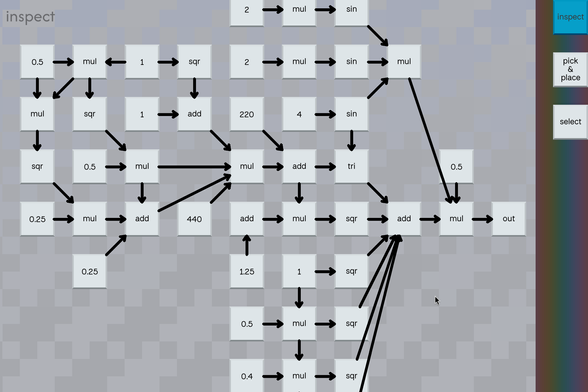
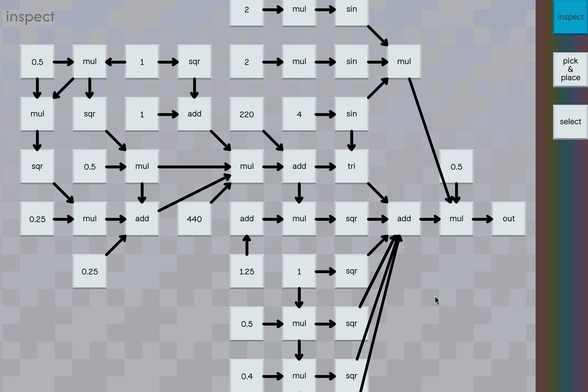
#mollytimeand this is the patch, or at least here is most of the patch. it probably looks complicated but I did not put a lot of thought into it
from my experimentation so far since I got all this working end-to-end, I think modality worked as useful convenience for standing up a visual programming language quickly, but it adds too much friction to this one. In particular when making patches I want to be able to alternate between placing/moving stuff around and connecting stuff, so those two modes need to be merged for sure.
I'm not really making good use of multitouch because I've been developing this using a mouse. I'd like to have it so I can touch two things to hear what they sound like connected or disconnected; and then double tap to connect or disconnect that connection when a quick connection is possible. Mouse mode will need to work differently.
Another verb I would like to implement is the ability to disconnect a wire and connect a new wire in the same frame. The current flow for disconnecting a wire and connecting a new wire is too long even with a touch screen, but I think anything where it is not one action would be.
Being able to suspend/resume updating the patch that is playing while making edits is also a thing I want to implement for similar reasons, but I think being able to splice parts quickly is useful in different ways.
I added a flip/flop instruction. It's mostly a toy, but it's helped me clarify how I want to handle envelopes.
here's what that patch sounds like
I'm sorry everyone but I have to confess to a sin. See that chain of flip flops up there two posts ago? That's a number. That's a number where every bit is a double precision float 😎
I came up with a pretty good approximation of a dial tone on accident while implementing a mixing node.
#mollytimeand here's the patch for that sound
Also now that I have tile types with multiple inputs and/or multiple outputs, I went and cleaned up manual connect mode to make it a little more clear what's going on.
today I added an envelope generator and some basic midi functionality. and then I made this absolute dog shit patch :3
#mollytimeit'll be a bit of work to do, but I want to eventually add a convolution verb to my synthesizer so I don't have to run it as a separate program. I'll probably also end up rewriting it to be a FFT because it would be nice to be able to have longer samples and maybe run several convolutions simultaneously. That might be "get a better computer" territory though.
I had this really great ambinet patch going where it was these washes of noise convolved with a short clip from the chrono cross chronopolis bgm, and I recorded 3 minutes of it but audacity just totally mangled it. There's this part that sounded like a storm rumbling in the distance but it was just the patch clipping, and that seems to be the danger zone for recording and playback I guess.
so you're just going to have to pretend you're hovering gently in a vast warm expanse of sky and ocean with no obvious notion of down, as a storm roils off in the distance, during an endless sunset. the moment is fleeting, yet lasts forever
saving and loading is probably going to be the next highest priority feature now. you can do a lot with simple patches, but it would be nice to be able to save the more interesting ones
I've got saving and loading patches working 😎 that was easy
I've been very careful so far to make it impossible to construct an invalid program, but I'm eventually going to add a reciprocal instruction (1/x), and was pondering what to do about the (1/0) case and I had a great idea which is instead of emitting infinity or crashing, what if it just started playing a sound sample as an easter egg. I'd have to add another register to the instruction to track the progress through the sample though.
I haven't picked out a good sample yet for the (1/0) case. A farting sound is too obvious and puerile. The most hilarious idea would be to start playing a Beatles song on the theory that if you messed up the copyright autotrolls would kill your stream, but I don't want the RIAA coming after my ass.
I might just have the rcp component explode if you feed it a zero.
ok it's less sensational than stuffing an easter egg in here, but I realized I can simply have it refuse to tell you the answer if you try to divide by zero
I'm thinking of adding a tile type that could be used to construct sequences. It would take an input for its reset value, a clock input, and an input for its update value. It outputs the reset value until the clock goes from low to high, at which point it copies the current update value to its output. This would let you build stuff like repeating note sequences with two tiles per note + a shared clock source, and you could use flipflops to switch out sections.
I made a crappy oscilloscope for debugging. Every frame it draws a new line for the magnitude of the sample corresponding to that frame. This does not show the wave form accurately because it's just whatever the main thread happens to get when it polls for the latest sample. This is mostly meant to help check the magnitude to verify that it matches expectations. A red line indicates clipping happened.
#mollytimeAnd here's what an eccentric patch looks like in scope view. I'm using the RNG node as if it were an oscillator, but I didn't try to correct the range, so the samples are all positive. Also it clips like crazy. Anyways here's 3 minutes and 29 seconds of hard static to relax and study to.
#mollytime@aeva I love the sounds you make 
this last one feels gameboy-ish or snes-y :3
what are your any plans for this? would this then be something that you can hook up to a daw? or just a thing to make sounds on its own?
@celestia I want to eventually have it be a library i can embed in my game projects, and i also want to use it for live jams. the big pieces that are missing still are a sequencer, a few different touch screen keyboards, a convolution verb, sampler, and i want to mess around with granular synthesis eventually
@celestia i'd also like to be able to set it up to render computationally improbable things into caches for sampling
 aeva
aeva


 Celes 🌙
 not sure if that's something that can be learned in a reasonable time-frame without lots of trial and error

 but I'm stuck in the fire temple, I should just grab a guide that thing is horrible