 Gork
GorkI would still download a car if I could. 🚗
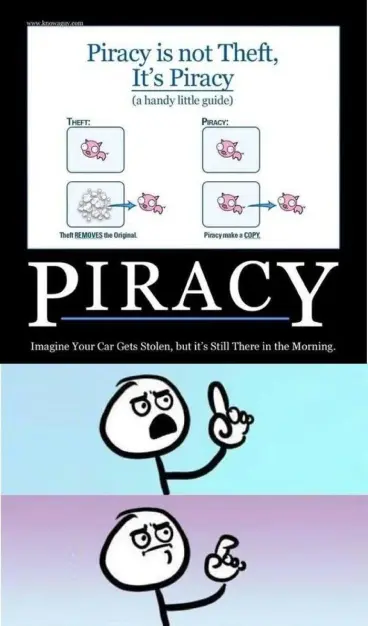
I’d rather download some bicycles, but yes.
I wished, we could pirate food.
Disclosure: I have been sailing the seas for years, but…
This logic does no justice to the objective financial harm being done to the creators/owners of valuable data/content/media.
The original creator/owner is at a loss when data is copied. The intent of that data is to be copied for profit. Now that the data has been copied against the creator/owners will, they do not receive the profit from that copy.
Yes yes the argument is made that the pirate would not have bought the copy anyways, but having free copies of the content available on the internet decreases the desire for people to obtain paid copies of the data. At the very least it gives people an option not to pay for the data, which is not what the creator wanted in creating it. They are entitled to fair compensation to their work.
It is true that pirating is not directly theft, but it does definitely take away from the creator’s/distributor’s profit.
Devil’s Advocate: Many pirates would have not paid for access to that media so to say it takes away from the creators profit isn’t exactly true since one act of piracy does not equal one lost sale.
Devil’s Advocate Part II: There is s significant amount of research that supports the notion that pirates actually spend more money on media than the average person.
I personally am an example of part II. I pirate a lot of music but I refuse to use Spotify because of how little it pays artists and I have also spent significant amounts of money buying music from artists I enjoy via Bandcamp or buying from the artist directly because I know they get a bigger cut of the profits that way.
Ditto on Spotify. I have big love for piracy of FLAC for my personal music server, but I also have a decent rack filled with physical offerings from my favorite bands.
My Bandcamp collection is also getting up there, since a few of my favs say they are treated well there, and it’s FLAC friendly as well.
Physical media or merch directly from the band is absolutely the way to go every time if possible.
I’m having trouble finding a link to substantiate it, but I remember in the early 2000’s a group of artists having to sue their record labels because of the lawsuits on file-sharing users. The record labels said they were doing it for the artists, but the artists had to sue the record labels to even ever see a penny from the fruits of those lawsuits. The record labels were just pocketing the money for themselves while saying it was “for the artists.”
Anyway, long story short is that kind of behavior from the recording industry made me want to give money directly to the artists and cut out these selfish middlemen who did nothing but claimed all the profits.
having free copies of the content available on the internet decreases the desire for people to obtain paid copies of the data.
According to who?
I guess herein lies the potential fallacy of my statement. Decreased desire is a Subjective observation.
One cannot draw a direct correlation, but there is data to conclude that not having a piracy option will boost sales of data initially, at least when it comes to games. (Hence why publishers continue to use Denuvo)
Counterpoint: When Louis CK (prior to being outed as a sex pest) released one of his comedy specials on his website DRM-free for $5 he became a millionaire almost overnight.
boingboing.net/…/drm-free-experiment-makes-loui.h…
Price point matters, too.
It also jives with early Steam Sales when Valve would cut titles like Left 4 Dead Counter Strike down to 90% off, and they would sell so many digital copies that they were actually making more money off the lower price.
geekwire.com/…/experiments-video-game-economics-v…
Now we did something where we decided to look at price elasticity. Without making announcements, we varied the price of one of our products. We have Steam so we can watch user behavior in real time. That gives us a useful tool for making experiments which you can’t really do through a lot of other distribution mechanisms. What we saw was that pricing was perfectly elastic. In other words, our gross revenue would remain constant. We thought, hooray, we understand this really well. There’s no way to use price to increase or decrease the size of your business.
But then we did this different experiment where we did a sale. The sale is a highly promoted event that has ancillary media like comic books and movies associated with it. We do a 75 percent price reduction, our Counter-Strike experience tells us that our gross revenue would remain constant. Instead what we saw was our gross revenue increased by a factor of 40. Not 40 percent, but a factor of 40. Which is completely not predicted by our previous experience with silent price variation. …
Then we decided that all we were really doing was time-shifting revenue. We were moving sales forward from the future. Then when we analyzed that we saw two things that were very surprising. Promotions on the digital channel increased sales at retail at the same time, and increased sales after the sale was finished, which falsified the temporal shifting and channel cannibalization arguments. Essentially, your audience, the people who bought the game, were more effective than traditional promotional tools. So we tried a third-party product to see if we had some artificial home-field advantage. We saw the same pricing phenomenon. Twenty-five percent, 50 percent and 75 percent very reliably generate different increases in gross revenue.
the pirate would not have bought the copy anyways, but having free copies of the content available on the internet decreases the desire
Also, the person deciding whether or not they “would have” paid for it, has a strong incentive to kid themselves that they wouldn’t. Imagine if cinemas worked that way, and you could just walk in and announce that you weren’t going to buy a ticket anyway and since there’s a seat over there still empty it’s not going to cost them anything for you to sit in it. They’d go out of business by the end of the week.
Also also, either the thing you’re copying has value that arose from the effort of creating it, or it doesn’t. If it’s of value, then it’s reasonable to expect payment for it. It’s it’s not of value, then you shouldn’t miss not having it.
Also also, either the thing you’re copying has value that arose from the effort of creating it, or it doesn’t. If it’s of value, then it’s reasonable to expect payment for it. It’s it’s not of value, then you shouldn’t miss not having it.
Doesn’t this contradict the whole rest of the argument? It either has value or it doesn’t. It being available for free somewhere doesn’t change the value. If it’s not of value, then they shouldn’t miss you having it.
Again, the point is you were saying (or agreeing) that copies being available for free decrease the value. You then later say it has intrinsic value.
I’m not arguing that they don’t have intrinsic value. I’m arguing that you undermined the point of value decreasing if it exists for free by admitting this. It doesn’t. It’s worth something no matter what someone else paid, and no matter what you paid.
A game decreasing in price over time isn’t doing so because it’s worth less (usually, with the exception of online games). They’re decreasing the price to capture customers who don’t agree with the original valuation. It doesn’t change value to the consumer based on the price changing. The object is not suddenly less valuable when there’s a sale and more valuable again after. It has a degree of “goodness” no matter what. The price doesn’t effect this.
Adding on to say: no. It doesn’t cost the creator anything when a pirated copy is made. They potentially miss a sale, but if their item wasn’t in a store where someone may have made a purchase you wouldn’t call that actively harmful, right?
In addition, most media the creators don’t actually make money from the profit. Most of the time they’re paid a salary, maybe with a bonus if it does particularly well. The company that owns the product takes the profit (or loss), not the actual creators.
Also, a lot of media isn’t even controlled by the same people as when it was made. For example, buying the Dune books doesn’t give money to Frank Herbert. It goes to his estate.
It’s not my fault if somebody makes content at a loss and isn’t able to recuperate their losses. It happens all the time, sucks for them. I mean that earnestly by the way, though it sounds callous – it really does suck for them, and I feel bad for artists who can’t turn a profit.
However, I just don’t agree with you that “objective harm” is done when one pirates media. If this were true, you must admit that it’s equally objectively harmful to the IP holder for one to not consume media at all. I just don’t see how you can square that.
I for one would definitely download a car, if I did not already own one I really like.
I’d happily let’s others download mine, if it didn’t affect me or my car in any way.
I am 100% down for sailing the high seas. But let’s not sugarcoat it, this analogy is always been kind of crap.
Somebody went to your mailbox took out your paycheck, made a copy of it, put the original back in your box, went to the bank and cashed it.
Theft still took place. You’re probably still getting paid. Maybe it got taken up by insurance and everyone’s premium goes up a tiny fraction, maybe it got taken up by the bank or by your business.
It’s still an incomplete analogy but it’s a little bit closer.
That’s not to say that the vast majority of piracy isn’t people who wouldn’t pay anyway. And back in the day, you certainly got more visibility in your games from people who were pirating.
But now that advertising is on its toes and steam exists, I won’t think they’re getting any serious benefit from piracy and I don’t think that they’re not losing At least modest numbers of sales.
I am 100% down for sailing the high seas. But let's not sugarcoat it, this analogy is always been kind of crap.
It's less an analogy than the literal legal definition of theft.
Somebody went to your mailbox took out your paycheck, made a copy of it, put the original back in your box, went to the bank and cashed it.
This analogy is crap. When they took your paycheck, that was theft. Even if temporarily, you didn't have the check. If they cash the fraudulent check, they're not copying the money; it's coming out of your account. That's also theft. Both cases, the original is being removed, whether it be the physical check or the money from your account. The only reason there might be a "copy" in your analogy is some sort of fraud protection by the bank, at which point it's the bank's money getting stolen. Still theft though.
This is a horseshit analogy.
Stealing money from your account is theft, it’s not still there afterwards.
The concept I think you might’ve been looking for is opportunity cost in that pirating deprives an artist of potential sales. Which is a fair point, but it is still not the same as stealing since it does not deprive the artists of their original copy.
It’s also all done in the context of a system that is not run by artists and does not primarily benefit artists, but is instead run by and benefits middlemen.
but it is still not the same as stealing since it does not deprive the artists of their original copy.
The artist has ownership rights to all copies, not just the original; it's literally in the word "copyright".
Yes, which is a distinctly different concept from stealing. It’s copyright. Note how copyright violation isn’t in the Bible. Note how the Bible itself would never have existed if copyright existed at the time given that it is a collection of passed down stories.
Copyright is a dumb as fuck concept. Its a scarcity based system, for stuff that is not scarce.
Its a scarcity based system
In what way?
Capitalism itself is a scarcity based system, and it falls apart somewhat when there’s abundance.
In capitalism, stuff only has value if it’s scarce. We all constantly need oxygen to live, but because it’s abundant, it’s value is zero. Capitalism does not start valuing oxygen until there are situations where it starts becoming rare.
This works for the most part in our world because physical goods by and large are scarce, but in the situations where they aren’t, capitalism doesn’t work. It’s the classic planned obscelesence lightbulb story, if you can make a dirt cheap light bulb that lasts forever, you’ll go out of business because you’ve created so much abundance that after a bit of production, you’re actually not needed at all anymore and raw market based capitalism has no mechanism to reward you long term.
The same is even more true for information. Unlike physical goods, information can flow and be copied freely at a fundamental physics level. To move a certain amount of physical matter a certain distance I need a certain amount of energy, and there are hard universal limits with energy density, but I can represent the number three using three galaxies, or three atoms. Information does not scale or behave the same, and is inherently abundant in the digital age.
Rather than develop a system that rewards digital artists based on how much something is used for free, we created copyright, which uses laws and DRM to create artificial scarcity for information, because then an author can be rewarded within capitalism since it’s scarce.
Unlike physical goods, information can flow and be copied freely at a fundamental physics level.
The electricity and silicon required to make this happen are not free, on a societal or physical level. There is a tangible cost to this transfer, even if you're ignoring the social construct of copyright.
I think this issue comes from a misunderstanding of "free", possibly conflating it for "trivially easy".
The electricity and silicon required to make this happen are not free, on a societal or physical level. There is a tangible cost to this transfer, even if you’re ignoring the social construct of copyright.
Completely irrelevant.
If I already have a computer and an internet connection then I’ve already paid the costs, prior to initiating that particular request.
I think this issue comes from a misunderstanding of “free”, possibly conflating it for “trivially easy”.
In the context of pricing resources, those are the same thing.
Feel free to come up with such a system. I think you’ll find that a rather difficult task.
The model is the same one used by streaming services. It’s one of reward and attribution rather artificial scarcity. Rather than having streaming and advertising middlemen you have a public system that lets everyone access what they want and rewards creators based on usages. Youtube without Google’s exorbitant profits.
Copyright has no basis in human culture or history. Our literal entire history is based on a tradition of free remixing and story telling, not copyright.
Copyright has no basis in human culture or history.
It's exited before any of us currently alive, so that's a pretty absurd notion. Unless human culture and history ended ~300 years ago?
K, versus 2,750,000 years.
Here’s 300 letter g’s:
gggggggggggggggggggggggggggggggggggggggg gggggggggggggggggggggggggggggggggggggggg gggggggggggggggggggggggggggggggggggggggg gggggggggggggggggggggggggggggggggggggggg gggggggggggggggggggggggggggggggggggggggggggggggggggggggggggggggggggggggggggggggg gggggggggggggggggggggggggggggggggggggggg ggggggggggggggggggggHere’s 2.75 million letter h’s
Oh wait, I can’t paste that many because at 40 chars per line, it would be 68,000 lines long, or 1000x the Android clipboard’s char limit.
You are literally describing a meaningless iota in the course of human history.
I don't get your argument. So because it's "new" according to your grand cosmic scale, it doesn't exist at all?
You can say "I think intellectual property is a dumb idea" and I'd love to hear your arguments for that, but to act like it isn't real just because we came up with the idea relatively recently, is just asinine.
,You can say “I think intellectual property is a dumb idea” and I’d love to hear your arguments for that,
Read the above comments then.
but to act like it isn’t real just because we came up with the idea relatively recently, is just asinine.
Again, read my comments. I didn’t say it wasn’t real, I said it has no basis in human culture or history.
I said it has no basis in human culture or history.
Not only is this incorrect, it would be meaningless even if it was accurate. What point are you even trying to make with this claim?
It is 100% correct. There was no concept of owning a story or a song just because you told it first, throughout literally all of history until the copyright laws of the 20th century.
And my point is that the literal entirety of human culture is based on a tradition of storytelling, something copyright expressly forbids.
Copyright is not a system that aligns with our natural inclinations or the way we evolved. It’s a crude, child like attempt to cram information into a capitalist mold that doesn’t work.
There was no concept of owning a story or a song just because you told it first, throughout literally all of history until the copyright laws of the 20th century.
Brother, copyright has been around since the 1700s, you're literally just making things up right now.
Oh, wow. I’m so impressed.
It’s existed since the time of the transatlantic slave trade.
Surely that makes it something human and good!
Totally compares to the previous 2.75 Million years of story telling culture and tradition. Totally not just an exploitative artifact of the corporate age. /S
And go ahead and cite your favourite book on copyright. Maybe I’ll read it. We’re all sure you have.
Your argument so far has been "it's new (even though it's not) and I don't like it". If you wanna get extra pedantic, the idea of copyright has been floated since the 1500s, and the concept of owning art predates even that. It wasn't until the late 1700s that our current "modern" copyright system began taking form.
Regardless, none of that changes the fact that it's still a real part of our lives now. We don't live 2.75 million years in the past, we live now. Presumably, you wipe after defecating, don't you? Didn't you know that toilet paper is a modern invention that we didn't have a million years ago and only went to market 3 years before slavery was abolished in the US? It's bad and we shouldn't use it, right???
I still don't get what any of this has to do with anything we're talking about, though. I feel like maybe you've talked yourself into a corner by making up nonsense and then trying to defend it. This is dumb, just like every argument defending piracy; it uses sovereign citizen logic where you make up arbitrary rules and definitions that nobody else in society agrees with to justify bad behavior.
If you wanna pirate stuff, then pirate it. But just own it; don't make up silly defenses for why it's okay, because they don't hold up under scrutiny.
I’ve only been pointing out that copyright is dumb, not that piracy is wholly justified.
We got into this corner because you ignored the actual points I made about why copyright is dumb (read: a scarcity based system is not suitable for digital information since it is inherently unscarce) and focused on the age of copyright instead.
Your other points amounted to little more than "I own my computer, therefore I'm entitled to your computer", and "free and not-free are the same thing", which are both equally absurd and not really worth dissecting further.
I thought perhaps you had an actual opinion on the matter that you've actually like... thought about, and not a reactionary one that seems like it was made up on the spot.
which are both equally absurd and not really worth dissecting further.
Try having a conversation without resorting to thought terminating cliches.
And if that’s what you took out of it you missed the point. And given the number of dismissive thought terminating cliches you keep using it does not seem like you actually care to learn or are having a good faith discussion.
If you are, you’ve missed the point, which is that information, at a fundamental, physics level, does not behave the same way as energy and matter. Computers make it essentially free to replicate information infinitely. That is not true for any physical good. The differences therein mean that information should be abundant, except that copyright and DRM create artificial scarcity where there is no need for it.
Real pirates steal stuff. So-called digital “piracy” isn’t piracy at all. This is just propaganda for the business model that the establishment is trying to hold onto.
It doesn’t hurt IP holders to “pirate” their data. It is no difference to them whether you were to pirate it or to have never been born at all in the first place. Their profit is the exact same either way. Their business model is imaginary and they want to force it on everyone else.
 django
 Snot Flickerman
 tenchiken
 melroy
 they_herd_owl_now
 Chozo
Chozo katy ✨
 ඞmir
ඞmir