welcome to the tiny glass PCB fab! we got beakers full of colorful liquids!

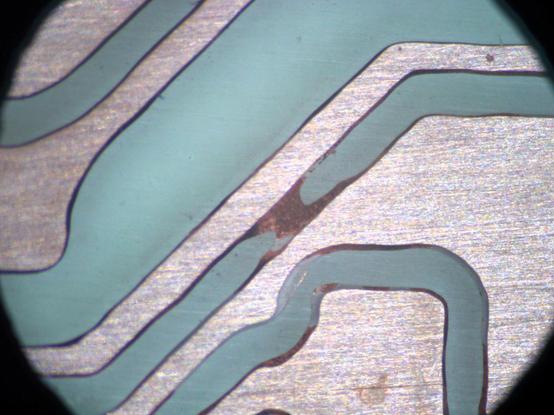
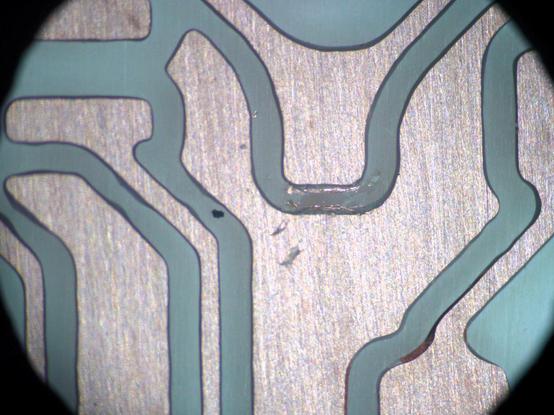
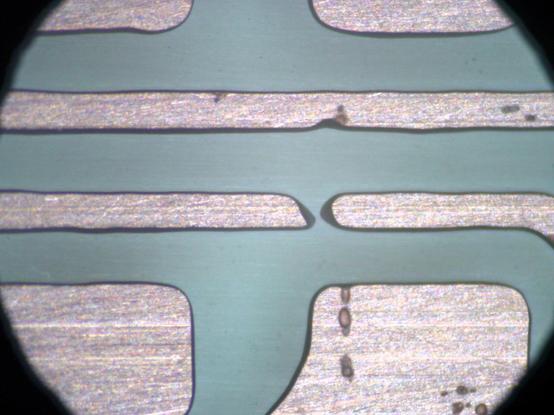
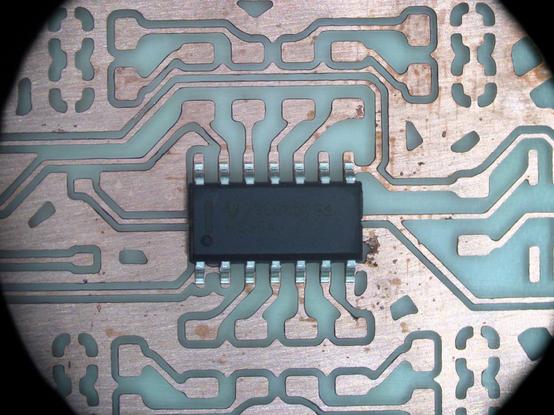
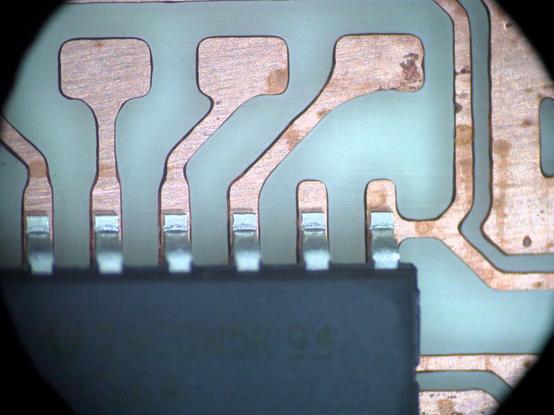
put today's tiny glass PCB and put it under the microscope to get some close up shots! it's really cool to see just how thick that 0.1mm copper is! there are still tons of flaws that become very apparently once you zoom in, some small bridges and some thin spots and breaks in in some traces. once you get up close it all looks very… organic.

#electronics #diypcb

here's some closeups of the small bridges. the very thin ones tend to be easier to see from the back. good thing glass is see through!
I'm still struggling to completely avoid these, but I think my track spacing might still be a little on the low side for this thick copper layer. maybe I also just need to etch for longer, but I'm worried about excessive under-etch…
luckily the small bridges are very easy to clean up with a scalpel.

#electronics #diypcb

there are also a bunch of other small defects, probably caused by small bubbles or other defects in the photoresist. luckily only one of them seems to have led to a broken trace which I'll have to fix later.

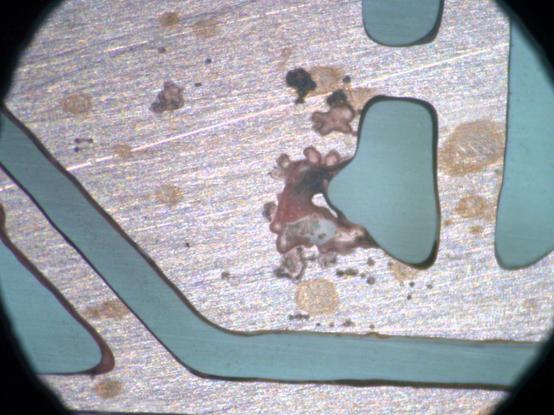
oh yeah, also, all the brown stains all over the PCB? don't just dump dry NaOH into the resist stripper bath when it's starting to run out. getting it onto the PCB will fuck up the copper surface…

#electronics #diypcb

last but not least, a test fit with one of the chips. it fits! Wheeeeee!

#electronics #diypcb

oh yeah, also, I used a different epoxy this time! Smooth on XTC-3D. It's meant to be used as a top coat for 3d prints but it's very nice and clear and it seems to stand up to the etching and everything even better than the cheap hardware store stuff I used before. It still comes out a little matte cause the brushed finish of the bottom of the copper impresses onto it so I might try giving the copper more of a polish before gluing.
@slyka You're making me think about the sanity of some kind of solder bonding the foil to the glass now...
@PatrickHerd sounds… tricky?!
@slyka So I've seen glass parts bonded to metals with solder, it's a mechanical bond effected by getting the glass up to soldering temperature and kind of "sliding" the glass onto the molten solder. So a heated press type arrangement might work - How many boards are you planning to make?
@PatrickHerd hmmm… interesting! I'd be worried about the different thermal expansion coefficients between the solder and glass. I know from experience that glass to metal joints can be pretty tricky. I assume this wouldn't just be your standard solder?
@slyka Apparently works with lead stuff, unsure about the newer ROHS solders
@slyka Just looked it up and yeah, the thermal expansion coefficients are... Different
@PatrickHerd ahh lead. how did the saying go? One half of materials science is coming up with cool new stuff, the other half is figuring our how to do it without lead.
@slyka Over here, lead solders are still easier to buy than leadfree