 Gork
GorkFart kontrol
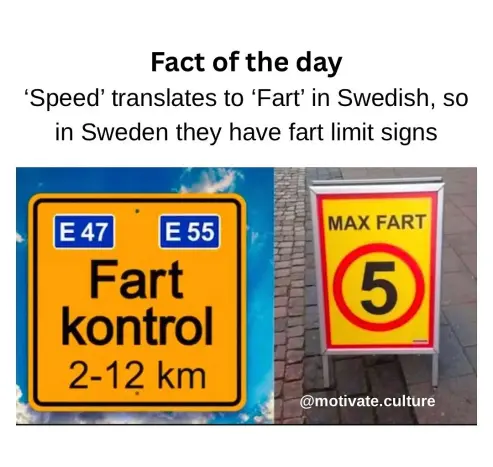
This is either Norwegian or Danish.
It’s true that ‘fart’ means speed in Swedish, but in this context ‘hastighet’ would be used (~‘hastiness’).
English has a lot of influence from both Germanic and Latin, to the point where I don’t think it’s reasonable to classify it as a strictly “Germanic” language.
There are plenty of English words that can be traced to old Norse (i.e. Norwegian Viking occupiers, raiders, and/or traders).
“fart” is colloquial swedish for speed, but the actual meaning (as used on signage) is “travel” or “fare”, like german “fahr-” words. so we have “sjöfart” (seafaring), “rymdfart” (space travel), “fartvind” (wind rushing by when moving quickly), “uppfart” (driveway) and, importantly for signs, “utfart” and “infart” (exit and entry for vehicles).
my favorite of this is a sign nearby on a narrow road that warns about multiple exits with no sight lines.
I know this is old, but it is a bit irksome that this post is titled “Fact of the day” when it can’t even keep its facts straight about which country does what.
Those signs aren’t from Sweden. Our traffic agency (who prints the signs) doesn’t use ‘fart’ meaning ‘speed’ - except for ‘gångfartsområde’, ‘walking speed area’, which disappointingly enough doesn’t even have the text on it - but mainly uses ‘hastighet’ meaning ‘velocity’. Other commenters in this thread have posted examples of ‘fart’ in a different meaning being used on Swedish traffic signs.
hastighet
As a native speaker of a language that’s unlike anything, I envy you folks so much. Knowing enough English and German you just look at it, and go ‘aaah, speediness’ (I guess the ‘hast’/‘hastig’ bit is the same as ‘haste’/‘hasty’ in English, and the ‘het’ is the same as ‘heit’ /~ness’/ in German).
You wouldn’t guess the word, reading it in context is so much easier.
English: ride to art museum
German: Fahrt zum Kunstmuseum
 MudMan
 Zachariah
 owenfromcanada
 lime!
lime!

 ByteJunk
 Diplomjodler
 AnBee
AnBee bort
bort Skullgrid
 Midnight Wolf
 matelt
 Swedneck
 This is fine🔥🐶☕🔥
 kindenough
 manigordo