 Erik H.
 Sven A. Schmidt
No, we don't. We need to talk about your trackers.
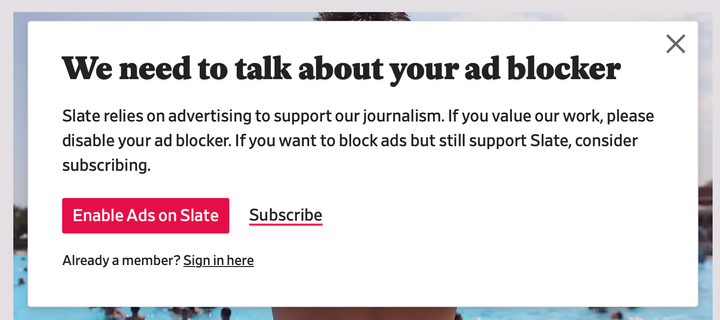
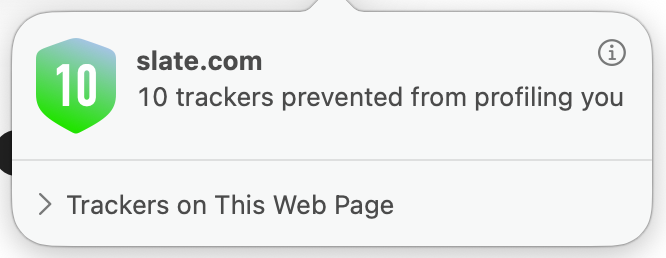
@finestructure I'm not talking to stalkers.
It's a bit like burglars complaining about your door lock....
@finestructure I share the sentiment, but I'd make the diff between "ad blocker" and "tracker blocker" though.
i.e. in practice I could be understanding of "either subscribe to support us or browse for free but with ads, bc _we can't work for free_".
But I would never tolerate "either subscribe or _enable cookies to allow us to track you_".
They can still serve you (non personalized) ads to get revenue for their work without needing to track you for it
@aligatr I didn’t mean this to sound contentious. I get your point and I think it’s important to support sites!
The thing is that these banners are always about the tracking cookies.
All they will get out of this is, permanent incognito tabs.
@finestructure The sites that use these banners tend to have the most obtrusive ads that make the site unusable anyway, so I make a point avoid them.
It's not even just the trackers. Ad networks are a security risk. I'm the IT guy for an SMB and when I started this job, I would get calls from people panicked that they had a virus. It was always some scareware popup injected through the ads on the site they were visiting. After I forced uBlock Origin on all of the PCs, those calls stopped.
@finestructure If they want to talk about ad blockers, they should start with why they were necessary.
First, popups that were hard to close, then a big block saying to allow popups, then hijacking ads, then drive by malware.
@finestructure fun fact: you can't subscribe to Slate's ad free offering with Firefox and an adblocker. Had to fire up chromium just to find out that they charge $120 per year. Oh, and of course you only find the price after the trial period in the small print, the prominently displayed price is $15.
Sigh. I like one of their podcasts but was very put off by being marketed to in this way.
Every site wants you to subscribe when all you want is *one* article, which was heavily promoted in various public media.
This is untenable for most people. Especially since you don't know in advance if the article is actually any good or just click bait.
What we need is a universal subscription service, where you can pay to get, say, 100 articles a month pulled from any of hundreds of different services.
 Alerta! Alerta!
 Olivier Halligon
 Workshopshed
 M0KHR
M0KHR Dan
Dan Dubi is here
 Kid Mania
 Seth Galitzer
 alys
alys @@
@@ Raymond
 Gilgwath
 Mieszko Ślusarczyk
 Fauve
Fauve Bert Driehuis
 Number6
 Edwin G.
 Furbland's Very Cool Mastodon™
 STrRedWolf
 SirWumpus 👾🍁