 bestelbus22
The meaning of `this`
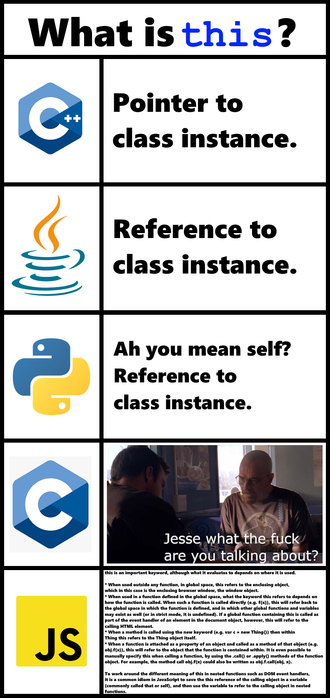
Partially unrelated to the meme, but I find it almost malicious how some python keywords are named differently from the nearly universal counterpart of other languagues.
This/self, continue/pass, except/catch and they couldn’t find a different word for switch so they just didn’t implement it.
It’s as if the original designers purposefully wanted to be different for the sake of it.
Speaking of big cumbersome things with wildly different syntax have you tried a ternary operation in python lately? Omg that thing is ugly. JavaScripts is hard to beat.
uglyTernary = True: if python_syntax == “shit” else: False prettyTernary = javascript_syntax == “pretty” ? true : false
That’s just because you’re used to it. The pythonic ternary is structured like spoken language, which makes it easier to read, especially if you nest them.
Is there an objective argument for the conventional ternary, other than „That’s how we’ve always done it!“?
I don’t read spoken language, but I do read written ones. The problem with python’s ternary is that it puts the condition in the middle, which means you have to visually parse the whole if-block just to see where the condition starts. Which makes it hard to read for anything but the most trivial examples.
The same goes for comprehensions and generators
 Scrubbles