 bestelbus22
The meaning of `this`
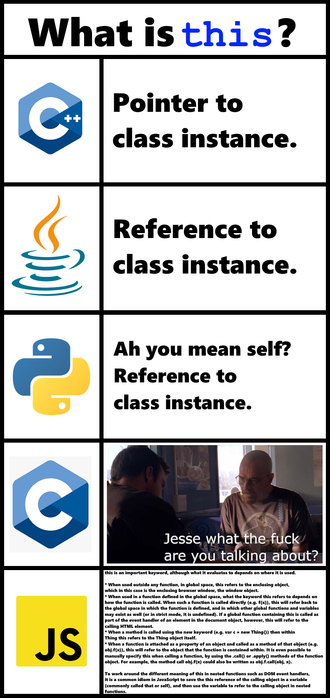
Partially unrelated to the meme, but I find it almost malicious how some python keywords are named differently from the nearly universal counterpart of other languagues.
This/self, continue/pass, except/catch and they couldn’t find a different word for switch so they just didn’t implement it.
It’s as if the original designers purposefully wanted to be different for the sake of it.
Maybe I’m missing something, but:
And switch cases (called match cases) are there as well.
I use lambdas all the time to shovel GTK signal emitions from worker threads into GLib.idle_add in a single line, works as you’d expect.
Previous commenters probably didn’t look at Python in a really long time.

Your All-in-One Learning Portal: GeeksforGeeks is a comprehensive educational platform that empowers learners across domains-spanning computer science and programming, school education, upskilling, commerce, software tools, competitive exams, and more.
Speaking of big cumbersome things with wildly different syntax have you tried a ternary operation in python lately? Omg that thing is ugly. JavaScripts is hard to beat.
uglyTernary = True: if python_syntax == “shit” else: False prettyTernary = javascript_syntax == “pretty” ? true : false
That’s just because you’re used to it. The pythonic ternary is structured like spoken language, which makes it easier to read, especially if you nest them.
Is there an objective argument for the conventional ternary, other than „That’s how we’ve always done it!“?
I don’t read spoken language, but I do read written ones. The problem with python’s ternary is that it puts the condition in the middle, which means you have to visually parse the whole if-block just to see where the condition starts. Which makes it hard to read for anything but the most trivial examples.
The same goes for comprehensions and generators
The conventional ternary is structured like a normal if-else. In fact, in many languages with functional influence, they’re the same thing.
For example, you can write this in Rust:
let vegetable = if 3 > 4 { "Potato" } else { "Tomato" };If the conventions suck you have to break them. How else can you improve things?
map and filter are almost always inferior to generators and comprehension expressions in terms of readability. If you prefer the former, it’s just because you got used to it, not because it’s better.
 Scrubbles
 lime!
lime!
 Natanox
 Jumuta