@ColinTheMathmo This was a nice nerd-snipe!
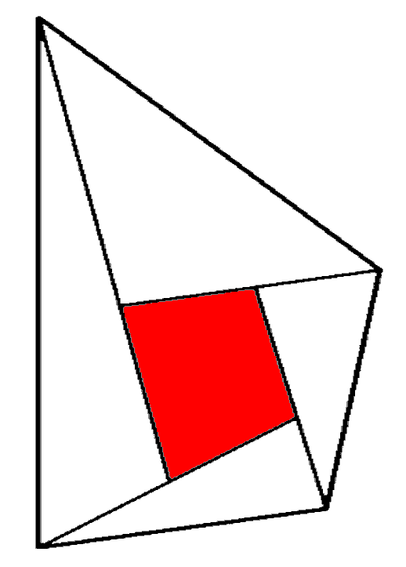
Areas behave nicely under affine transformations, and in particular the ratio of the areas of two regions is preserved, so we may as well assume that three of the vertices of the quadrilateral are at nice coordinates. I chose \((0,0)\), \((2,0)\), and \((0,2)\) (the choice of \(2\) was so that the midpoints were still integers). So then the fourth point is at, say \((a,b)\).
The quadrilateral then has area \(a + b\) (which took me by surprise when I saw it!)
Playing with this in Geogebra shows that the ratio of \(5\), to within the display precision, is surprisingly persistent. But it doesn't take much experimenting to get into the region where it is obviously false.
As a counter-example, with the fourth vertex at \((20,2)\) then I get the ratio to be \(5.33\). But even by \((100,2)\) then it only gets up to about \(5.7\).
I have formulae for the intersection points. They're okay, but not the nicest formulae I've ever seen. So in theory I could give you a formula for the area of the smaller quadrilateral - I just haven't quite got the energy to put it all together just yet! If I knew how to use a symbolic algebra system then it would be a bit easier.
 Colin the Mathmo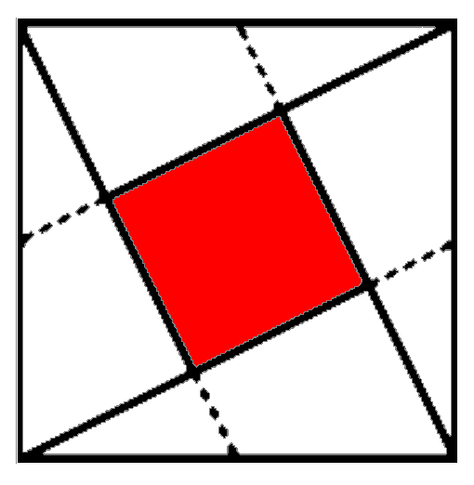
 Andrew Stacey (he/him)