So here's a nice puzzle from Donald Bell.

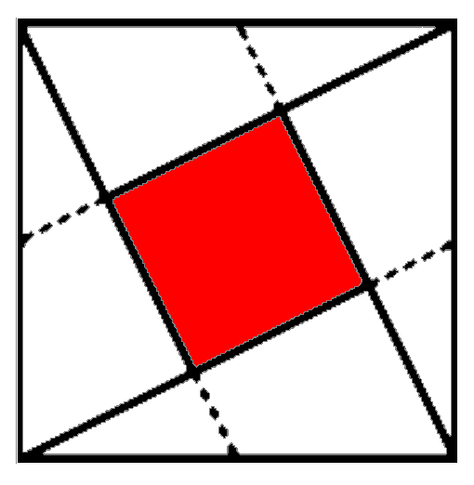
It's a lovely question to show that the shaded area in the first image here has area one fifth of the original square.

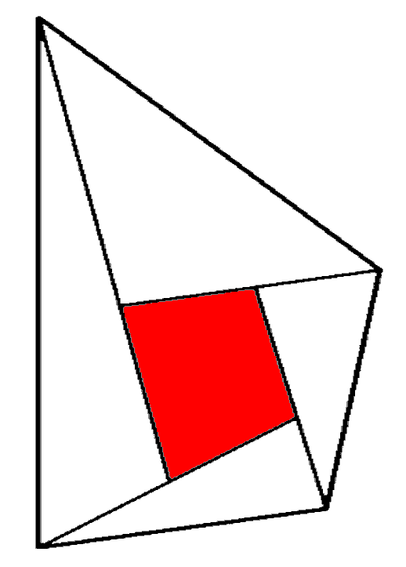
Using the same construction, joining vertices to midpoints, does the same thing hold true for a general quadrilateral?

How would you prove it? Do you have a counter-example?

#Geometry #Puzzle

@ColinTheMathmo This was a nice nerd-snipe!

Areas behave nicely under affine transformations, and in particular the ratio of the areas of two regions is preserved, so we may as well assume that three of the vertices of the quadrilateral are at nice coordinates. I chose \((0,0)\), \((2,0)\), and \((0,2)\) (the choice of \(2\) was so that the midpoints were still integers). So then the fourth point is at, say \((a,b)\).

The quadrilateral then has area \(a + b\) (which took me by surprise when I saw it!)

Playing with this in Geogebra shows that the ratio of \(5\), to within the display precision, is surprisingly persistent. But it doesn't take much experimenting to get into the region where it is obviously false.

As a counter-example, with the fourth vertex at \((20,2)\) then I get the ratio to be \(5.33\). But even by \((100,2)\) then it only gets up to about \(5.7\).

I have formulae for the intersection points. They're okay, but not the nicest formulae I've ever seen. So in theory I could give you a formula for the area of the smaller quadrilateral - I just haven't quite got the energy to put it all together just yet! If I knew how to use a symbolic algebra system then it would be a bit easier.

@ColinTheMathmo Okay, done a bit more analysis.

If I keep \(b = 2\) and let \(a\) get very large then the area of the central region tends to \(\frac{a}{6}\). Since the area of the quadrilateral is roughly \(a\) by this point, the ratio tends to \(\frac{1}{6}\).

In fact, if I keep \(b\) constant and let \(a\) get large then the ratio tends to \(\frac{1}{6}\).

Code to work out the area of the quadrilateral defined by joining each vertex to the next-but-one midpoint of an edge, where the original quadrilateral has vertices (0,0), (2,0), (a,b), and (0,2).

Code to work out the area of the quadrilateral defined by joining each vertex to the next-but-one midpoint of an edge, where the original quadrilateral has vertices (0,0), (2,0), (a,b), and (0,2). ...

Gist

@loopspace @ColinTheMathmo If I haven't screwed up and Mathematica isn't lying to me (neither of these assumptions is very safe) then for a quadrilateral with vertices (0,1), (0,0), (1,0), (x,y) ...

(choosing the handedness so that each vertex is joined to the midpoint of the next two)

the area ratio is 1/5 exactly when 1+x=2y OR 2x+y=3

the area ratio for (x, tx) with x large and k fixed approaches 1/6 + 5t/(18+78t+72𝑡²)

in particular, (1,inf) and (inf,1) both yield a ratio of 1/6 (so to speak)

in particular, "on the diagonal" it approaches 11/56, obviously a combination of 1/5 and 1/6 :-)

in particular, (2x,x) for large x yields a limit of 1/5; if you want exactly 1/5, as mentioned above (2x-1,x) will do for any x

the area ratio for (1+u,1+v) is 1/5 + >=quartic terms in u,v, so for "parallelogram-ish" values of u,v it's not surprising that the answer is close to 1/5

the quantity 1/5 - area ratio is a rational function whose numerator is a square and whose denominator is a product of linear terms that are positive when x+y>1, so the area ratio never goes above 1/5 (at least for convex quadrilaterals)

the quantity area ratio - 1/6 is a rational function whose denominator is again a product of linear terms that are positive when x+y>1; its numerator is the product of two quadratic things defining hyperbolae, which can just barely reach 0 at (0,1) and (1,0) but can't be negative in the region of convex quadrilaterals, so the area ratio never goes below 1/6 for convex quadrilaterals