TOPIC>
"Stars On A Trail"

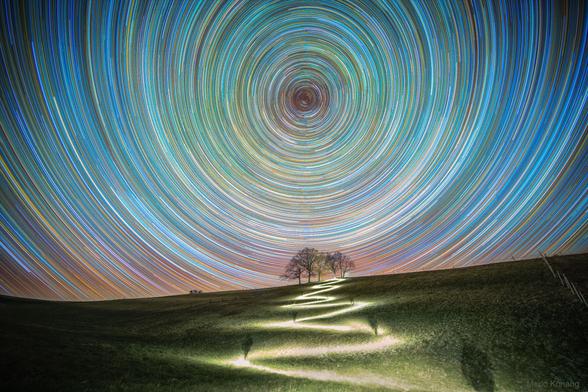
A Path North
* Image Credit & Copyright: Mario Konang

Explanation:
What happens if you keep going north? The direction north on the Earth, the place on your horizon below the northern spin pole of the Earth -- around which other stars appear to slowly swirl, will remain the same. This spin-pole-of-the-north will never move from its fixed location on the sky -- night or day -- and its height will always match your latitude. The further north you go, the higher the north spin pole will appear. Eventually, if you can reach the Earth's North Pole, the stars will circle a point directly over your head. Pictured, a four-hour long stack of images shows stars trailing in circles around this north celestial pole. The bright star near the north celestial pole is Polaris, known as the North Star. The bright path was created by the astrophotographer's headlamp as he zigzagged up a hill just over a week ago in Lower Saxony, Germany. The astrophotographer can be seen, at times, in shadow. Actually, the Earth has two spin poles -- and much the same would happen if you started below the Earth's equator and went south.

https://apod.nasa.gov/apod/ap200407.html

#space #earth #astrophotography #photography #astroart #art #science #nature #education
APOD: 2020 April 7 - A Path North

A different astronomy and space science related image is featured each day, along with a brief explanation.

Star Trails of the North and South
* Image Credit & Copyright: Saeid Parchini

Explanation:
What divides the north from the south? It all has to do with the spin of the Earth. On Earth's surface, the equator is the dividing line, but on Earth's sky, the dividing line is the Celestial Equator -- the equator's projection onto the sky. You likely can't see the Earth's equator around you, but anyone with a clear night sky can find the Celestial Equator by watching stars move. Just locate the dividing line between stars that arc north and stars that arc south. Were you on Earth's equator, the Celestial Equator would go straight up and down. In general, the angle between the Celestial Equator and the vertical is your latitude. The featured image combines 325 photos taken every 30 seconds over 162 minutes. Taken soon after sunset earlier this month, moonlight illuminates a snowy and desolate scene in northwest Iran. The bright streak behind the lone tree is the planet Venus setting.

https://apod.nasa.gov/apod/ap200212.html

#space #earth #astrophotography #photography #astroart #art #science #nature #education

APOD: 2020 February 12 - Star Trails of the North and South

A different astronomy and space science related image is featured each day, along with a brief explanation.

Sky Full of Arcs
* Image Credit & Copyright: Rory Gannaway

Explanation:
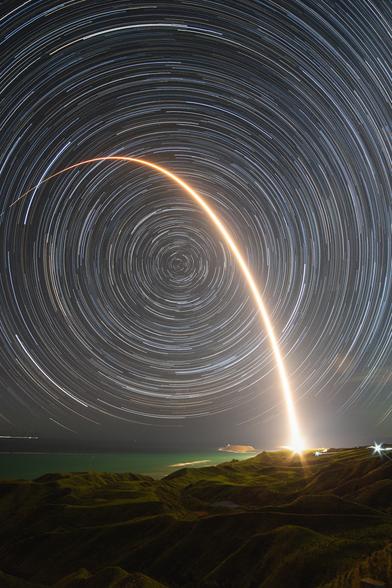
On August 11 a Rocket Lab Electron rocket launched from a rotating planet. With a small satellite on board its mission was dubbed A Sky Full of SARs (Synthetic Aperture Radar satellites), departing for low Earth orbit from Mahia Peninsula on New Zealand's north island. The fiery trace of the Electron's graceful launch arc is toward the east in this southern sea and skyscape, a composite of 50 consecutive frames taken over 2.5 hours. Fixed to a tripod, the camera was pointing directly at the South Celestial Pole, the extension of planet Earth's axis of rotation in to space. But no bright star marks that location in the southern hemisphere's night sky. Still, the South Celestial Pole is easy to spot. It lies at the center of the concentric star trail arcs that fill the skyward field of view.

https://apod.nasa.gov/apod/ap240817.html

#space #earth #astrophotography #photography #astroart #art #science #nature #education
APOD: 2024 August 17 - Sky Full of Arcs

A different astronomy and space science related image is featured each day, along with a brief explanation.

North Celestial Aurora
* Image Credit & Copyright: Chirag Upreti

Explanation:
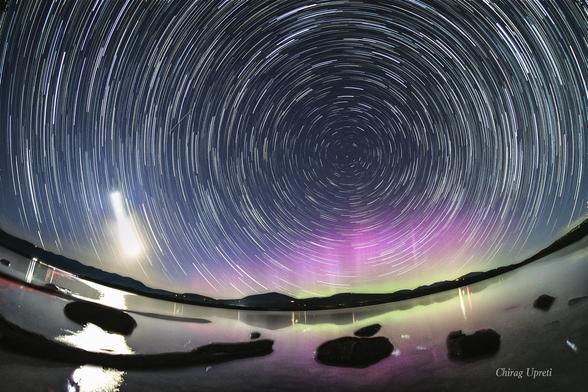
Graceful star trail arcs reflect planet Earth's daily rotation in this colorful night skyscape. To create the timelapse composite, on May 12 consecutive exposures were recorded with a camera fixed to a tripod on the shores of the Ashokan Reservoir, in the Catskills region of New York, USA. North star Polaris is near the center of the star trail arcs. The broad trail of a waxing crescent Moon is on the left, casting a strong reflection across the reservoir waters. With intense solar activity driving recent geomagnetic storms, the colorful aurora borealis or northern lights, rare to the region, shine under Polaris and the north celestial pole.

https://apod.nasa.gov/apod/ap240518.html

#space #earth #astrophotography #photography #astroart #art #science #nature #education
APOD: 2024 May 18 - North Celestial Aurora

A different astronomy and space science related image is featured each day, along with a brief explanation.

The Windmill and the Star Trails
* Image Credit & Copyright: Antonio Gonzalez

Explanation:
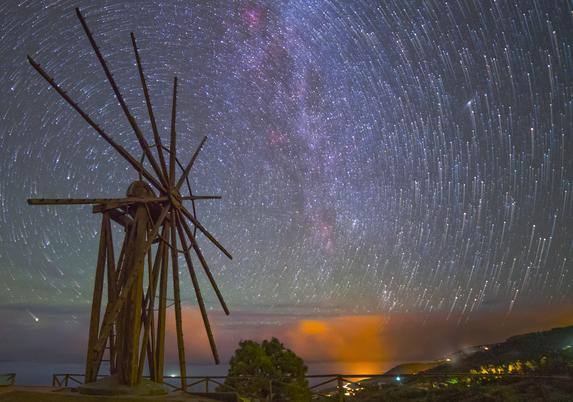
Stars can't turn these old wooden arms, but it does look like they might in this scene from a rotating planet. The well-composed night skyscape was recorded from Garafia, a municipality on the island of La Palma, Canary Islands, planet Earth. The center of the once working windmill, retired since 1953, is lined-up with the north celestial pole, the planet's rotation axis projected on to the northern sky. From a camera fixed to a tripod, the star trails are a reflection of the planet's rotation traced in a digital composite of 39 sequential exposures each 25 seconds long. Brought out by highlighting the final exposure in the sequence, the stars themselves appear at the ends of their short concentric arcs. A faint band of winter's Milky Way and even a diffuse glow from our neighboring Andromeda Galaxy also shine in the night.

https://apod.nasa.gov/apod/ap200417.html

#space #earth #astrophotography #photography #astroart #art #science #nature #education
APOD: 2020 April 17 - The Windmill and the Star Trails

A different astronomy and space science related image is featured each day, along with a brief explanation.

A Night at Poker Flat
* Image Credit: NASA / Jamie Adkins

Explanation:
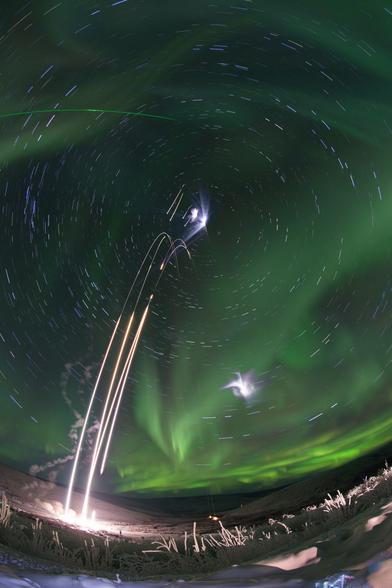
Four NASA suborbital sounding rockets leapt into the night on January 26, from the University of Alaska's Poker Flat Research Range. This time lapse composite image follows all four launches of the small, multi-stage rockets to explore winter's mesmerizing, aurora-filled skies. During the exposures, stars trailed around the North Celestial Pole, high above the horizon at the site 30 miles north of Fairbanks, Alaska. Lidar, beams of pulsed green lasers, also left traces through the scene. Operating successfully, the payloads lofted were two Mesosphere-Lower Thermosphere Turbulence Experiments (M-TeX) and two Mesospheric Inversion-layer Stratified Turbulence (MIST) experiments, creating vapor trails at high altitudes to be tracked by ground-based observations.

https://apod.nasa.gov/apod/image/1501/PFlatLaunch_compositeJan26_0.jpg

#space #earth #astrophotography #photography #astroart #art #science #nature #education
North Celestial Tree
* Image Credit & Copyright: Jerónimo Losada

Explanation:
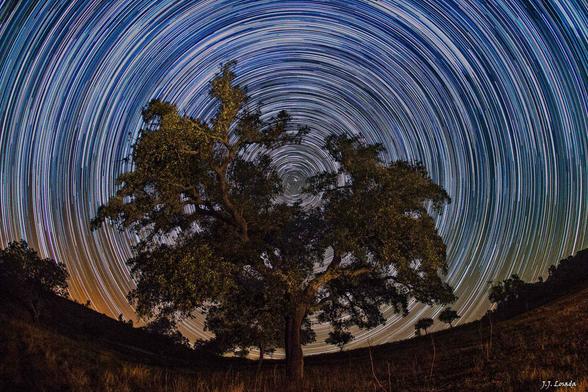
If you climbed this magnificent tree, it looks like you could reach out and touch the North Celestial Pole at the center of all the star trail arcs. The well-composed image was recorded over a period of nearly 2 hours as a series of 30 second long, consecutive exposures on the night of October 5. The exposures were made with a digital camera fixed to a tripod near Almaden de la Plata, province of Seville, in southern Spain, planet Earth. Of course, the graceful star trails reflect the Earth's daily rotation around its axis. By extension, the axis of rotation leads to the center of the concentric arcs in the night sky. Convenient for northern hemisphere night sky photographers and celestial navigators alike, the bright star Polaris is very close to the North Celestial Pole and so makes the short bright trail in the central gap between the leafy branches.

https://apod.nasa.gov/apod/ap131023.html

#space #earth #astrophotography #photography #astroart #art #science #nature #education
APOD: 2013 October 23 - North Celestial Tree

A different astronomy and space science related image is featured each day, along with a brief explanation.

Haute-Provence Star Trails
* Credit & Copyright: Alexandre Santerne / OHP-CNRS

Explanation:
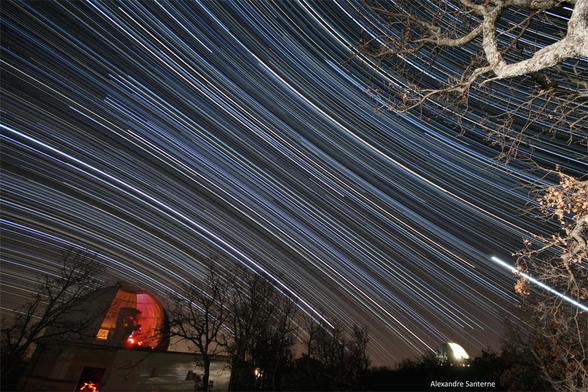
Fix your camera to a tripod and you can record the graceful trails traced by the stars as planet Earth rotates on its axis. For example, this dramatic 5 hour long exposure was made on February 24 from Haute-Provence Observatory (OHP) in southeastern France. Actually a composite of 300 consecutive 1-minute exposures, the image nicely shows stars near the celestial equator tracing nearly straight lines in projection, while stars north and south of the equator, respectively, appear to circle the north and south celestial poles. Domes at the bottom left and right house the OHP telescopes. Brilliant planet Venus makes the short bright trail at the lower right, while trails of stars in the constellation Orion end near the lower right observatory dome. Sirius, alpha star of Canis Major, traces the bright arc over the dome at the left. Astronomer Alexandre Santerne also briefly illuminated a foreground oak tree during the exposure sequence.

https://apod.nasa.gov/apod/ap090314.html

#space #earth #astrophotography #photography #astroart #art #science #nature #education
APOD: 2009 March 14 - Haute-Provence Star Trails

A different astronomy and space science related image is featured each day, along with a brief explanation.

Star Trails at Dawn
* Credit & Copyright: Koen van Gorp

Explanation:
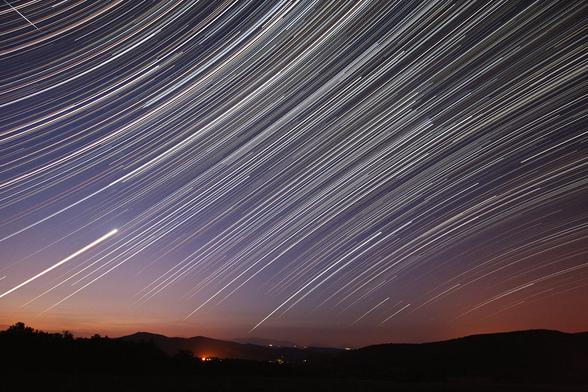
Just fix your camera to a tripod and you too can make an image of graceful trails traced by the stars as planet Earth rotates on its axis. Made on September 14 from Montlaux, France, this wide-angle view nicely shows the stars near the celestial equator tracing nearly straight lines in projection, while stars north and south of the equator, respectively, appear to circle the north and south celestial poles. Featured are the stars of Orion (right of center), brilliant Venus rising (left) as bright star Sirius rises in the south (bottom center), and a polar orbiting Iridium satellite (upper left). Beautiful dawn sky colors seem painted along the horizon. This remarkable picture was constructed from 477 consecutive 30 second digital exposures recorded over 4.3 hours and later combined

https://apod.nasa.gov/apod/ap071208.html

#space #earth #astrophotography #photography #astroart #art #science #nature #education
APOD: 2007 December 8 - Star Trails at Dawn

A different astronomy and space science related image is featured each day, along with a brief explanation.

Star Trails above Table Mountain
* Image Credit & Copyright: Eric Nathan

Explanation:
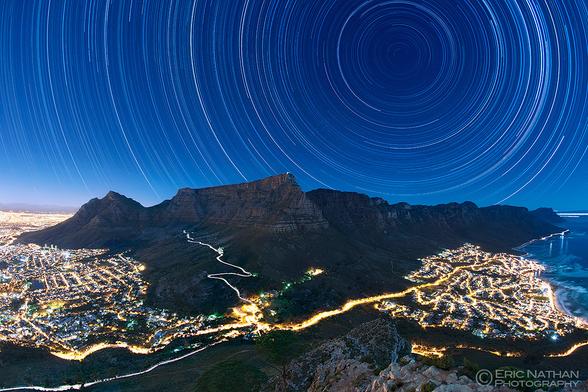
Stars trail above and urban lights sprawl below in this moonlit nightscape from Cape Town, South Africa, planet Earth. The looming form of Table Mountain almost seems to hold terrestrial lights at bay while the stars circle the planet's South Celestial Pole. This modern perspective on the natural night sky was captured in June 2014, the scene composed of over nine hundred, stacked 30 second exposures. The stunning result was chosen as the winner in the Against the Lights category, a selection from over 800 entries in The World at Night's 2015 International Earth and Sky Photo Contest.

https://apod.nasa.gov/apod/ap150625.html

#space #earth #astrophotography #photography #astroart #art #science #nature #education
APOD: 2015 June 25 - Star Trails Above Table Mountain

A different astronomy and space science related image is featured each day, along with a brief explanation.

South Pole Star Trails
* Image Credit & Copyright: Robert Schwarz (South Pole Station)

Explanation:
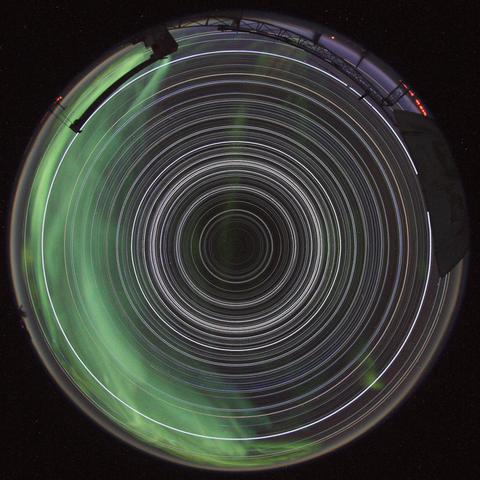
No star dips below the horizon and the Sun never climbs above it in this remarkable image of 24 hour long star trails. Showing all the trails as complete circles, such an image could be achieved only from two places on planet Earth. This example was recorded during the course of May 1, 2012, the digital camera in a heated box on the roof of MAPO, the Martin A. Pomerantz Observatory at the South Pole. Directly overhead in the faint constellation Octans is the projection of Earth's rotational axis, the South Celestial Pole, at the center of all the star trail circles. Not so well placed as Polaris and the North Celestial Pole, the star leaving the small but still relatively bright circle around the South Celestial Pole is Beta Hydri. The inverted umbrella structure on the horizon at the right of the allsky field of view is the ground shield for the SPUD telescope. A shimmering apparition of the aurora australis also visited on this 24 hour night.

https://apod.nasa.gov/apod/ap120802.html

#space #earth #astrophotography #photography #astroart #art #science #nature #education
APOD: 2012 August 2 - South Pole Star Trails

A different astronomy and space science related image is featured each day, along with a brief explanation.

Warped Sky: Star Trails Panorama
* Credit & Copyright: Peter Ward

Explanation:
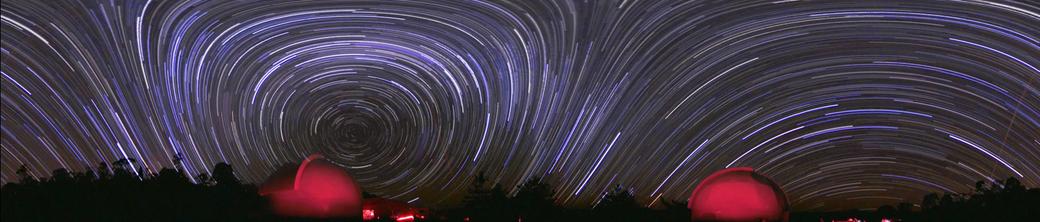
What's happened to the sky? A time warp, of sorts, and a digital space warp too. The time warp occurs because this image captured in a single frame a four hour exposure of the night sky. As a result, prominent star trails are visible. The space warp occurs because the picture is actually a full 360 degree panorama, horizontally compressed to fit your browser. As the Earth rotated, stars appeared to circle both the South Celestial Pole, on the left, and the North Celestial Pole, just below the horizon on the right. The image captured the sky over Mudgee, New South Wales, Australia, including the domes of two large telescopes illuminated by red lighting. A horizontally unwarped image is visible by clicking on the image.

https://apod.nasa.gov/apod/ap100711.html

#space #earth #astrophotography #photography #astroart #art #science #nature #education
APOD: 2010 July 11 - Warped Sky: Star Trails Panorama

A different astronomy and space science related image is featured each day, along with a brief explanation.

Annapurna Star Trails
* Credit & Copyright: Wang Jinglei, Jia Hao

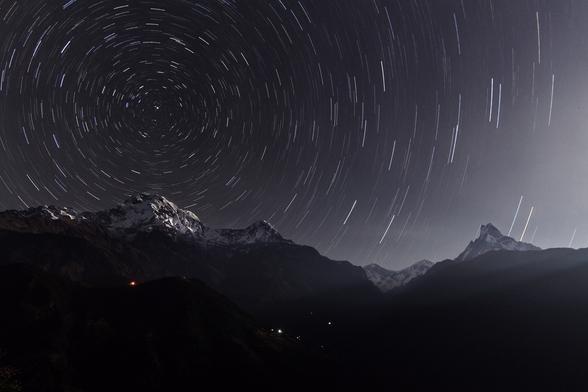
Explanation: In myth, Atlas holds up the heavens. But in this moonlit mountainscape, peaks of the Himalayan Annapurna Range appear to prop up the sky as seen from Ghandruk, Nepal. From left to right the three main peaks are Annapurna South (7,219 meters), Hiunchuli (6,441 meters), and Machapuchare (6,995 meters). Of course the mountains are moving not the stars, the Earth's rotation about its axis causing the concentric star trails recorded in the time exposure. Positioned above Annapurna South, the North Celestial Pole is easily identified as the point at the center of all the star trail arcs. The star Polaris, also known as the North Star, made the very short and bright arc closest to the North Celestial Pole.

https://apod.nasa.gov/apod/ap091128.html

#space #earth #astrophotography #photography #astroart #art #science #nature #education
APOD: 2009 November 28 - Annapurna Star Trails

A different astronomy and space science related image is featured each day, along with a brief explanation.

11 Hour Star Trails
* Credit & Copyright: Josch Hambsch

Explanation:
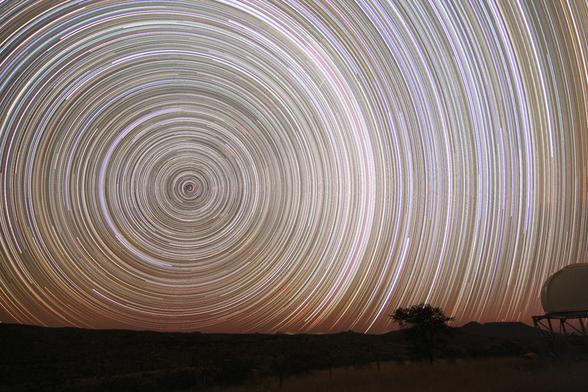
Fix your camera to a tripod, lock the shutter open, and you can make an image of star trails - graceful concentric arcs traced by the stars as planet Earth rotates on its axis. Of course, the length of the star trails will depend on the exposure time. While exposures lasting just five minutes produce a significant arc, in about 12 hours a given star would trace out half a circle. But in any long exposure, the background glow from light-polluted skies can build up to wash out the trails. Still, astronomer Josch Hambsch produced this stunning composite of star trails around the South Celestial Pole with an effective "all night" exposure time of almost 11 hours. To do it, he combined 128 consecutive five minute long digital exposures recorded in very dark night skies above Namibia. In his final image, the background glow on the right is due in part to the faint, arcing Milky Way.

https://apod.nasa.gov/apod/ap060915.html

#space #earth #astrophotography #photography #astroart #art #science #nature #education
APOD: 2006 September 15 - 11 Hour Star Trails

A different astronomy and space science related image is featured each day, along with a brief explanation.

Cosmos in Reflection
* Image Credit & Copyright: Jeff Dai (TWAN)
https://twanight.org/profile/jeff-dai/

Explanation:
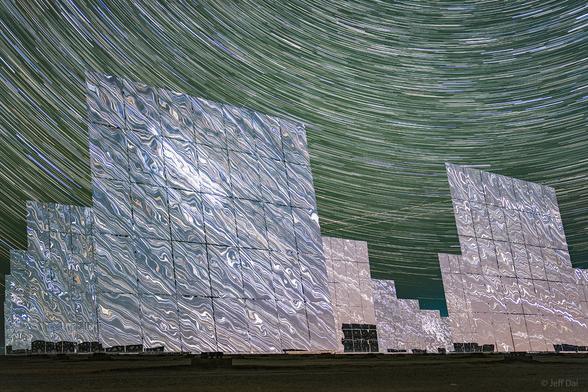
During the day, over 12,000 large mirrors reflect sunlight at the 100-megawatt, molten-salt, solar thermal power plant at the western edge of the Gobi desert near Dunhuang, Gansu Province, China. Individual mirror panels turn to track the sun like sunflowers. They conspire to act as a single super mirror reflecting the sunlight toward a fixed position, the power station's central tower. During the night the mirrors stand motionless though. They reflect the light of the countless distant stars, clusters and nebulae of the Milky Way and beyond. This sci-fi night skyscape was created with a camera fixed to a tripod near the edge of the giant mirror matrix on September 15. The camera's combined sequence of digital exposures captures concentric arcs of celestial star trails through the night with star trails in surreal mirrored reflection.

https://apod.nasa.gov/apod/ap230922.html

#space #earth #astrophotography #photography #astroart #art #science #nature #education
TWAN | Jeff Dai

Dedicated nightscape photographer who spends most of his imaging nights in Tibet.

TWAN

Stars Trail over Ragusa
* Image Credit & Copyright: Gianni Tumino

Explanation:
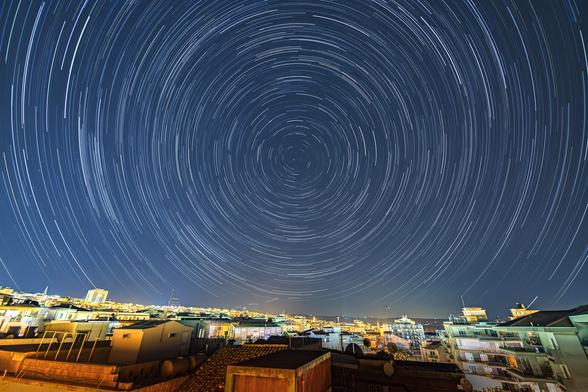
In trying times, stars still trail in the night. Taken on March 14, this night skyscape was made by combining 230 exposures each 15 seconds long to follow the stars' circular paths. The camera was fixed to a tripod on an isolated terrace near the center of Ragusa, Italy, on the island of Sicily. But the night sky was shared around the rotating planet. A friend to celestial navigators and astrophotographers alike Polaris, the north star, makes the short bright trail near the center of the concentric celestial arcs.

https://apod.nasa.gov/apod/ap200328.html

#space #earth #astrophotography #photography #astroart #art #science #nature

APOD: 2020 March 28 - Stars Trail over Ragusa

A different astronomy and space science related image is featured each day, along with a brief explanation.

South Celestial Rocket Launch
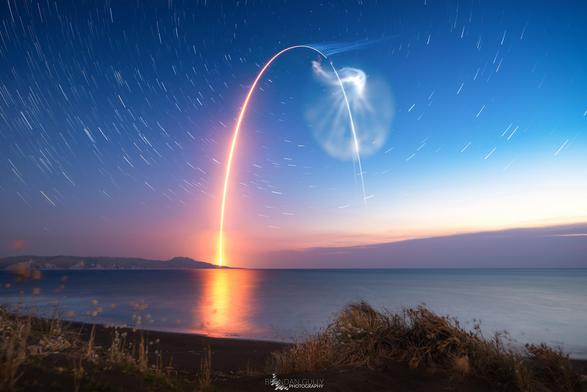
* Image Credit & Copyright: Brendan Gully

Explanation:
At sunset on December 6 a Rocket Lab Electron rocket was launched from a rotating planet. With multiple small satellites on board it departed on a mission to low Earth orbit dubbed Running Out of Fingers from Mahia Peninsula on New Zealand's north island. The fiery trace of the Electron's graceful launch arc is toward the south in this southern sea and skyscape. Drifting vapor trails and rocket exhaust plumes catch the sunlight even as the sky grows dark though, the setting Sun still shinning at altitude along the rocket's trajectory. Fixed to a tripod, the camera's perspective nearly aligns the peak of the rocket arc with the South Celestial Pole, but no bright star marks that location in the southern hemisphere's evening sky. Still, it's easy to find at the center of the star trail arcs in the timelapse composite.

https://apod.nasa.gov/apod/ap200228.html

#space #earth #astrophotography #photography #astroart #art #science #nature

APOD: 2020 February 28 - South Celestial Rocket Launch

A different astronomy and space science related image is featured each day, along with a brief explanation.

Lines of Time
* Image Credit & Copyright: Anton Komlev

Explanation:
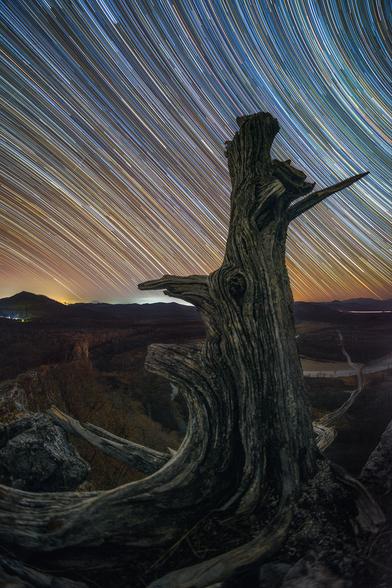
In time stars trace lines through the night sky on a rotating planet. Taken over two hours or more, these digitally added consecutive exposures were made with a camera and wide angle lens fixed to a tripod near Orel farm, Primorsky Krai, Russia, planet Earth. The stars trail in concentric arcs around the planet's south celestial pole below the scene's horizon, and north celestial pole off the frame at the upper right. Combined, the many short exposures also bring out the pretty star colours. Bluish trails are from stars hotter than Earth's Sun, while yellowish trails are from cooler stars. A long time ago this tree blossomed, but now reveals the passage of time in the wrinkled and weathered lines of its remains.

https://apod.nasa.gov/apod/ap191207.html

#space #earth #astrophotography #photography #astroart #art #science #nature

APOD: 2019 December 7 - Lines of Time

A different astronomy and space science related image is featured each day, along with a brief explanation.

Star Trails for a Red Planet
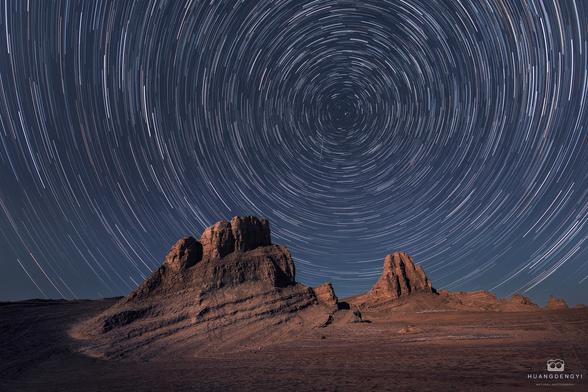
* Image Credit & Copyright: Dengyi Huang

Explanation:
Does Mars have a north star? In long exposures of Earth's night sky, star trails make concentric arcs around the north celestial pole, the direction of our fair planet's axis of rotation. Bright star Polaris is presently the Earth's North Star, close on the sky to Earth's north celestial pole. But long exposures on Mars show star trails too, concentric arcs about a celestial pole determined by Mars' axis of rotation. Tilted like planet Earth's, the martian axis of rotation points in a different direction in space though. It points to a place on the sky between stars in Cygnus and Cepheus with no bright star comparable to Earth's north star Polaris nearby. So even though this ruddy, weathered landscape is remarkably reminiscent of terrain in images from the martian surface, the view must be from planet Earth, with north star Polaris near the center of concentric star trails. The landforms in the foreground are found in Qinghai Province in northwestern China.

https://apod.nasa.gov/apod/ap191130.html

#space #earth #mars #astrophotography #photography #astroart #art #science #nature

APOD: 2019 November 30 - Star Trails for a Red Planet

A different astronomy and space science related image is featured each day, along with a brief explanation.

Star Trails and the Equinox Sunrise
* Image Credit & Copyright: Juan Carlos Casado (TWAN, Earth and Stars)
Acknowledgement: Andrea Rodriguez Anton

Explanation:
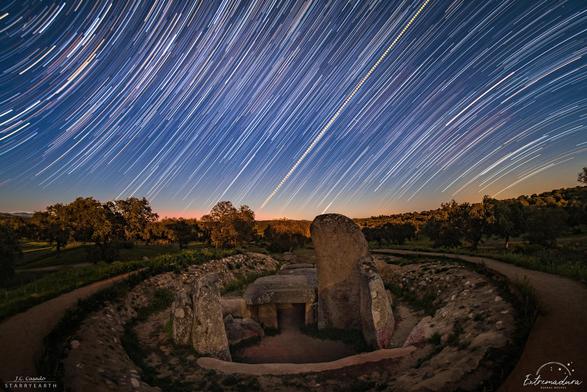
Stars trail and the Sun rises in this night and day composite panorama made on March 19. The view looks toward the eastern horizon from La Nava de Santiago, Spain. To create it, a continuous series of digital frames was recorded for about two hours and combined to trace the concentric motion of the stars through the night sky. A reflection of the Earth's rotation, star trails curve around the north celestial pole toward upper left and the south celestial pole toward the lower right. Of course on that day the Sun was near the celestial equator, a diagonal straight line in the wide-angle projection. A dense dimming filter was used to capture the Sun's image every two minutes. Superimposed on the star trails it rose due east in the morning sky. In the scene, foreground landscape and a local prehistoric monument were illuminated by full moonlight, though. The monument's corridor faces nearly to the east and the equinox sunrise.

https://apod.nasa.gov/apod/ap190321.html

#space #earth #astrophotography #photography #astroart #art #science #nature #education

APOD: 2019 March 21 - Star Trails and the Equinox Sunrise

A different astronomy and space science related image is featured each day, along with a brief explanation.

Circumpolar Star Trails
Image Credit & Copyright: Gabriel Funes

Explanation:
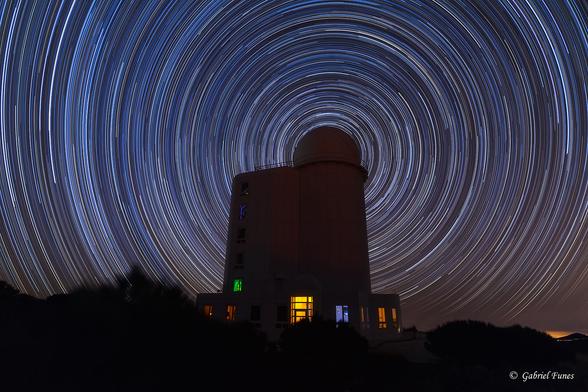
As Earth spins on its axis, the stars appear to rotate around an observatory in this well-composed image from the Canary Island of Tenerife. Of course, the colorful concentric arcs traced out by the stars are really centered on the planet's North Celestial Pole. Convenient for northern hemisphere astro-imagers and celestial navigators alike, bright star Polaris is near the pole and positioned in this scene to be behind the telescope dome. Made with a camera fixed to a tripod, the series of over 200 stacked digital exposures spanned about 4 hours. The observatory was not operating on that clear, dark night, but that's not surprising. The dome houses the Teide Observatory's large THEMIS Solar Telescope.

https://apod.nasa.gov/apod/ap190118.html

#space #earth #astrophotography #photography #astroart #art #science #nature

APOD: 2019 January 18 - Circumpolar Star Trails

A different astronomy and space science related image is featured each day, along with a brief explanation.

Mount Everest Star Trails
* Image Credit & Copyright: Jeff Dai (TWAN)

Explanation:
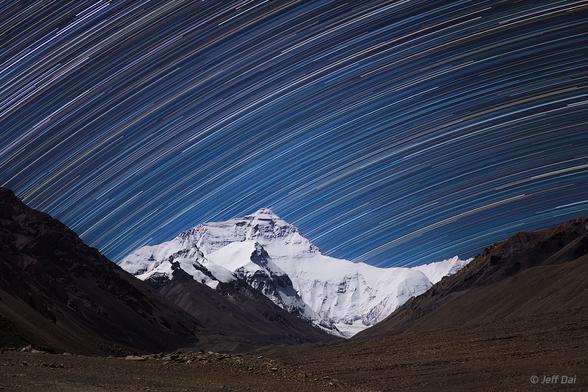
The highest peak on planet Earth is framed in this mountain and night skyscape. On September 30, the digital stack of 240 sequential exposures made with a camera fixed to a tripod at an Everest Base Camp captured the sheer north face of the Himalayan mountain and foreground illuminated by bright moonlight. Taken over 1.5 hours, the sequence also recorded colorful star trails. Reflecting the planet's daily rotation on its axis, their motion is along gentle concentric arcs centered on the south celestial pole, a point well below the rugged horizon. The color of the trails actually indicates the temperatures of the stars. Blueish hues are from hotter stars, and yellow to reddish hues are from stars cooler than the Sun.

https://apod.nasa.gov/apod/ap181201.html

#space #earth #astrophotography #photography #astroart #art #science #nature

APOD: 2018 December 1 - Mount Everest Star Trails

A different astronomy and space science related image is featured each day, along with a brief explanation.

Little Planet Lookout
* Image Credit & Copyright: Gyorgy Soponyai

Explanation:
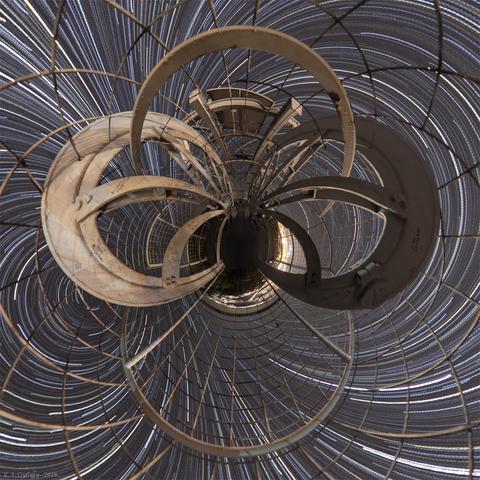
Don't panic. This little planet projection looks confusing, but it's actually just a digitally warped and stitched, nadir centered mosaic of images that covers nearly 360x180 degrees. The images were taken on the night of October 31 from a 30 meter tall hill-top lookout tower near Tatabanya, Hungary, planet Earth. The laticed lookout tower construction was converted from a local mine elevator. Since planet Earth is rotating, the 126 frames of 75 second long exposures also show warped, concentric star trails with the north celestial pole at the left. Of course at this location the south celestial pole is just right of center but below the the little planet's horizon. the little planet's horizon.

https://apod.nasa.gov/apod/ap181109.html

#space #earth #astrophotography #photography #astroart #art #science #nature

APOD: 2018 November 9 - Little Planet Lookout

A different astronomy and space science related image is featured each day, along with a brief explanation.

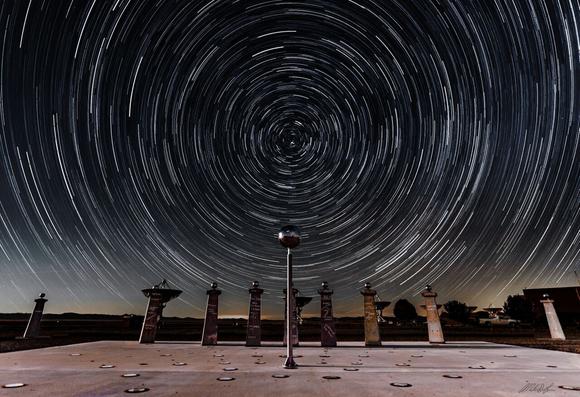
Star Trails and the Bracewell Radio Sundial
* Image Credit & Copyright: Miles Lucas at NRAO

Explanation:
Sundials use the location of a shadow to measure the Earth's rotation and indicate the time of day. So it's fitting that this sundial, at the Very Large Array Radio Telescope Observatory in New Mexico, commemorates the history of radio astronomy and radio astronomy pioneer Ronald Bracewell. The radio sundial was constructed using pieces of a solar mapping radio telescope array that Bracewell orginaly built near the Stanford University campus. Bracewell's array was used to contribute data to plan the first Moon landing, its pillars signed by visiting scientists and radio astronomers, including two Nobel prize winners. As for most sundials the shadow cast by the central gnomon follows markers that show the solar time of day, along with solstices and equinoxes. But markers on the radio sundial are also laid out according to local sidereal time. They show the position of the invisible radio shadows of three bright radio sources in Earth's sky, supernova remnant Cassiopeia A, active galaxy Cygnus A, and active galaxy Centaurus A. Sidereal time is just star time, the Earth's rotation as measured with the stars and distant galaxies. That rotation is reflected in this composited hour-long exposure. Above the Bracewell Radio Sundial, the stars trace concentric trails around the north celestial pole.

https://apod.nasa.gov/apod/ap180713.html

#space #earth #astrophotography #photography #astroart #art #science #nature

APOD: 2018 July 13 - Star Trails and the Bracewell Radio Sundial

A different astronomy and space science related image is featured each day, along with a brief explanation.

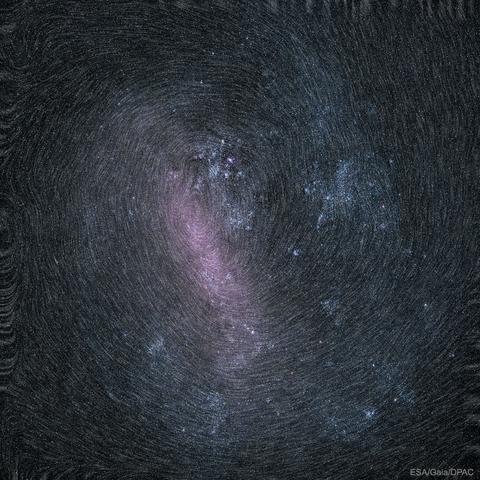
Rotation of the Large Magellanic Cloud
* Image Credit & Licence: ESA, Gaia, DPAC

Explanation:
This image is not blurry. It shows in clear detail that the largest satellite galaxy to our Milky Way, the Large Cloud of Magellan (LMC), rotates. First determined with Hubble, the rotation of the LMC is presented here with fine data from the Sun-orbiting Gaia satellite. Gaia measures the positions of stars so accurately that subsequent measurements can reveal slight proper motions of stars not previously detectable. The featured image shows, effectively, exaggerated star trails for millions of faint LMC stars. Inspection of the image also shows the center of the clockwise rotation: near the top of the LMC's central bar. The LMC, prominent in southern skies, is a small spiral galaxy that has been distorted by encounters with the greater Milky Way Galaxy and the lesser Small Magellanic Cloud (SMC).

#space #earth #astrophotography #photography #astroart #art #science #nature

https://apod.nasa.gov/apod/ap180516.html

APOD: 2018 May 16 - Rotation of the Large Magellanic Cloud

A different astronomy and space science related image is featured each day, along with a brief explanation.

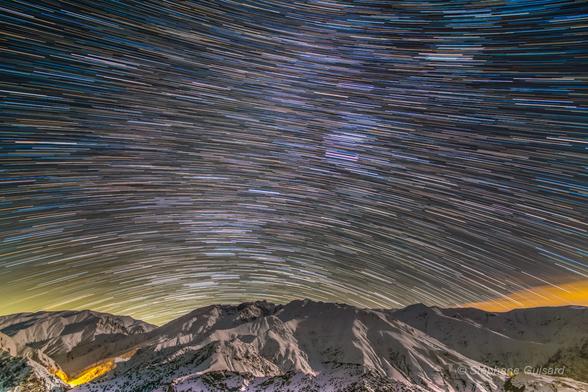
Alborz Mountain Star Trails
* Image Credit & Copyright: Stéphane Guisard (Los Cielos de America, TWAN)

Explanation:
Colourful star trails arc through the night in this wide-angle mountain and skyscape. From a rotating planet, the digitally added consecutive exposures were made with a camera fixed to a tripod and looking south, over northern Iran's Alborz Mountain range. The stars trace concentric arcs around the planet's south celestial pole, below the scene's rugged horizon. Combined, the many short exposures also bring out the pretty star colours. Bluish trails are from stars hotter than our Sun, while yellowish trails are from cooler stars. Near the center, the remarkably pinkish trail was traced by the star-forming Orion Nebula.

https://apod.nasa.gov/apod/ap180302.html

#space #earth #astrophotography #photography #astroart #art #science #nature

APOD: 2018 March 2 - Alborz Mountain Star Trails

A different astronomy and space science related image is featured each day, along with a brief explanation.

Bow Tie Moon and Star Trails
* Image Credit & Copyright: Haitong Yu

Explanation:
On January 31, a leisurely lunar eclipse was enjoyed from all over the night side of planet Earth, the first of three consecutive total eclipses of the Moon. This dramatic time-lapse image followed the celestial performance for over three hours in a combined series of exposures from Hebei Province in Northern China. Fixed to a tripod, the camera records the Full Moon sliding through a clear night sky. Too bright just before and after the eclipse, the Moon's bow tie-shaped trail grows narrow and red during the darker total eclipse phase that lasted an hour and 16 minutes. In the distant background are the colorful trails of stars in concentric arcs above and below the celestial equator.

https://apod.nasa.gov/apod/ap180208.html

#space #earth #astrophotography #photography #astroart #art #science #nature

APOD: 2018 February 8 - Bow Tie Moon and Star Trails

A different astronomy and space science related image is featured each day, along with a brief explanation.

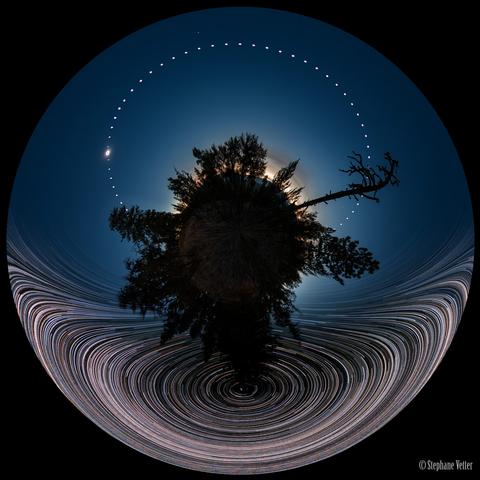
Panoramic Eclipse Composite with Star Trails
Image Credit & Copyright: Stephane Vetter (Nuits sacrees, TWAN)

Explanation:
What was happening in the sky during last week's total solar eclipse? This featured little-planet, all-sky, double time-lapse, digitally-fused composite captured celestial action during both night and day from a single location. In this 360x180 panorama, north and south are at the image bottom and top, while east and west are at the left and right edges, respectively. During four hours the night before the eclipse, star trails were captured circling the north celestial pole (bottom) as the Earth spun. During the day of the total eclipse, the Sun was captured every fifteen minutes from sunrise to sunset (top), sometimes in partial eclipse. All of these images were then digitally merged onto a single image taken exactly during the total solar eclipse. Then, the Sun's bright corona could be seen flaring around the dark new Moon (upper left), while Venus simultaneously became easily visible (top). The tree in the middle, below the camera, is a Douglas fir. The images were taken with care and planning at Magone Lake in Oregon, USA.

https://apod.nasa.gov/apod/ap170830.html

#space #earth #astrophotography #photography #astroart #art #science #nature

APOD: 2017 August 30 - Panoramic Eclipse Composite with Star Trails

A different astronomy and space science related image is featured each day, along with a brief explanation.

Cerro Tololo Trails
* Image Credit & Copyright: Babak Tafreshi (TWAN), AURA

Explanation:
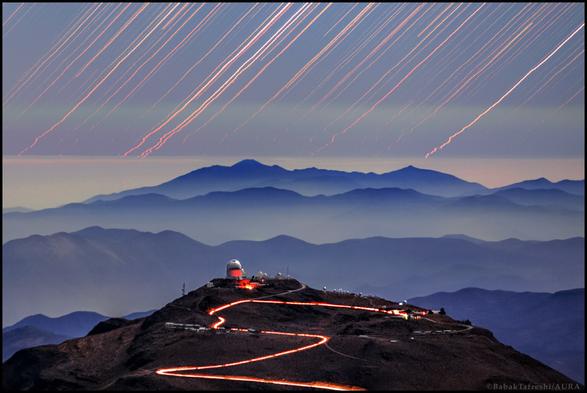
Early one moonlit evening car lights left a wandering trail along the road to the Chilean Cerro Tololo Inter-American Observatory. Setting stars left the wandering trails in the sky. The serene view toward the mountainous horizon was captured in a telephoto timelapse image and video taken from nearby Cerro Pachon, home to Gemini South. Afforded by the mountaintop vantage point, the clear, long sight-line passes through layers of atmosphere. The changing atmospheric refraction shifts and distorts the otherwise steady apparent paths of the stars as they set. That effect also causes the distorted appearance of Sun and Moon as they rise or set near a distant horizon.

https://apod.nasa.gov/apod/ap161022.html

#space #earth #astrophotography #photography #astroart #art #science #nature

APOD: 2016 October 22 - Cerro Tololo Trails

A different astronomy and space science related image is featured each day, along with a brief explanation.

Gemini Observatory North
* Image Credit & Copyright: Joy Pollard (Gemini Observatory)

Explanation:
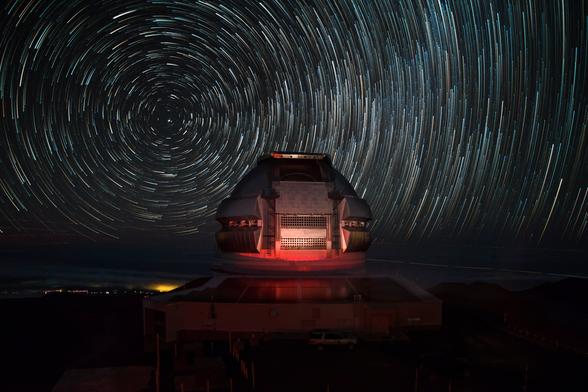
It does look like a flying saucer, but this technologically advanced structure is not here to deliver the wise extraterrestrial from the scifi classic movie The Day the Earth Stood Still. It is here to advance our knowledge of the Universe though. Shown sitting near the top of a mountain in Hawaii, the dome of the Gemini Observatory North houses one of two identical 8.1-meter diameter telescopes. Used with its southern hemisphere twin observatory in Chile, the two can access the entire sky from planet Earth. Constructed from 85 exposures lasting 30 seconds each with camera fixed to a tripod, the image also clearly demonstrates that the Earth did not stand still. Adjusted to be brighter at the ends of their arcs, the concentric star trails centered on the North Celestial Pole are a reflection of Earth's rotation around its axis. Close to the horizon at Hawaiian latitudes, Polaris, the North Star, makes the shortest star trail. The fainter denser forest of star trails toward the right is part of the rising Milky Way.

https://apod.nasa.gov/apod/ap161015.html

#space #earth #astrophotography #photography #astroart #art #science #nature

APOD: 2016 October 15 - Gemini Observatory North

A different astronomy and space science related image is featured each day, along with a brief explanation.

Little Planet Astro Camp
* Image Credit & Copyright: György Soponyai

Explanation:
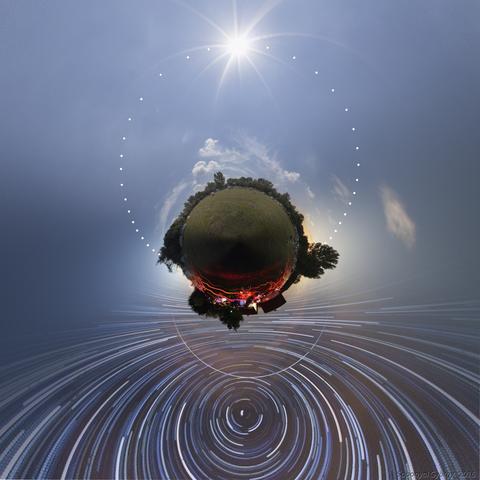
Day and night on this little planet look a lot like day and night on planet Earth. In fact, the images used to construct the little planet projection, a digitally warped and stitched mosaic covering 360x180 degrees, were taken during day and night near Tarján, Hungary, planet Earth. They span a successful 33-hour-long photo experiment at July's Hungarian Astronomical Association Astro Camp. The time-series composite follows the solar disk in 20 minute intervals from sunrise to sunset and over six hours of star trails in the northern night sky centered on the North Celestial Pole near bright star Polaris. The orbiting International Space Station traced the offset arc across the northern night. Below the little planet's nightside horizon, red light lamps of fellow astro-campers left the night-long, dancing trails.

https://apod.nasa.gov/apod/ap160902.html

#space #earth #astrophotography #photography #astroart #art #science #nature

APOD: 2016 September 2 - Little Planet Astro Camp

A different astronomy and space science related image is featured each day, along with a brief explanation.

Ghosts and Star Trails
* Image Credit & Copyright: Chris Kotsiopoulos (GreekSky)

Explanation:
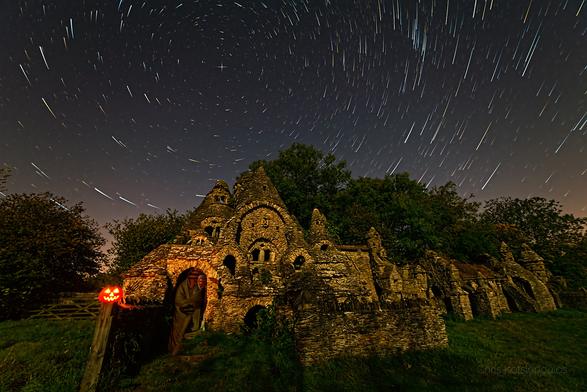
Don't be scared. Stars won't fall from the sky and ghosts won't really haunt your neighborhood tonight. But it looks like they might be doing just that in this eerie picture of an eccentric old abandoned house in moonlight. A treat for the eye the image is a trick of stacked multiple exposures, 60 frames exposed for 25 seconds each. While the digital frames were recorded with a camera fixed to a tripod, stars traced concentric arcs about the north celestial pole. But that's only a reflection of planet Earth's rotation on its axis. Conveniently marked by bright star Polaris, the pole could be positioned above the peaks of the deserted dwelling. Wrapped in a blanket to stay warm, the photographer's own movements during the exposures were blended into the ghostly apparitions. Of course, the grinning Jack-o-Lantern is there to wish you a safe and Happy Halloween!

https://apod.nasa.gov/apod/ap151031.html

#space #earth #astrophotography #photography #astroart #art #science #nature

APOD: 2015 October 31 - Ghosts and Star Trails

A different astronomy and space science related image is featured each day, along with a brief explanation.

Auroras and Star Trails over Iceland
* Image Credit & Copyright: Vincent Brady

Explanation:
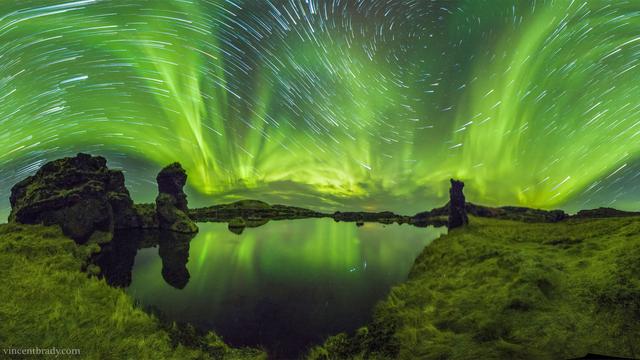
It was one of the quietest nights of aurora in weeks. Even so, in northern- Iceland during last November, faint auroras lit up the sky every clear night. The featured 360-degree panorama is the digital fusion of four wide-angle cameras each simultaneously taking 101 shots over 42 minutes. In the foreground is serene Lake Myvatn dotted with picturesque rock formations left over from ancient lava flows. Low green auroras sweep across the sky above showing impressive complexity near the horizon. Stars far in the distance appear to show unusual trails -- as the Earth turned -- because early exposures were artificially faded.

https://apod.nasa.gov/apod/ap150518.html

#space #earth #astrophotography #photography #astroart #art #science #nature

APOD: 2015 May 18 - Auroras and Star Trails over Iceland

A different astronomy and space science related image is featured each day, along with a brief explanation.

When Vega is North
* Image Credit & Copyright: Miguel Claro | Dark Sky Alqueva

Explanation:
In only about 12,000 years Vega will be the North Star, the closest bright star to our fair planet's North Celestial Pole. By then, when you fix your camera to a tripod long exposures of the night sky will show the concentric arcs of star trails centered on a point near Vega as Earth rotates on its axis. Of course, presently the bright star conveniently near the North Celestial Pole is Polaris, but that will change as the Earth's axis of rotation precesses, like the wobble of a spinning top with a precession period of about 26,000 years. If your camera is ready now and you don't want to wait 12,000 years for Vega to be the North Star, consider this ingenious demonstration of contemporary star trails (left) versus star trails reminiscent of the year 14000 CE. Both were recorded this April at the Alqueva Dark Sky Reserve in Alentejo, Portugal. To produce the more Vega-centric star trails of the distant future, astronomer Miguel Claro combined the rotation of two startracking camera mounts to create the apparent shift in the North Celestial Pole. (Addendum: Thanks to APOD readers who note that when Vega is the North Star it will also appear near the same position that Polaris is now relative to the landscape.)

https://apod.nasa.gov/apod/ap150508.html

#space #earth #astrophotography #photography #astroart #art #science #nature

APOD: 2015 May 8 - When Vega is North

A different astronomy and space science related image is featured each day, along with a brief explanation.

Star Trails Over Indonesia
*Image Credit & Licence: HuiChieh (my dark sky)

Explanation:
Both land and sky were restless. The unsettled land included erupting Mount Semeru in the distance, the caldera of steaming Mount Bromo on the left, flowing fog, and the lights of moving cars along roads that thread between hills and volcanoes in Bromo Tengger Semeru National Park in East Java, Indonesia. The stirring sky included stars circling the South Celestial Pole and a meteor streaking across the image right. The above 270-image composite was taken from King Kong Hill in mid-June over two hours, with a rising Moon lighting the landscape.

https://apod.nasa.gov/apod/ap140818.html

#space #earth #astrophotography #photography #astroart #art #science #nature

APOD: 2014 August 18 - Star Trails Over Indonesia

A different astronomy and space science related image is featured each day, along with a brief explanation.

A Luminous Night
* Image Credit & Copyright: Phil Hart

Explanation:
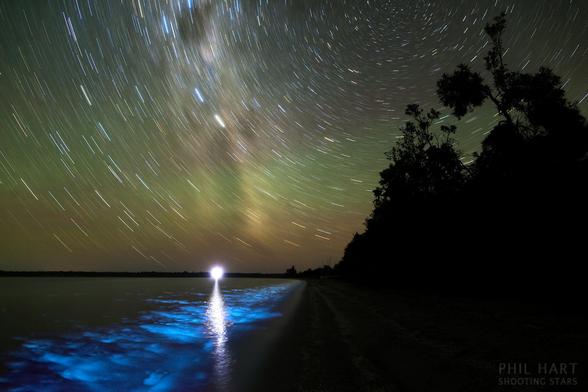
What shines in the world at night? Just visible to the eye, a rare electric blue glow spread along the shores of Victoria Lake on January 16, 2013. Against reflections of a light near the horizon, this digitally stacked long exposure recorded the bioluminescence of Noctiluca scintillans, plankton stimulated by the lapping waves. Above, the night skies of the Gippsland Lakes region, Victoria, Australia shine with a fainter greenish airglow. Oxygen atoms in the upper atmosphere, initially excited by ultraviolet sunlight, produce the more widely seen fading atmospheric chemiluminescence. Washed out by the Earth's rotation, the faint band of the southern summer Milky Way stretches from the horizon as star trails circle the South Celestial Pole.

https://apod.nasa.gov/apod/ap140809.html

#space #earth #astrophotography #photography #astroart #art #science #education

APOD: 2014 August 9 - A Luminous Night

A different astronomy and space science related image is featured each day, along with a brief explanation.

Rio at Night
* Image Credit & Copyright: Babak Tafreshi (TWAN)

Explanation:
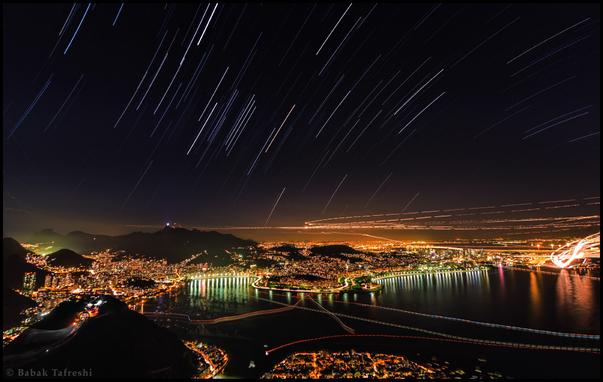
In this night skyscape setting stars trail above the western horizon over Rio de Janeiro, Brazil, a venue for the 2014 World Cup. Gentle arcs from the bright, colorful stars of Orion are near the center of the frame, while the starfield itself straddles planet Earth's celestial equator during the long exposure. Of course, trails from more local lights seem to create the strident paths through the scene. Air traffic smears an intense glow over an airport at the far right, while helicopters fly above the city and boats cruise near the coast. Striping the waterfront are tantalizing reflections of bright lights along Rio's central beaches, Botafogo and Flamengo. Near the horizon, the brightest fixed light is the famous Cristo statue overlooking Rio at night.

https://apod.nasa.gov/apod/ap140620.html

#space #earth #astrophotography #photography #astroart #art #science #nature

APOD: 2014 June 20 - Rio at Night

A different astronomy and space science related image is featured each day, along with a brief explanation.

Star Trails over El Capitan
* Image Credit & Copyright: Michael Bolte (UCSC)

Explanation:
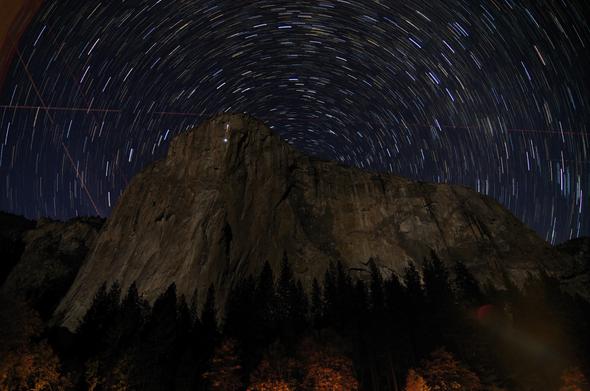
Towering 3,000 feet from base to summit, the famous granite face of El Capitan in Earth's Yosemite National Park just hides the planet's north celestial pole in this skyscape. Of course, the north celestial pole is at the center of all the star trails. Their short arcs reflecting the planet's daily rotation on its axis are traced in a digital stack of 36 sequential exposures. Linear trails of passing airplane navigation lights and a flare from car lights along the road below are also captured in the sequential stack. But the punctuated trail of light seen against the sheer El Capitan itself follows a climbing team on the night of November 8, 2013. The team is ascending toward the summit along The Nose, a historic rock climbing route.

https://apod.nasa.gov/apod/ap140321.html

#space #earth #astrophotography #photography #astroart #art #science #nature

APOD: 2014 March 21 - Star Trails over El Capitan

A different astronomy and space science related image is featured each day, along with a brief explanation.

Warped Sky: Star Trails over Arches National Park
* Image Credit & Copyright: Vincent Brady

Explanation:
What's happened to the sky? A time warp, of sorts, and a digital space warp too. The time warp occurs because this image captured in a single frame a two and a half hour exposure of the night sky. As a result, prominent star trails are visible. The space warp occurs because the picture is actually a full 360 degree panorama, horizontally compressed to fit your browser. As the Earth rotated, stars appeared to circle both the North Celestial Pole, on the left, and the South Celestial Pole, just below the horizon on the right. The above panorama over Arches National Park in Utah, USA, was captured two weeks ago during early morning hours. While the eye-catching texture of ancient layered sandstone covers the image foreground, twenty-meter tall Delicate Arch is visible on the far right, and the distant arch of our Milky Way Galaxy is visible near the image center.

https://apod.nasa.gov/apod/ap140317.html

#space #earth #astrophotography #photography #astroart #art #science #nature

APOD: 2014 March 17 - Warped Sky: Star Trails over Arches National Park

A different astronomy and space science related image is featured each day, along with a brief explanation.

Rocket Streak and Star Trails
* Image Credit & Copyright: Mike Killian / AmericaSpace

Explanation:
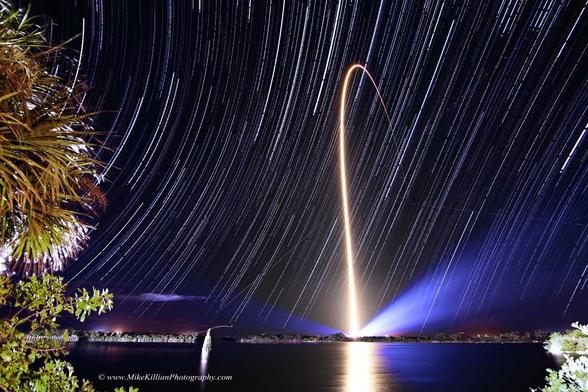
Fixed to a tripod and looking east across the Kennedy Space Center's Turn Basin, a camera captured these star trails as a series of short exposures over a three hour period on the evening of January 23rd. Positioned just a few miles from Space Launch Complex 41 at Cape Canaveral Air Force Station, it also captured a spectacular night launch of an Atlas V rocket carrying NASA's Tracking and Data Relay Satellite TDRS-L. Creating the trails, the apparent motion of the stars through the sky is just a reflection of the daily rotation of planet Earth on its axis. But that rotation is also the reason the rocket streak follows a path arcing east across the Atlantic. Launching toward the east, in the direction of Earth's rotation, adds the rotation velocity to the rocket and reduces the fuel needed to reach orbit. A little ironically, TDRS-L is destined for a geostationary orbit. From there, 36,000 kilometers or so above the equator, its orbital period will match Earth's rotation and the satellite will hang motionless in planet Earth's sky.

https://apod.nasa.gov/apod/ap140130.html

#space #earth #astrophotography #photography #astroart #science #nature

APOD: 2014 January 30 - Rocket Streak and Star Trails

A different astronomy and space science related image is featured each day, along with a brief explanation.

Grand Canyon Star Trails
* Image Credit & Copyright: Babak Tafreshi (TWAN)

Explanation:
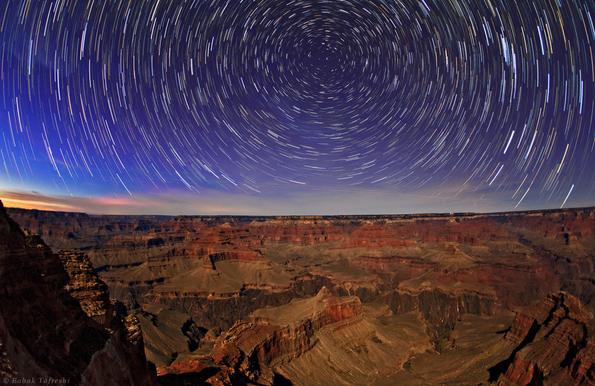
One of the natural wonders of planet Earth, the Grand Canyon in the American southwest stretches across this early evening skyscape. The digitally stacked sequence reveals the canyon's layers of sedimentary rock in bright moonlight. Exposed sedimentary rock layers range in age from about 200 million to 2 billion years old, a window to history on a geological timescale. A recent study has found evidence that the canyon itself may have been carved by erosion as much as 70 million years ago. With the camera fixed to a tripod while Earth rotates, each star above carves a graceful arc through the night sky. The concentric arcs are centered on the north celestial pole, the extension of Earth's rotation axis into space, presently near the bright star Polaris.

https://apod.nasa.gov/apod/ap130303.html

#space #earth #astrophotography #photography #astroart #art #science #nature

APOD: 2013 March 3 - Grand Canyon Star Trails

A different astronomy and space science related image is featured each day, along with a brief explanation.

Teimareh Petroglyphs and Star Trails
* Image Credit & Copyright: Babak Tafreshi (TWAN)

Explanation:
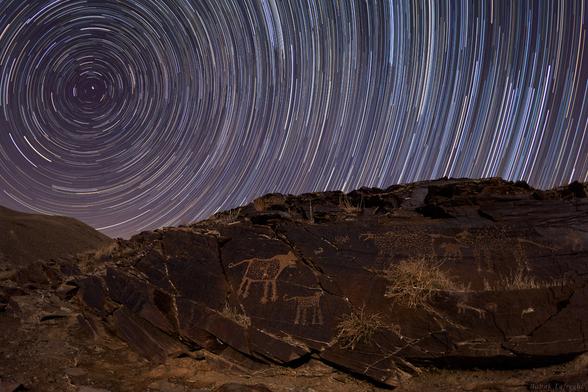
Engraved in rock, these ancient petroglyphs are abundant in the Teimareh valley, located in the Zagros Mountains of central Iran. They likely tell a tale of hunters and animals found in the middle eastern valley 6,000 years ago or more, etched by artists in a prehistoric age. In the night sky above are star trails etched by the rotation of planet Earth during the long composite exposure made with a modern digital camera. On the left, the center of the star trail arcs is the North Celestial Pole (NCP), the extension of Earth's axis into space. Polaris, the North Star, leaves the bright, short, stubby trail closest to the NCP. But when these petroglyphs were carved, Polaris would have made a long arc through the night. Since the Earth's rotation axis precesses like a wobbling top, 6,000 years ago the NCP was near the border of the constellations Draco and Ursa Major, some 30 degrees from its current location in planet Earth's sky.
https://apod.nasa.gov/apod/ap120712.html

#space #earth #astrophotography #photography #astroart #art #science #nature

APOD: 2012 July 12 - Teimareh Petroglyphs and Star Trails

A different astronomy and space science related image is featured each day, along with a brief explanation.

La Silla Star Trails North and South
* Image Credit & Copyright: Alexandre Santerne (Laboratoire d'Astrophysique de Marseille / Observatoire de Haute Provence)

Explanation:
If the tripod is set up at ESO's La Silla Observatory, high in the Atacama desert of Chile, your star trails would look something like this. Spanning about 4 hours on the night of January 24, the image is actually a composite of 250 consecutive 1-minute exposures, looking toward the north. The North Celestial Pole, at the center of the star trail arcs, is just below the horizon in this southern hemisphere perspective. In the foreground, the polished 15-meter diameter dish antenna of the Swedish-ESO Submillimeter Telescope (now decommissioned) shows star trails toward the south by reflection. Sweeping around the South Celestial Pole, the distorted arcs of those stars appear underneath the southern horizon in the focusing dish's inverted view. Right of the dish is the dome of the observatory's 3.6 meter telescope, home to the planet hunting HARPS spectrograph.

https://apod.nasa.gov/apod/ap120202.html

#space #earth #astrophotography #photography #astroart #art #science #nature

APOD: 2012 February 2 - La Silla Star Trails North and South

A different astronomy and space science related image is featured each day, along with a brief explanation.

MAGIC Star Trails
* Image Credit & Copyright: Babak Tafreshi (TWAN)

Explanation:
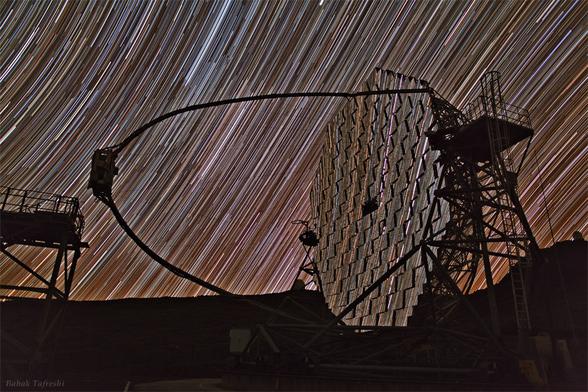
Colorful star trails arc across the night in this surreal timelapse skyscape from the Roque de los Muchachos Observatory on the Canary island of La Palma. A reflection of the Earth's daily rotation on its axis, the star trails are also reflected in one of a pair of 17 meter diameter, multi-mirrored MAGIC telescopes. The MAGIC (Major Atmospheric Gamma Imaging Cherenkov) telescope itself is intended to detect gamma rays - photons with over 100 billion times the energy of visible light. As the high energy gamma rays impact the upper atmosphere they produce air showers of high-energy particles. A fast camera monitoring the multi-mirrored surface records in detail brief flashes of optical light, called Cherenkov light, created by the air shower particles. Astronomers can then ultimately relate the optical flashes to cosmic sources of extreme gamma-rays.

https://apod.nasa.gov/apod/ap111014.html

#space #earth #astrophotography #photography #astroart #science #nature

APOD: 2011 October 14 - MAGIC Star Trails

A different astronomy and space science related image is featured each day, along with a brief explanation.

A Summer Night's Dream
* Image Credit & Copyright: Mike Rosinski

Explanation:
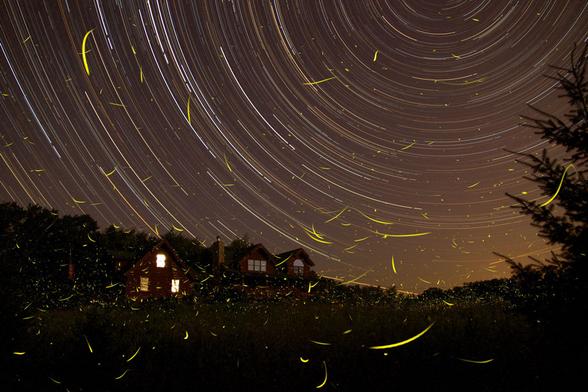
Fix your digital camera to a tripod, start a long series of exposures, and you too can record star trails. The concentric arcs traced by the stars as planet Earth rotates on its axis often produce dreamlike scenes in otherwise familiar situations. Fall asleep, though, and the results might surprise you. Setting up on a summer night, photographer Mike Rosinski began his exposures, initially planning to capture about 45-55 minutes worth of star trails from his yard in Hartland, Michigan, USA. But he dozed, only to awaken some 3 hours later to find his camera had continued to run until the battery died. Composing the resulting images, the graceful concentric star trails were expected, along with light from a late rising Moon glinting on windows. Still, as he slept on the warm night a blizzard of yellow streaks flooded the scene, not left by fairies but fireflies.

https://apod.nasa.gov/apod/ap110805.html

#space #earth #astrophotography #photography #astroart #science #nature

APOD: 2011 August 5 - A Summer Night's Dream

A different astronomy and space science related image is featured each day, along with a brief explanation.

Lewin's Challenge: 360 Degree Star Trails
* Image Credit & Copyright: Peter Wienerroither (U. Wien)

Explanation:
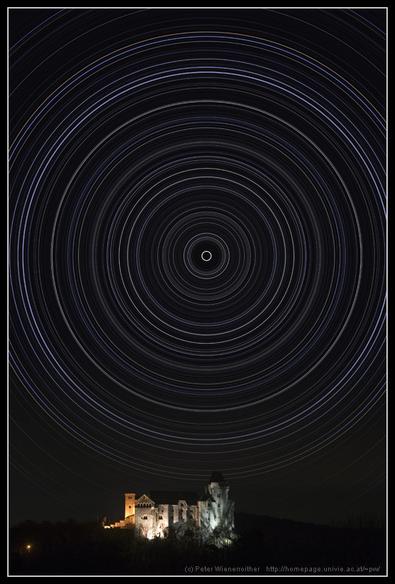
You could be the first person ever to take a real single-exposure image like this. The above image from Vienna, Austria is not real in the sense that the 360 degree star trails in the sky appear only because of a digital trick. Real star trails observed above Vienna could never go 360 degrees around because the Sun would rise at some time during the exposure and dominate the frame. Star trails of any length occur because as the Earth spins on its axis, the sky seems to rotate around us. This motion, called diurnal motion, produces the beautiful concentric arcs traced by stars during long time exposures. Towards the middle of the above digitally stretched picture is the North Celestial Pole (NCP), easily identified as the point in the sky at the center of all the star trail arcs. The star Polaris, commonly known as the North Star, made the very short bright circle near the NCP. Walter Lewin, though, has asked APOD to pose this as a challenge to astrophotographers: create a real single-exposure image of a clear night sky that features 360 degree star trails. Of course, such an image would only be possible near the poles of our fair planet, because only there could a nighttime run for more than 24 hours.

https://apod.nasa.gov/apod/ap110717.html

#space #earth #astrophotography #photography #astroart #science #nature

APOD: 2011 July 17 - Lewin's Challenge: 360 Degree Star Trails

A different astronomy and space science related image is featured each day, along with a brief explanation.

Scintillating
* Image Credit & Copyright: Juergen Michelberger

Explanation:
On June 4, 2010 Regulus, alpha star of the constellation Leo, and wandering planet Mars were at about the same apparent brightness, separated on the sky by 1.5 degrees. An ingenious and creative 10 second exposure from a swinging camera recorded these gyrating trails of the celestial pairing. Can you tell which trail belongs to the star and which to the planet? Hint: atmospheric turbulence causes the image of the star to scintillate or vary in brightness and color more readily than the planet. The scintillation is more pronounced because the star is effectively a point source of light seen as a narrow bundle of light rays. Rapidly changing refraction due to turbulence along the line of sight affects different colors of light by different amounts and generally produces a twinkling effect for stars. But Mars is much closer than the distant stars and an extended source of light. Though tiny, its disk is seen as a bundle of light rays that is substantially broader compared to a star's and so, on average, less affected by small scale turbulence. The result is the varied, rainbow like trail for Regulus (left) and the steadier, consistently reddish trail for Mars.
https://apod.nasa.gov/apod/ap110428.html

#space #earth #astrophotography #photography #astroart #science #nature

APOD: 2011 April 28 - Scintillating

A different astronomy and space science related image is featured each day, along with a brief explanation.

Night and Day above Almost Planet Sounio
* Credit & Copyright: Chris Kotsiopoulos (GreekSky)

Explanation:
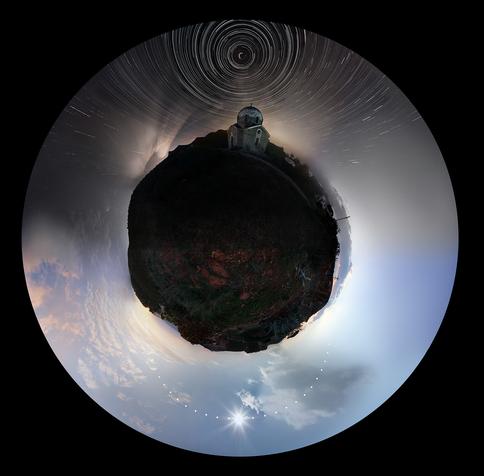
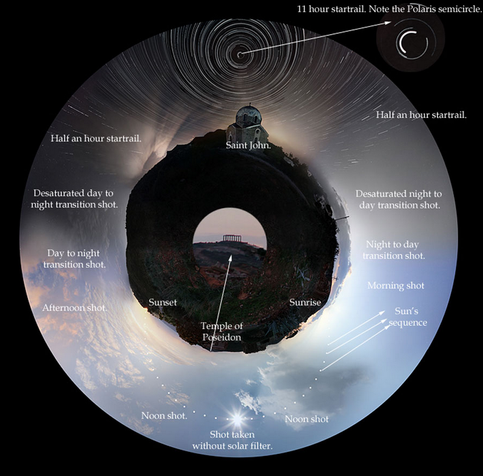
Has a new planet been discovered? What is pictured above is a remarkable 24 hour mosaic surrounding a spot on Sounio, Greece, right here on planet Earth. Images taken at night compose the top half of the picture, with star trails lasting as long as 11 hours visible. Contrastingly, images taken during the day compose the bottom of the image, with the Sun being captured once every 15 minutes. The image center shows a Little Prince wide angle projection centered on the ground but including gravel, grass, trees, Saint John's church, clouds, crepuscular rays, and even a signature icon of the photographer -- the Temple of Poseidon. Meticulous planning as well as several transition shots and expert digital processing eventually culminated in this image documenting half of the final two days of last year.

https://apod.nasa.gov/apod/ap110117.html

#space #earth #astrophotography #photography #astroart #art #science #nature

APOD: 2011 January 17 - Night and Day above Almost Planet Sounio

A different astronomy and space science related image is featured each day, along with a brief explanation.

Quadrantids over Qumis
* Image Credit & Copyright: Babak Tafreshi (TWAN)

Explanation:
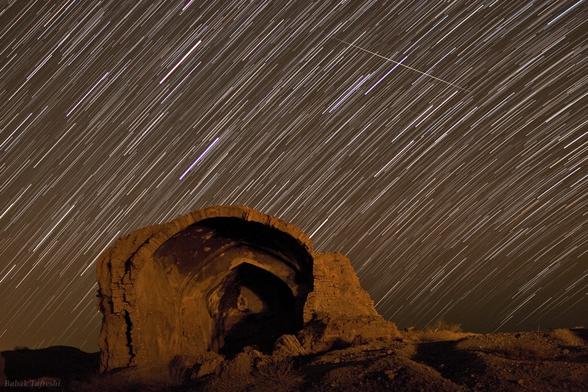
The Quadrantid Meteor Shower is an annual event for planet Earth's northern hemisphere skygazers. It usually peaks briefly in the cold, early morning hours of January 4. The shower is named for its radiant point on the sky within the old, astronomically obsolete constellation Quadrans Muralis. That position is situated near the boundaries of the modern constellations Hercules, Bootes, and Draco. In this haunting time exposure, two quadrantid meteor streaks are captured crossing trails left by rising stars of the constellations Virgo and Corvus, but Saturn leaves the brightest "star" trail. The meteor streaks, one bright and one faint, are nearly parallel above and right of center in the frame. Fittingly, the old cistern structure in the foreground lies above the now buried city of Qumis. Known as a city of many gates, Qumis (in Greek history Hecatompylos), was founded 2300 years ago in ancient Persia.

https://apod.nasa.gov/apod/ap110114.html

#space #earth #astrophotography #photography #science #nature

APOD: 2011 January 14 - Quadrantids over Qumis

A different astronomy and space science related image is featured each day, along with a brief explanation.

Star Trails in the North
* Image Credit & Copyright: P-M Hedén (Clear Skies, TWAN)

Explanation:
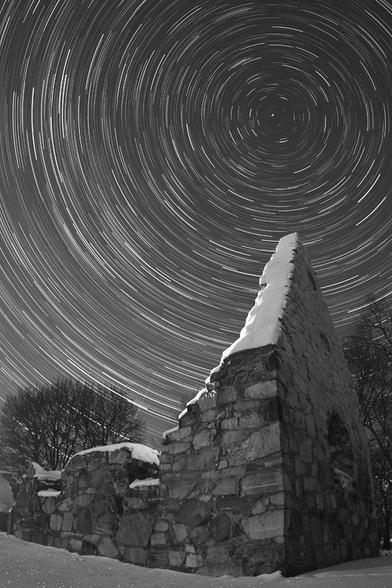
Pointing skyward, the wall of this ruined Viking church still stands after a thousand winters, near the town of Vallentuna, Sweden. The time exposure records the scene on December 14th as stars leave graceful arcing trails during a long night, reflecting planet Earth's daily rotation on its axis. The Earth's axis points toward Polaris, the North Star, near the center of the concentric trails. Welcomed by skygazers on this winter's night, a bright meteor from the annual Geminid meteor shower also flashes through the frame. The meteor cuts across the star trails just above the lower church wall. Contributing to the beautiful composition, meteor streak and church apex both gesture toward the North Celestial Pole.

https://apod.nasa.gov/apod/ap101224.html

#space #earth #astrophotography #photography #astroart #art #science #nature

APOD: 2010 December 24 - Star Trails in the North

A different astronomy and space science related image is featured each day, along with a brief explanation.

Star Trails and the Captain's Ghost
* Credit & Copyright: Chris Kotsiopoulos (GreekSky)

Explanation:
Look closely at this surreal nightscape. In the dreamlike scene, star trails arc over an old ship run aground on a beach near Gytheio, Peloponnesus in southern Greece. Could that be the captain's ghost haunting the beach, gazing forlornly at the decaying wreck, hovering over starlight reflected in still water? Actually, the ephemeral shape is the photographer. Instead of a single long exposure to record the motion of the stars as the Earth rotates on its axis, the picture is composed of 90 consecutive images, each exposure 90 seconds long. Digitally stacking the individual exposures then reconstructs the star trails. It also creates a ghostly, semi-transparent figure of the photographer who was captured standing on the beach in only one of the exposures.

https://apod.nasa.gov/apod/ap101029.html

#space #earth #astrophotography #photography #astroart #science #nature

APOD: 2010 October 29 - Star Trails and the Captain's Ghost

A different astronomy and space science related image is featured each day, along with a brief explanation.

Star Trails and Tajinastes
* Image Credit & Copyright: Daniel López

Explanation:
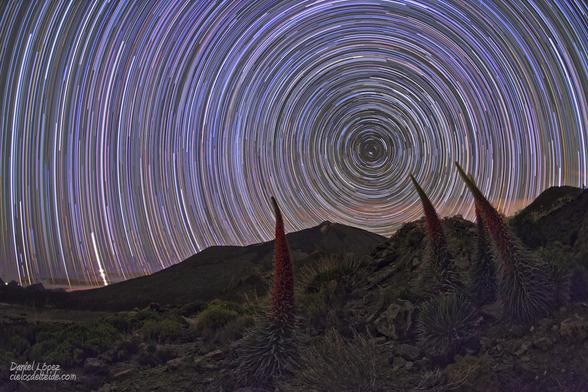
What bizarre planet do these alien creatures inhabit? It's only planet Earth, of course. In this well-composed scene, the sky is filled with star trails around the north celestial pole. A reflection of the Earth's daily rotation on its axis, star trails are familiar to photographers who fix their camera to a tripod and make long exposures of the night sky. But the imposing forms gazing skyward probably look strange to many denizens of Earth. Found on the Canary Island of Tenerife, they are red tajinastes, rare flowering plants that grow to a height of up to 3 meters. Hidden among the rocks of the volcanic terrain, tajinastes bloom in spring and early summer and then die after their seeds mature. On the distant horizon, below and left of the celestial pole, lies the Teide volcano.

https://apod.nasa.gov/apod/ap100618.html

#space #earth #astrophotography #photography #astroart #science #nature

APOD: 2010 June 18 - Star Trails and Tajinastes

A different astronomy and space science related image is featured each day, along with a brief explanation.

Illuminated Cloud Trails Above Greece
* Credit & Copyright: Chris Kotsiopoulos

Explanation:
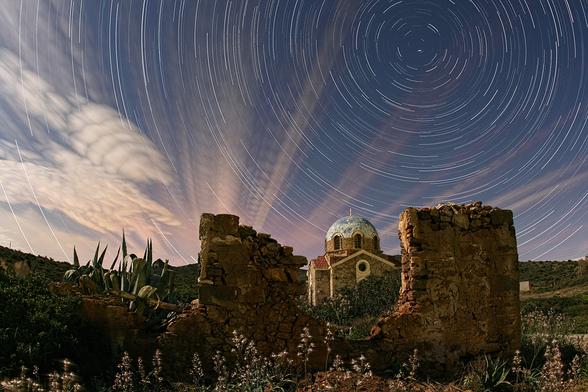
It may appear to be day, but it's night. Those wondrous orange streaks may appear to be rays from the setting Sun, but they're actually thin clouds illuminated by the Moon as they quickly streaked toward the distant horizon. The thick clouds on the far left may appear to have many layers, but actually they are just a few simple clouds captured on numerous separate exposures. What is surely true, though, is that the above time lapse image sequence was taken over two hours, about two weeks ago, in Sounio, Greece. Also, those really are star trails swirling around the north star Polaris on the upper right of the image. But what about the building in the foreground? It may appear to be a famous ancient structure, but it's actually a small deserted church built only last century.

https://apod.nasa.gov/apod/ap100315.html

#space #earth #astrophotography #photography #astroart #science #nature

APOD: 2010 March 15 - Illuminated Cloud Trails Above Greece

A different astronomy and space science related image is featured each day, along with a brief explanation.

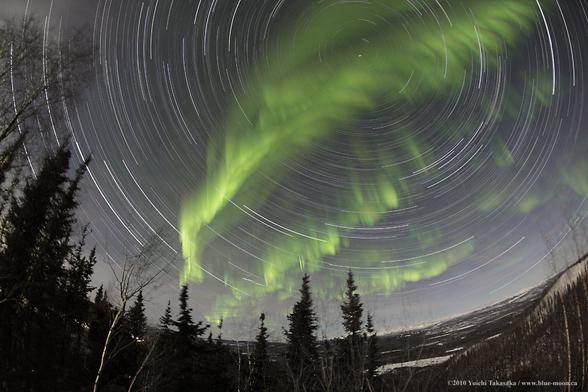
Yukon Aurora with Star Trails
* Image Credit & Copyright: Yuichi Takasaka / TWAN / www.blue-moon.ca

Explanation:
Fixed to a tripod, a camera can record graceful trails traced by stars as planet Earth rotates on its axis. But at high latitudes during March and April, it can also capture an aurora shimmering in the night. In fact, the weeks surrounding the equinox, in both spring and fall, offer a favorable season for aurora hunters. The possibilities are demonstrated in this beautiful moonlit vista from northwestern Canadian territory the Yukon. It was taken during the early morning of March 1, off the Klondike Highway about 60 kilometers south of Dawson City. To compose the picture, many short exposures were digitally combined to follow the concentric star trail arcs while including the greenish auroral curtains also known as the northern lights.

https://apod.nasa.gov/apod/ap100311.html

#space #earth #astrophotography #photography #science #nature

APOD: 2010 March 11 - Yukon Aurora with Star Trails

A different astronomy and space science related image is featured each day, along with a brief explanation.

Star Trails Over Oregon
* Credit & Copyright: Joshua Bury

Explanation:
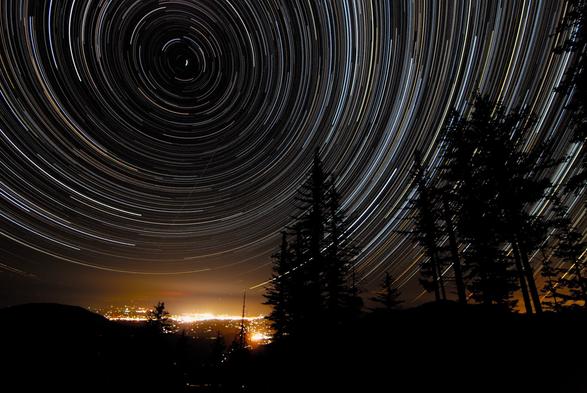
As the Earth spins on its axis, the sky seems to rotate around us. This motion, called diurnal motion, produces the beautiful concentric trails traced by stars during time exposures. Partial-circle star trails are pictured above over Grants Pass, Oregon, USA last month. Near the middle of the circles is the North Celestial Pole (NCP), easily identified as the point in the sky at the center of all the star trail arcs. The star Polaris, commonly known as the North Star, made the very short bright circle near the NCP. About 12,000 years ago, the bright star Vega was the North Star, and in about 14,000 years, as the Earth's spin axis slowly continues to precess, Vega will become the North Star again.

https://apod.nasa.gov/apod/ap090909.html

#space #earth #astrophotography #photography #astroart #science #nature

APOD: 2009 September 9 - Star Trails Over Oregon

A different astronomy and space science related image is featured each day, along with a brief explanation.

@grobi

Praying to the Universe.

@appassionato

it was amazing for me today to see how much this trail-pics make me feel a part of it (the universe) this might be due to the reminder 'we are living on a rotating ball hovering around the sun being part of a solar system in one of many galaxies in a massive interstellar consortium of space matter and energy Phaenomene'. These pictures make me aware of our axis and that everything is in flux ..