So. A while back while clearing Lucian's stuff. We took possession of some valves. In there was a Vidicon tube. I sadly had to return that as it went to the broadcast museum peeps.

Cut to yesterday when we got another batch of choobs from a friend..... Containing not one.
Not two.
But THREE Vidicon choobs o.o

This is how stuff was filmed on analogue TV o.o

It's effectively a back to front CRT.

The front is a special coating that can "store" an image that's being projected on it.
Then a scanning electron beam within the tube flashes across the front plate in the same manner as in a CRT. The electrons interact with the light and dark parts of the image and are spat out via a ring at the front.

One tube for black and white. Often 3 of them for colour.
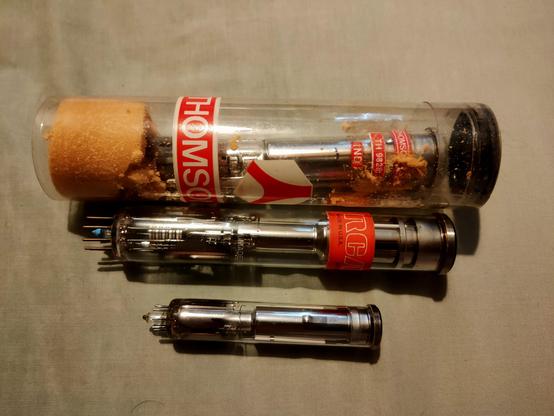
@Jencen @asj weren't you working to turn one of these into a webcam once?
@crashtestdev @Jencen Yep, but I think the coating had failed somehow? I couldn't amplify any signal from it, despite being pretty sure my deflection was working.
@asj @crashtestdev must have been a hell of a lump to sit atop a monitor. What with the deflection yoke and lens assembly o.o
Kris\Slyka (@[email protected])

Attached: 1 video wheee! now to clean my place cause I got people coming over tomorrow and it's fucking filthy…

Pawb.Fun - Pawbs, beans, and all things fluffy
@asj out of curiosity, how did you do your deflection? did you find an original deflection assembly or did you DIY it? Original deflection assemblies are super hard to come by and I'd love to be able to build them from scratch at some point
@slyka i wound them on a lathe with a lasercut jig, and tested with a very adorable soviet crt :)
@asj ohh, that's really cool! did you use a vidicon with electrostatic focus or did you also wind the focus coil?
@slyka it had electrostatic focus which saved quite a bit of effort. maybe i should try again sometime, it's possibly my amplifier was just not sensitive enough
@asj yeah, the amplification is tricky, the output levels are often just a few nanoampere and they're very susceptible to noise. I had to make a custom shielded mount for the tube and lens and use a very high gain transimpedance amplifier. Doing it on a breadboard was also a pain but I've just got a bunch of PCBs made to make the task easier in the future cause my ultimate goal is to build a digital vidicon still image camera from scratch. They're not tested yet but they're open source https://git.sr.ht/~slyka/vidicon-preamp
@slyka Ooh I will definitely take a look at that. thanks for sharing!
@Jencen Early colour cameras even had 4 of them, one for luma, and 3 for chroma. That way you got around registration errors. You'd have a sharp monochrome image while slight errors in the blurry chroma channel didn't matter as much.
@Jencen
Hang on, I recognise that name. Is this Lucian Nunes' collection? I guess that means he's died then. ☹️ Apologies if I'm late to the news.

@jamesb yes. He sadly lost his battle last year.
Lucian was a good friend of ours. My other half had known him for many years. I only recently got acquainted, but felt like I'd known him much much longer

We've inherited the organ collection. With the hope of continuing his mission to preserve and repair them.

Massive boots to fill >.<

@Jencen
Aww dammit. I didn't know him personally but came across him in so many esoteric places and was in awe of both his knowledge and collection. I did know he had cancer. I hope everything goes to a good home and his spirit is kept alive with it.

@jamesb things have gone to a good home. Many of them. >.>

Organs to us at the East Mids Organ Association.

A lot of the phone and esoteric audio stuff went to Sam at "Look mum no computer" / "This museum is not obsolete"

Radios, mics and camera stuff went to the broadcast museum.

Theatre/lighting to the lighting museum.

Other things ended up in other places.

So lots was saved. ^_^

@Jencen @kieran I worked in the class 100 clean room at the Plumbicon tube manufacturing facility owned by Philips in Slatersville, RI. It was a college internship. My father was a sales engineer for Amperex which became Philips Electronics, and I used a microscope to measure the depth and angle of the grid that detected the photons to determine if there was any regularity to the individual, hand crafted blown glass tubes. (There wasn’t much. :)

A good amount of equipment salvaged by my father made its way to Emerson College and then to the broadcast museum in Woonsocket, RI.