#BabelOfCode 2024
Week 9
Language: Ada (Spark?)

Confidence level: High

PREV WEEK: https://mastodon.social/@mcc/114463342416949024
NEXT WEEK: https://mastodon.social/@mcc/114582208242623432

So I start reading the manual for Ada. I think: This is *great!* This has all these features, conveniences etc I was wishing for for years in C++, and didn't get until I jumped to Rust. I might have been using this for games in 2010 if I'd dug into it then!

Then I start writing an actual Ada program. It turns out to be basically a pain in the ass.

Now, it's possible that the reason I'm unhappy is I jumped directly into something Ada is not designed for. However, that thing I jumped into was "load a file at runtime into a string whose length is not known at compile time". I don't think this should be so hard in a recently-revised language. (I seem to be tragically consistent in this challenge at accidentally picking languages whose input systems prefer structured data-- like Ada and Fortran-- on puzzles where I'm parsing raw ASCII art.)
To pick at this. "Software" can mean a do of different things! There's environments where you spend lots of time poking at text strings— text files in a world where the UNIX "everything is a file" philosophy won, webdev. There's really important environments where they don't! If you're writing backend software interacting with databases and network services, maybe it turns out Ada is *perfect* for this environment and you don't care about the friction on files and variable-length strings. Dunno.
Anyway. I was able to open a file whose name is given on the command line, but not read lines from it (the line reader only wants to work with stdin). I was not able to take an arbitrary-length string from stdin (I hardcoded to 10,000 bytes, the length of my largest input). I wasted a bunch of time on it, decided this wasn't important, and moved on. I'm trying to write "professional" software in this challenge and Ada, at least for the UNIX-y cmdline-and-files environment, did not reward that.

Compromises on basic things continue. I want to create an array whose size is not known at compile time. I believe I can declare this with

Mem : Array (Natural range <>) of Integer range -1..Integer'Last;

But this errors there's no initialization. You can initialize an array to a fixed value with (Others => -1), but then it doesn't know the size. I wind up making a sub-procedure *just* because that is the only syntax I can find for initializing an array to a size. https://github.com/mcclure/aoc2024/blob/b46079ddcb5c45d52af5882e940a593050c7beb9/09-01-disk/src/puzzle.adb#L14

aoc2024/09-01-disk/src/puzzle.adb at b46079ddcb5c45d52af5882e940a593050c7beb9 · mcclure/aoc2024

Advent of Code 2024 challenge (laid-back/"babel" version) - mcclure/aoc2024

GitHub

Small observations:

- Inner procedures and functions of a larger procedure and function can access the outer procedure's local variables. That's nice. I suspect this is hiding some sort of horrible restriction on recursion, but it's nice.

- The error messages, at least in "gnat" the open source Ada compiler, are NOT good. I think this is downstream from the language having lots of minor similar-but-distinct concepts instead of single powerful concepts. There's a lot of jargon and lots of edges

Something I don't know how you'll feel about: You know how in every programming language except Lua you index arrays from 0, and in Lua you index arrays from 1? In Ada, if I'm understanding this correctly, you choose whether your code indexes arrays from 0 or 1. *On an array by array basis*. You could mix 0- and 1-indexed arrays in the same code. You could have an array which contains 10 elements at indexes 10 through 19 inclusive, if you wanted. An array is a map with integer keys in a range

Man writing Ada is *really* making me think I was too hard on Haskell

Maybe the problem with Ada was that the things it was trying to do were too advanced for the tools that were available to the designers at the time.

I'm having an awful problem with a very straightforward bit of code because I want to scan over some code iterating a variable erratically. But I don't have any good value to give *before iteration begins*— because Ada integer types are range-limited, I can't use "0". This would be no problem at all I had Option<>. But I don't have Option<>.

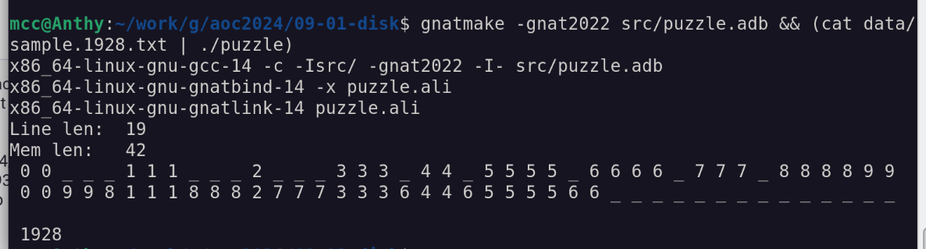
Guh. Part 1 done. It was ok once I actually had my data loaded into memory, but every moment up until there was pulling teeth, and honestly the ergonomics weren't *great* after that. The final insult was it taking a startling amount of time trying to figure out how to convert an Integer to a Long_Integer when it turned out my result was over 32 bits. It's Long_Integer(), but StackOverflow was a bunch of "how do I cast in Ada?" "*bragging* In Ada, you don't NEED to cast!"

https://github.com/mcclure/aoc2024/blob/9048d0cd5d29fc8f987c4f7369360279199fc2b0/09-01-disk/src/puzzle.adb

aoc2024/09-01-disk/src/puzzle.adb at 9048d0cd5d29fc8f987c4f7369360279199fc2b0 · mcclure/aoc2024

Advent of Code 2024 challenge (laid-back/"babel" version) - mcclure/aoc2024

GitHub

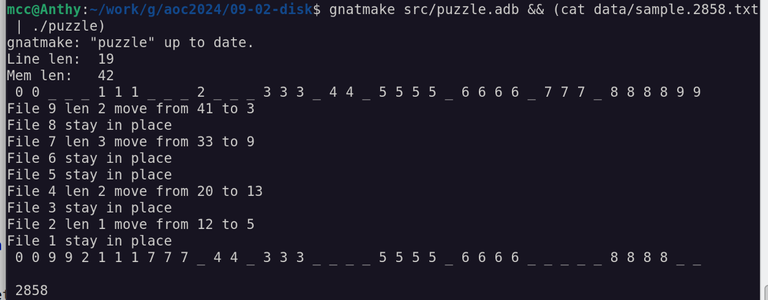
I pushed through Part 2 just to get it over with. I could have done a very clean, efficient implementation in any other language, but Ada makes creating new arrays enough of a pain I just wound up like… doing it the dumb nested loops way. Whatever. I realized in literally the final line of code I wrote that part of why I was struggling with loops was I didn't know "exit" existed.

It works. It's even relatively efficient. I don't feel proud of this code.

https://github.com/mcclure/aoc2024/blob/3adbb87169b82453caafd75308837c203247edc4/09-02-disk/src/puzzle.adb#L80

aoc2024/09-02-disk/src/puzzle.adb at 3adbb87169b82453caafd75308837c203247edc4 · mcclure/aoc2024

Advent of Code 2024 challenge (laid-back/"babel" version) - mcclure/aoc2024

GitHub
There's a lot I'm curious about in Ada. I'd really like to know more about its builtin Task primitive. I find the basic "in the small" writing of Ada frictionful enough I have lost my curiosity about attempting to experience its high-level primitives. I was originally intending to do part 1 of this puzzle in Ada and part 2 in Spark, but I don't… I just kinda want to stop. This puzzle has taken very almost the whole week, and part of that is WestJet's fault (long story), but I want to move on.

A problem I anticipated with this "Babel of Code" project and sure am hitting now: The AOC puzzles are a great way to learn a language, but they'll always focus on *only part* of a language. When I hit smalltalk, I'll have little opportunity to use objects. Multiprocessing, or verification capabilities like Spark, can be applied in *some* puzzles, but it's hard to know *which* puzzles until it's half complete. Like, what formal properties does THIS puzzle have to verify?

https://adventofcode.com/2024/day/9

Day 9 - Advent of Code 2024

#BabelOfCode 2024
Week 9.5??
Language: Spark

Against my better judgement, but since it was one of the main things that intrigued me about Ada, I decide to port my "day 9" solution to Spark.

I put at the top of my program:

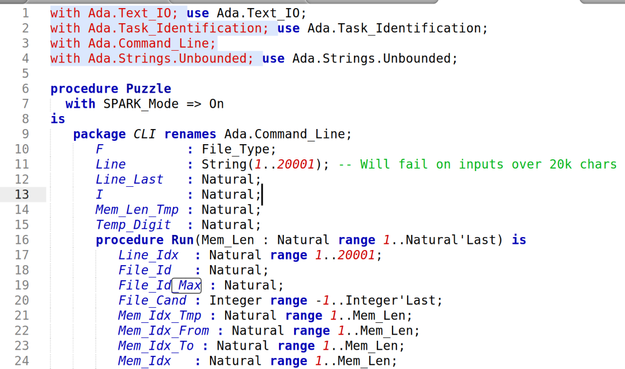
with SPARK_Mode => On

And run it. Nothing happens. Or rather it runs normally. I assume that this sets an attribute read by the Spark toolchain, and is ignored by basic Ada.

The docs suggest running gnatprove. Which… isn't in debian apt? I think I have to go to Github?

gnatprove-x86_64-linux-14.1.0-1.tar.gz turns out to be 412MB gzipped, and contains both a complete installation of GCC and a Python 3. That seems like why dpkg exists, but it seems the AdaCore corporation really, really wants me to be using gnatprove as part of their IDE. Which I guess is also why gnatprove unlike gnat itself can't be run on single files and I have to make a project file. Whatever, fine.

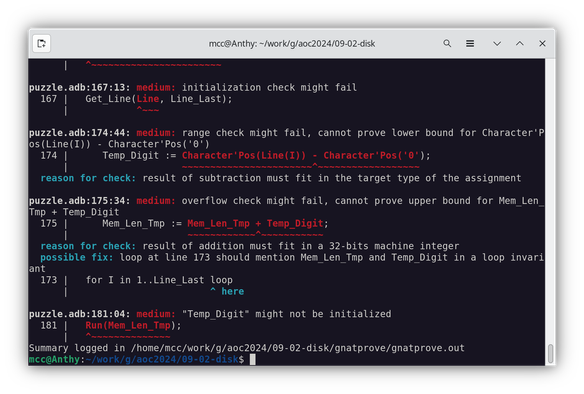
It's running. It gives me hundreds of validation errors. Which I guess is what I wanted.

Spark is immediately proving itself interesting. My very first error:

puzzle.adb:47:21: medium: range check might fail, cannot prove upper bound for 1
47 | Mem_Idx := 1;
| ^ here
reason for check: value must fit in the target type of the assignment

What this means: Mem_Idx has type
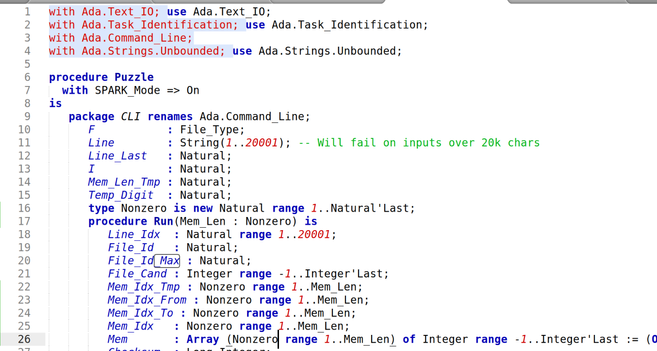
Mem_Idx : Natural range 1..Mem_Len;
where Mem_Len is a Natural argument of the procedure. But *nothing guarantees Mem_Len is nonzero*. That's a real uninterrogated assumption!

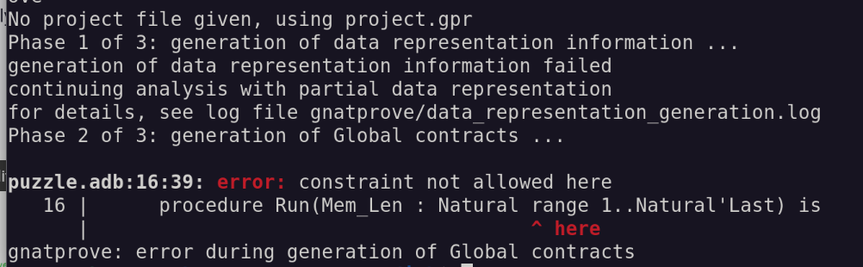
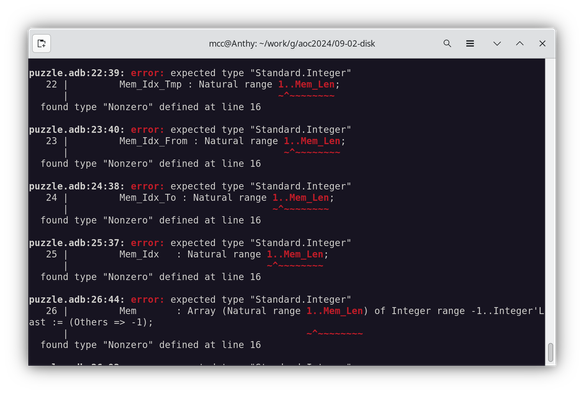
More odd friction. It turns out Ada/Spark don't allow integer narrowing on a argument parameter. Why? They just don't. OK, so I create a typedef Nonzero for the integer range of Mem_Len. Now anytime I say I have a Natural of range 1…Mem_Len, it complains I used Natural and not Nonzero. Bro!! Bro u r introducing an unnecessarily strong binding between structural and nominal typing!! It could have detected Natural range 1..Mem_Len necessarily conforms to Nonzero, but instead I have to annotate it.

Continuing with the "couldn't you do the math yourself?" complaints, it now turns out I can't add Natural (range 0..Natural'Last) to Nonzero (range 1…Natural'Last). These types share a common upper bound and neither may be zero; this addition is safe in all cases!

I guess I expected working with a theorem prover language would have lots of paperwork. I don't know if I expected this. (Also *this* issue is Ada not Spark?) Would Idris have been able to figure this one out? I bet Prolog would have.

@mcc If this is a fixed-width type, you could overflow, right?
@jrose @mcc or otherwise exceed the bounds.