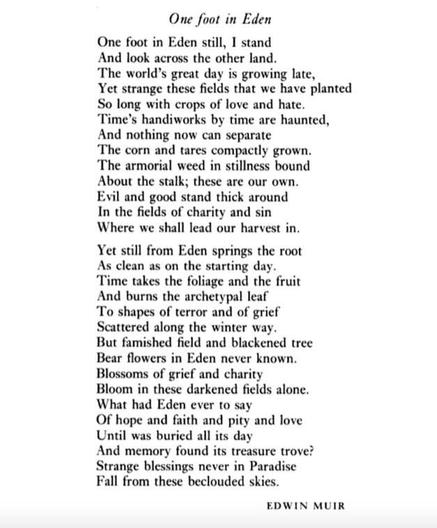
I never felt so much
Since I have felt at all
The tingling smell and touch
Of dogrose and sweet briar,
Nettles against the wall,
All sours and sweets that grow
Together or apart
In hedge or marsh or ditch…

—“A Birthday”, by poet, novelist & translator Edwin Muir (1887–1959) – born #OTD, 15 May

1/8

#Scottish #literature #poem #poetry #20thCentury #EdwinMuir #Orkney
“Edwin Muir is a mysteriously neglected, gorgeous, & emotionally penetrating poet. Of all the many pieces of writing spurred by the Cold War & the threat of nuclear apocalypse… his poem ‘The Horses’ may be the most effective, perhaps because it is the most calm and gentle. The plainness of the writing, the persuasive speech rhythms under the almost hidden iambic pulse, manifest immense art, culminating in a last line that could be incised in stone.”
—Robert Pinsky

2/8

https://slate.com/culture/1999/01/the-horses.html

The Horses

To hear Robert Pinsky read "The Horses," click here.

Slate

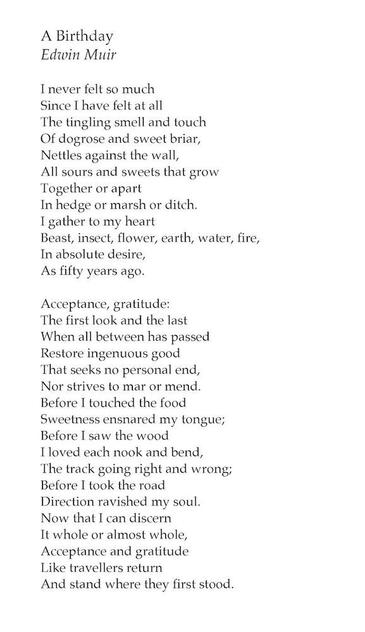
On the second day
The radios failed; we turned the knobs; no answer.
On the third day a warship passed us, heading north,
Dead bodies piled on the deck…

—Edwin Muir, “The Horses”

3/8

#Scottish #literature #poem #poetry #20thCentury #EdwinMuir #Orkney #apocalypse

“On the second Friday of March 2020, before the first UK lockdown had begun… I was listening to the BBC news & boiling pasta for my children’s tea when a line of verse ran through my head…”

—Jeremy Noel-Tod on Edwin Muir’s “The Horses”

4/8

https://someflowerssoon.substack.com/p/we-would-not-have-it-again

#Scottish #literature #poem #poetry #20thCentury #EdwinMuir #Orkney #apocalypse #lockdown
We would not have it again

On Edwin Muir's 'The Horses'

Some Flowers Soon

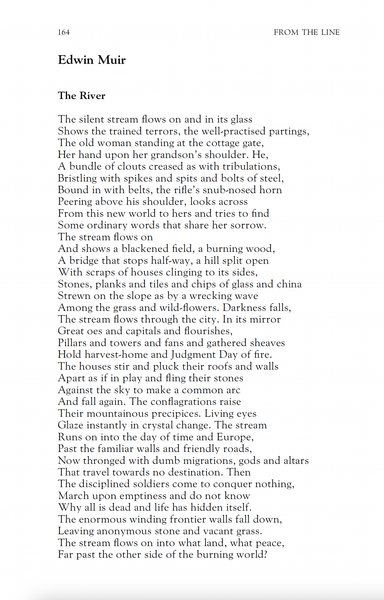
The houses stir and pluck their roofs and walls
Apart as if in play and fling their stones
Against the sky to make a common arc
And fall again. The conflagrations raise
Their mountainous precipices…

—Edwin Muir, “The River”

5/8

#Scottish #literature #poem #poetry #20thCentury #EdwinMuir #Orkney
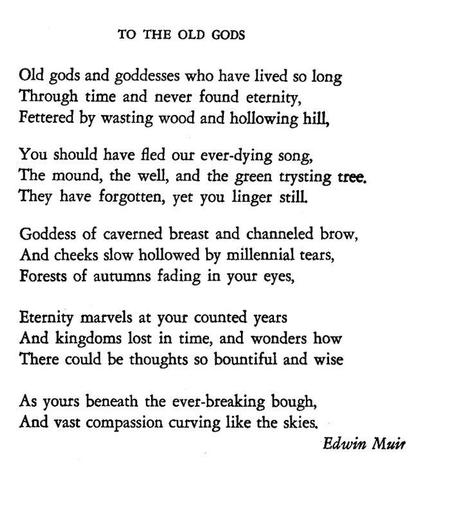
Old gods and goddesses who have lived so long
Through time and never found eternity,
Fettered by wasting wood and hollowing hill,
You should have fled our ever-dying song…

—Edwin Muir, “To the Old Gods”

6/8

#Scottish #literature #poem #poetry #20thCentury #EdwinMuir #Orkney

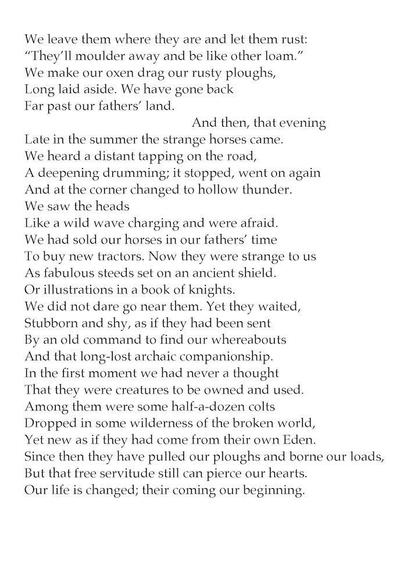
One foot in Eden still, I stand
And look across the other land.
The world’s great day is growing late,
Yet strange these fields that we have planted
So long with crops of love and hate…

—Edwin Muir, “One Foot in Eden”

7/8

#Scottish #literature #poem #poetry #20thCentury #EdwinMuir #Orkney
“[Edwin Muir’s] travels in the 1920s immediately after the end of World War One, and again at the end of World War Two, tell a story of Europe itself at critical points in its history.”

—Dr Margery Palmer McCulloch, on the Oxford University Press blog

8/8

https://blog.oup.com/2017/05/edwin-muir-story-europe/

#Scottish #literature #history #Europe #20thCentury #EdwinMuir #Orkney

Edwin Muir and a story of Europe

While reading recently British Library correspondence files relating to the poet Edwin Muir—the 130th anniversary of whose birth will be on 15 May this year—I was struck, as I have often been, by the important part played in his development as man and poet by his contact with the life of Europe—a continent that is currently high on the agenda of many of us with a possible British Brexit in view.

OUPblog

“What is remarkable is that Muir did not become a social realist, like W.H. Auden, Cecil Day-Lewis, Stephen Spender, and other related British poets during the 1930s, who didn’t know anything close to what Muir knew directly about urban poverty”

—Andrew Frisardi on the life & work of Edwin Muir

@litstudies

9/8

https://www.sacredweb.com/volume-51/the-good-life-of-edwin-muir/

#Scottish #literature #poem #poetry #20thCentury #EdwinMuir #Orkney #modernism
The Good Life of Edwin Muir

In Muir’s political poetry, history is reimagined as an internal event. Muir depicted our time as one of transition, an interregnum of civilization, during which the danger is great that we can forget altogether the meanings and associations that make specifically human life possible.

Sacred Web