With the LP.8.1.* variant on the way to dominance in most places, it is time to ponder which variant might drive the next wave.

The leading contenders at this point are LF.7.7.2, NB.1.8.1, XFG and XFJ.

I show them here using a log scale, so you can compare their growth rates vs the most common LP.8.1.* sub-lineage: LP.8.1.1. Note the recent sample volumes are quite low, so the right side of this chart might not be a representative picture.

#COVID19 #LF_7_7_2 #NB_1_8_1 #XFG #XFJ
🧵

LF.7.7.2 is descended from FLiRT JN.1.16.1. LF.7 added several Spike mutations: T22N, S31P, K182R, R190S and K444. Then LF.7.7.2 added the Spike H445P mutation.

LF.7.7.2 has been most successful in Canada (8%) and the US (5%). But growth has slowed noticeably, and it hasn’t been very successful elsewhere.
🧵

NB.1.8.1 is descended from XDV.1.5.1. XDV was a recombinant of XDE and JN.1. XDE was a recombinant of GW.5.1 and FL.13.4 (both descended from XBB), so this represents the last current variant with any non-JN.1 ancestry.

XDV.1 added the F456L mutation, then XDV.1.5 added G184S and K478I. NB.1 then added Spike mutations: T22N and F59S. Then NB.1.8 added the Spike Q493E mutation that characterised KP.3.1 FLuQE – an example of convergent evolution. Finally NB.1.8.1 added the A435S mutation.

NB.1.8.1 had mainly been reported from Hong Kong, rising to 93% frequency. It has also shown sustained growth in several other countries in the region, plus Canada and the US - all adding to its credibility.
🧵

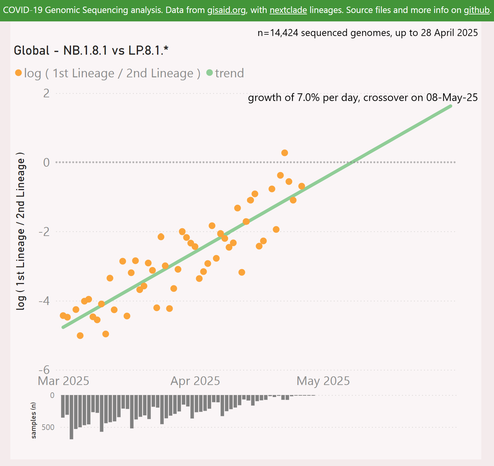
Globally, the NB.1.8.1 variant is showing strong a growth advantage of 7% per day (49% per week) over the dominant LP.8.1.* variants. That predicts a crossover in early May.

Strong growth advantages like that (if sustained) could point to higher waves than those seen for LP.8.1.* (which were typically very low).
🧵

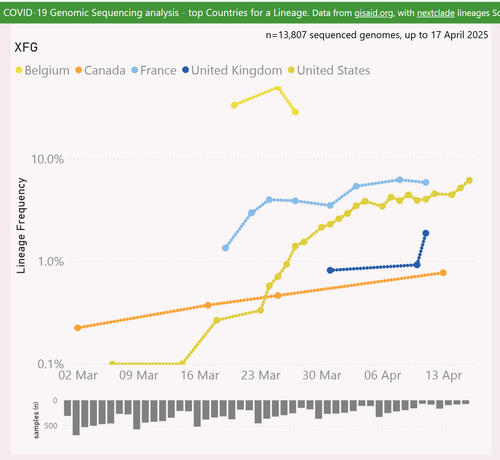
XFG is a recombinant of LF.7 and LP.8.1.2, with a presumed origin in Quebec.

Growth of XFG accelerated in the recent French samples to 7%. Growth in the US reached 6%, now reported from many states. Belgium only reported 25 samples for March, but FWIW XFG reached 50% frequency there.
🧵

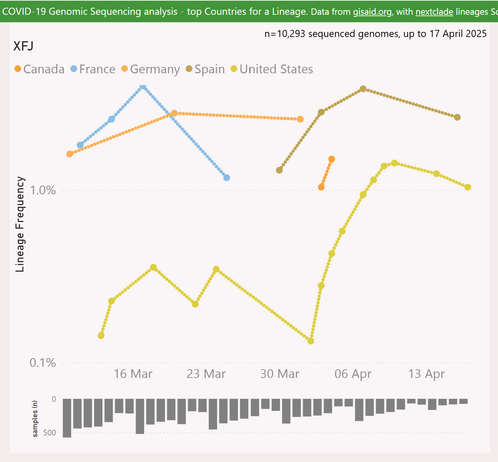
XFJ is a recombinant of LF.7 and LS.2. LS.2 was descended from JN.1.18.5.

Recently, XFJ has been most successful in France and Spain, rising to 4% frequency. But growth has slowed noticeably.
🧵

I will stick with NB.1.8.1 as the leading contender. It is showing growth in multiple countries, and a credible global growth advantage over the incumbent LP.8.1.* variants.
XFG now looks the next most likely.

I will continue to monitor this topic.
🧵

The usual caveats apply - recent sample sizes are smaller which might skew these results, and “global” sequencing data is dominated by wealthy countries, with many under-sampled regions.
🧵
Huge thanks to Federico Gueli for his tips on new lineages to watch out for, eg
https://skywriter.blue/pages/siamosolocani.bsky.social/post/3locmcp35l222
🧵
Page by Federico Gueli | @siamosolocani.bsky.social

Newly updated Collection #42 by @wolfeagle1989.bsky.social It seems XFG vs NB.1.8.1 with XEC.25.1 & alike to be confirmed fast . XFJ XFC and to a lesser extent LF.7.9 and LF.7.6.2 could compete vers...

Interactive genomic sequencing dataviz, code, acknowledgements and more info here:
https://github.com/Mike-Honey/covid-19-genomes#readme
🧵 ends
GitHub - Mike-Honey/covid-19-genomes: Projects on COVID-19 topic of genomic sequencing - mostly DataViz

Projects on COVID-19 topic of genomic sequencing - mostly DataViz - Mike-Honey/covid-19-genomes

GitHub