XFP is the latest recombinant variant to be classified and incredibly it is the third of a recent set of recombinants with identical spike mutations. The earlier ones were XFJ and XFM.

I think of them as the "Doppelgängers". Note this is not an agreed variant nickname, nor should it be. There doesn’t seem to be anything stopping other sets of variants or recombinants from ending up the same way, as multiple Doppelgänger packs.

Also note their non-Spike mutations do vary. But the Spike proteins of SARS-CoV-2 are the focus of much study and explain the success of most variants.

#COVID19 #XFJ #XFM #XFP #Doppelgängers
🧵

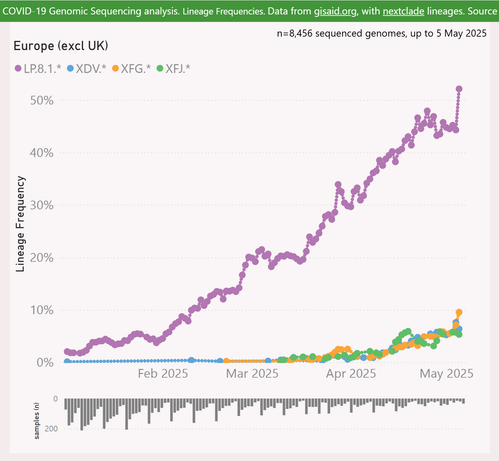
Here's the latest variant picture for Europe (excluding the UK), to early May.

The LP.8.1.* variant continued to dominate, growing steadily to around 52% frequency.

The presumed next challengers are still at low frequencies but growing – XFG.* to around 10%, and XDV.* (led by NB.1.8.1) to around 6%, and also XFJ.* grew to 5%.

#COVID19 #EUR #LP_8_1 #XFG #XDV #NB_1_8_1 #XFJ
🧵

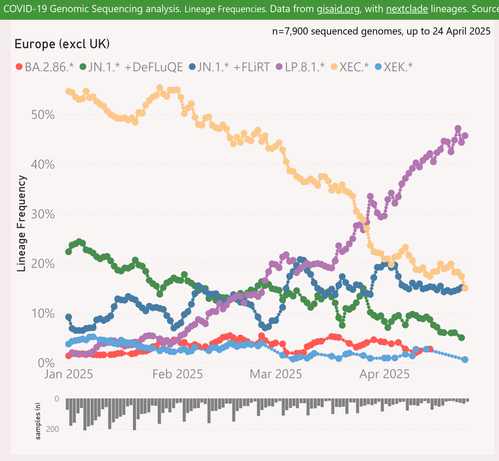
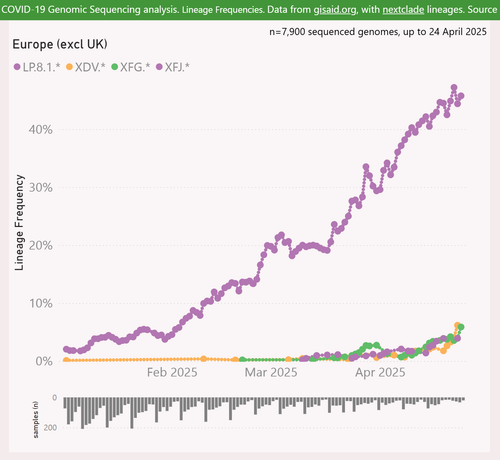
Here's the latest variant picture for Europe (excluding the UK), to mid-April.

The LP.8.1.* variant took over dominance, growing steadily to around 43% frequency.

The presumed next challengers are growing – XFG.* and XDV.* (led by NB.1.8.1) to around 6%, and also XFJ.* grew to 4%.

#COVID19 #EUR #LP_8_1 #XFG #XDV #NB_1_8_1 #XFJ

Report link:
https://mike-honey.github.io/covid-19-genomes/output/Coronavirus%20-%20Genomic%20Sequencing%20-%20report%20EUR-UK.pdf

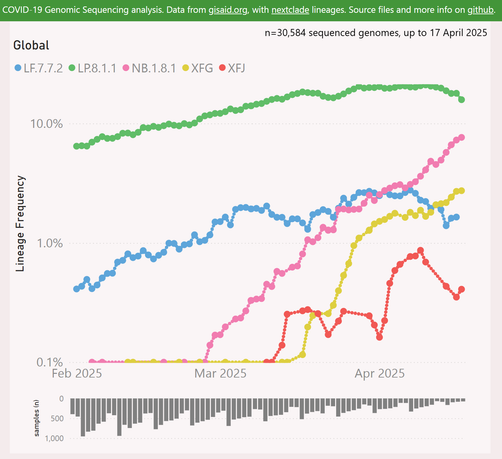
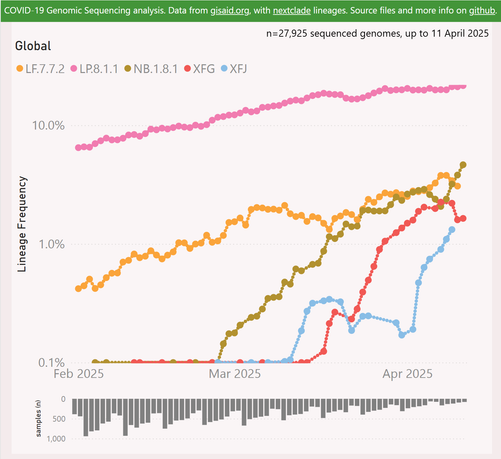
With the LP.8.1.* variant on the way to dominance in most places, it is time to ponder which variant might drive the next wave.

The leading contenders at this point are LF.7.7.2, NB.1.8.1, XFG and XFJ.

I show them here using a log scale, so you can compare their growth rates vs the most common LP.8.1.* sub-lineage: LP.8.1.1. Note the recent sample volumes are quite low, so the right side of this chart might not be a representative picture.

#COVID19 #LF_7_7_2 #NB_1_8_1 #XFG #XFJ
🧵

With the LP.8.1.* variant on the way to dominance in most places, it is time to ponder which variant might drive the next wave.

The leading contenders at this point are LF.7.7.2, NB.1.8.1, XFG and XFJ.

I show them here using a log scale, so you can compare their growth rates vs the most common LP.8.1.* sub-lineage: LP.8.1.1. Note the recent sample volumes are quite low, so the right side of this chart might not be a representative picture.

#COVID19 #LF_7_7_2 #NB_1_8_1 #XFG #XFJ
🧵

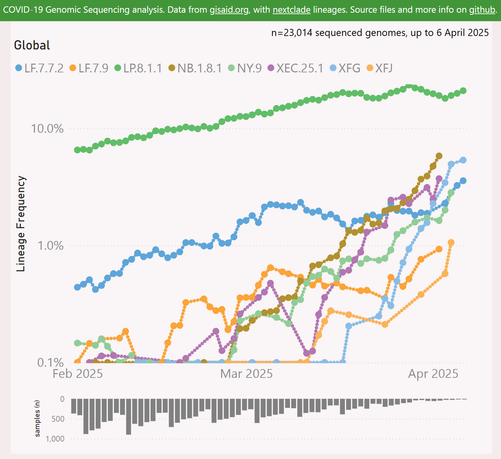
With the LP.8.1.* variant on the way to dominance in most places, it is time to ponder which variant might drive the next wave.

The leading contenders at this point are LF.7.7.2, LF.7.9, NB.1.8.1, NY.9 (new), XEC.25.1, XFG and XFJ.

I show them here using a log scale, so you can compare their growth rates vs the most common LP.8.1.* sub-lineage: LP.8.1.1. Note the recent sample volumes are quite low, so the right side of this chart might not be a representative picture.

#COVID19 #LF_7_7_2 #LF_7_9 #NB_1_8_1 #XEC #XFG #XFJ
🧵

Here's an animated map showing the spread of the XFJ variant. The first sample was detected in Cote d'Ivoire in late August. After a long pause, a second sample was detected in South Africa in December. Then it appeared in New York in late February and soon began spreading more widely.

Recently classified XFJ is a recombinant of LF.7 and LS.2. LF.7 is descended from FLiRT JN.1.16.1. LF.7 added several Spike mutations: T22N, S31P, K182R, R190S and K444. LS.2 was descended from JN.1.18.5.

Audio credit:
Swarm_Bees_outdoor_stereo by leonseptavaux -- https://freesound.org/s/573839/ -- License: Attribution 4.0

#COVID19 #XFJ

Swarm_Bees_outdoor_stereo by leonseptavaux

Freesound: collaborative database of creative-commons licensed sound for musicians and sound lovers. Have you freed your sound today?

Freesound

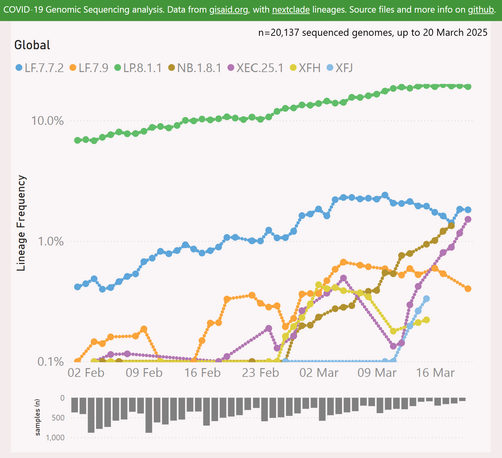
With the LP.8.1.* variant on the way to dominance in most places, it is time to ponder which variant might drive the next wave.

The leading contenders at this point are LF.7.7.2, LF.7.9, NB.1.8.1, XEC.25.1 XFH and (new) XFJ.

I show them here using a log scale, so you can compare their growth rates vs the most common LP.8.1.* sub-lineage: LP.8.1.1. There are more recent samples available, but the frequency analysis becomes increasingly distorted due to low volumes and patchy coverage.

#COVID19 #LF_7_7_2 #LF_7_9 #NB_1_8_1 #XEC #XFH #XFJ
🧵