 compostgoblin
ISO 8601
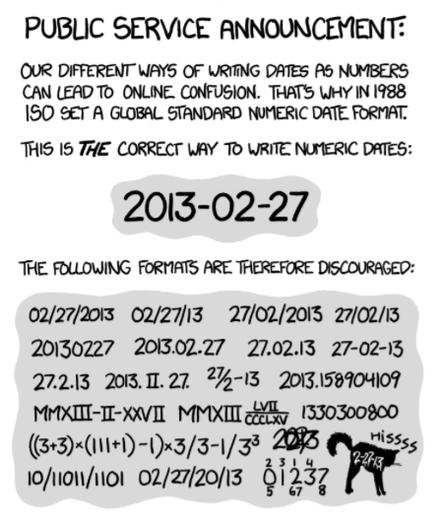
ISO 8601
So, assuming you got the time wrong and meant you could confuse year and time of day, ISO also put time after date.
2025-05-01T18:18:03Z
Which makes sense. Higher unit to lower unit.
8/3/2012
You do. 8th of Feb in the entire civilised world and possibly 3rd of something in Trumpistan.
8/3/2012
8th of Feb
Feb
You uh… you sure about that?
RFC-3336
I figured there were problems with existing calendars, so I created a new one to supersede all others. That reminds me, though: I need to declare the “official” format for the calendar, to avoid all this nonsense.
I see a window of opportunity, here. Normally, there’s no chance for any calendar revision to succeed in adoption; however, I think if I use the right words with the President, I could get it pushed into adoption by fiat. Y’all had best start learning my new calendar to get ahead of everyone else.
Note for the humorously disadvantaged: the Saturnalia Calendar is a mechanism through which I’m playing with a new (to me) programming language. I am under no disillusion that anyone else will see the obvious advantages and clear superiority of the Saturnalia Calendar, much less adopt it. And no comments from the peanut gallery about the name! What, did you expect me to actually spend time thinking of a catchy name when a perfectly good, mostly unused one already existed?
That’s where I started. I wanted a little project to try V on, and had come across the IFC, so I wrote a thing. While I was doing that, I got to thinking about the deficiencies and inherited complexities in IFC, and thought up Saturnalia.
If you pop up to my profile in Sourcehut, you’ll find a similar program - just a lot longer and more complex, for IFC.
I don’t know if they makes me a genius, but yes. Yes it does.
I’m a pope, but then, we’re all popes.
My problem with Discordianism is that it’s all 5s, when 6 is clearly superior, and 12 trumps them all.
Hail Eris.
Hey, I quite like this! You’re the first person I’ve found that’s thought of fixing the calendar by adopting 6-day weeks. I have a very similar personal version, with two main differences:
Only in eight year chunks. By year seven there is more unalignment than there was in year one, but it goes back to normal on year eight. Same thing as with leap days, just a slightly bigger scale.
In fact, with current rules, [the shift in the regular Gregorian calendar becomes quite big when considering 100-year and 400-year cycles](File:Gregoriancalendarleap_solstice.svg). In theory, a leap week calendar with new and updated rules could have a very comparable if not a smaller average deviation from the true solar date, though I haven’t ran the precise calculations
Ok, so, first, let me say that while I’m enthusiastic about the concept, I understand it’s entirely theoretical. We can’t even get US civilians to adopt metric, FFS. Just a caveat, lest anyone wander by and overhear us.
That said, I did spend some cycles trying to see it it would be possibly to line up a lunar and solar calendar, and it’s not. And it isn’t nearly as important as it used to be. It would still have been nice.
So if you do run calculations, I’d like to see them.
Here they are! Orange represents my Leapweek calendar and blue is Gregorian. The Y-axis is deviation from the tropical year and the X-axis is the year number. It’s a 19200-year cycle to allow for both Gregorian and Leapweek to do entire iterations of their 400-year and 768-year cycles, respectively.
The Gregorian rules are, as you already know: if a year is divisible by 4, it is a leap year; unless it is divisible by 100, when it is a common year; unless it is also divisible by 400, in which case it is actually a leap year.
My Leapweek rules are: years divisible by 8, are leap (short, with 360 days instead of the usual 366) years, as are years divisible by 768 (after subtracting 4 so as not to clash with years divisible by 8). Just two rules as opposed to Gregorian’s three, but they result in almost perfect correction: it takes 625 000 years to fall out of sync by 1 day, as opposed to Gregorian’s 3 216 years for the same amount)
The catch is that Leapweek falls out of sync by up to 5½ days either way in between 768-year cycles, and up to 2½ days either way in between 8-year cycles. But they average out.
About the lunisolar I’m afraid to say that I ran into the same issue. Lunations are a very inconvenient duration to try and fit into neat solar days and months.
I wish it weren’t as theoretical, because I really like this calendar, but yea. It’s one of those things that will be impossible to change even though there’s arguably better options. It’s too arbitrary yet too essential and it goes in the same box as the metric second/minute/hour, the dozenal system and the Holocene calendar.
Here’s a challenge though: try and devise a Martian calendar! That one is not standardised yet. I had good fun trying to match the Martian sol and year to metric units of time and maybe giving some serious use to the kilosecond, megasecond and gigasecond
This is fantastic. I’m going to have to spend more time with it.
Since we’re discussing timescales over which there’s a not insignificant chance something radical will happen to society, there’s also the fact that the day is getting longer by 2ms every hundred years. If you’re scheduling out 625,000 years, that’s 12-some seconds by the end, compounded - 6 extra seconds every day by the 312,000th year, etc.
…if I use the right words with the President…
Depending on which president you’re referring to, those words could get you banned here.
It’s an easy fix at least, just check if you’re comparing numbers on both sides and switch to a simple numerical sort.
I think Windows used to get this wrong, but it was fixed so long ago that I’m not even sure now.

 amniotic druid
 TechGuy
 A_norny_mousse
 pelya
pelya Bezier
 rnercle
 Cid Vicious
 edgemaster72
 𝕽𝖚𝖆𝖎𝖉𝖍𝖗𝖎𝖌𝖍
 UnderpantsWeevil
 BigFig
 The_Decryptor
 JackbyDev
 TeamAssimilation