A project I have been working on got its official release today.

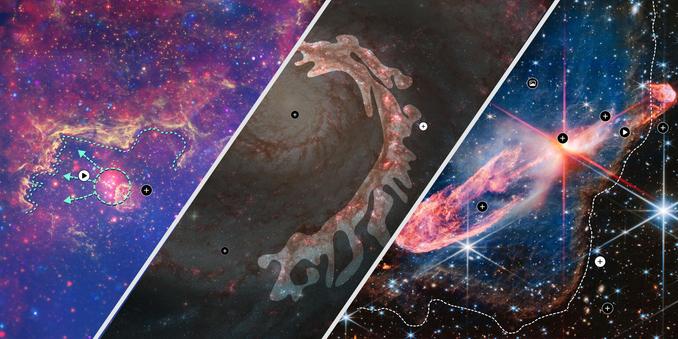
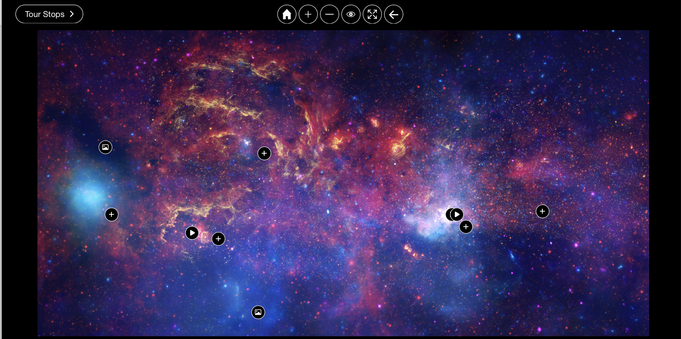
Space images are pretty, but would you like to know what the important features are, and the science behind their appearance? ViewSpace Interactive Image Tours take you on a guided exploration of astronomical images.

Designed to be used on touch screens in museums and science centers, they are also fun to explore on your own. They work best on tablets or computers (devices bigger than a phone).
https://www.universe-of-learning.org/contents/news/traverse-across-space-with-the-interactive-image-tours

#Space #Astronomy #Astrodon

For now, there are three tours available, more will be added this year.

The first explores a Hubble, Chandra, and Spitzer view of the center of our galaxy. The center of the Milky Way is a very bizarre place, home not only to our resident supermassive black hole, Sagittarius A*, but also to very strong magnetic fields and clusters of young, massive stars.

https://viewspace.org/interactives/image_tours/2

ViewSpace | Image Tours: Center of the Milky Way Galaxy

A free, web-based collection of astronomy and Earth science videos and interactives.

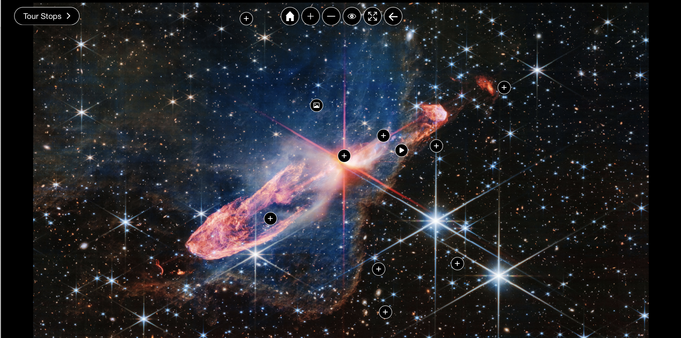
The second tour is of HH 46/47, jets of material blown out by a pair of stars forming inside a dark, cold cloud of gas and dust. These jets are carving out oval-shaped cavities in the surrounding nebula, creating the orange lobes seen in this infrared JWST image.

https://viewspace.org/interactives/image_tours/5

ViewSpace | Image Tours: Herbig-Haro 46/47

A free, web-based collection of astronomy and Earth science videos and interactives.

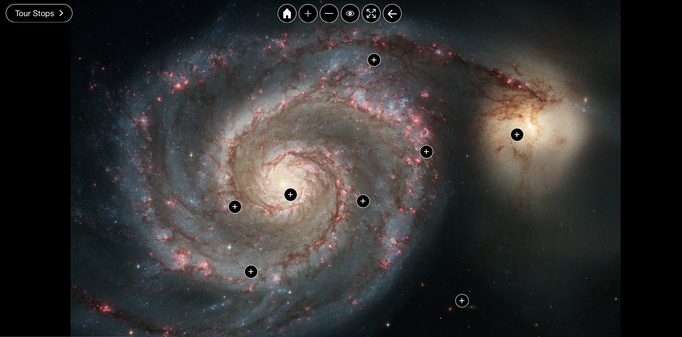
And the final tour is of the Whirlpool galaxy, a grand design face-on spiral galaxy that is interacting with a smaller companion galaxy.

https://viewspace.org/interactives/image_tours/4

ViewSpace | Image Tours: The Whirlpool Galaxy

A free, web-based collection of astronomy and Earth science videos and interactives.

@kellylepo the universe is so damn cool and we are such a tiny, insignificant dot in it

@kellylepo

This is awesome! Thanks for sharing!

Wow, I love this!!

@kellylepo Now all you need to do is to integrate these enhanced images with Gaia Mission maps like these:

https://gruze.org/posters_2024/

so people can see them in their context in the Milky Way.

Galaxy Map 2024 poster downloads (png)