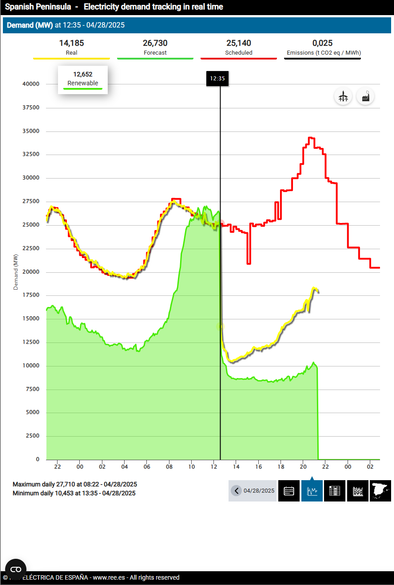
When Spain's power system tripped, shortly after noon today, renewables were providing a little more power than there was demand. At that moment, relatively little conventional power plants were running, but 3.4 GW of nuclear was. Right after that, nuclear went offline and a lot of renewables too.
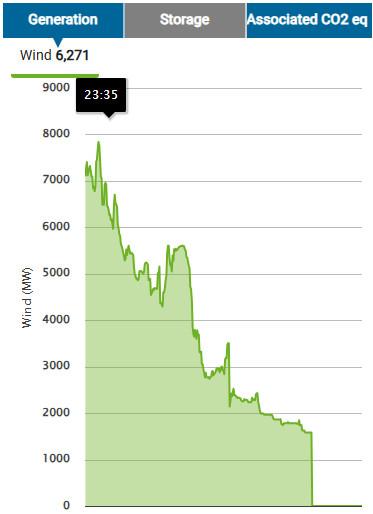
A fascinating aspect is that Spain's power system apparently didn't lose a lot of wind power when it broke down around (12:30, the little spike in the middle of this graph). Wind speeds were going down all day, but only around 0.5 GW went offline.
However, ..
.. solar PV's contribution fell off a cliff, losing around 13 GW(!) in very little time, ~75% of what it was providing. This could e.g. be due to the inverters switching off when they detect an abnormal situation on the grid. But this kind of swing is very hard to deal with for any power system.
@Sustainable2050 too much grid following and not enough grid forming?
@Sustainable2050 do we know how much of the ~30GW load was met by inverter/solar at the time of the disturbance? Sudden loss of 3.4GW nuclear is also a big loss of inertia; any synchronous system is going to be stressed by that... đŸ˜¬

@clanger9 @Sustainable2050

There's been a fair bit of talk about the grid frequency interia provided by the fossil-fuel based generators as against solar or wind.

Is it really infeasible just to keep large flywheels running just to keep the grid frequency stable? They would presumably only draw power when trying to damp down unwanted fluctuating frequencies?

(I have no idea whether this could actually work at the required scale).

#PowerOutage

@tpuddle @clanger9 @Sustainable2050

Flywheels are actually being used for frequency inertia already.

The most prominent one might be the big one in Ireland to deal with a loss of grid connection to Britain:
https://www.siemens-energy.com/global/en/home/stories/irelands-great-grid-stabilizer.html

But they are being rolled out in Germany for a while now, too:
https://www.siemens-energy.com/global/en/home/press-releases/siemens-energy-technology-stabilizes-german-power-grid.html

And talking of Spain, there are some planned on the Canary and Balearic Islands:
https://new.abb.com/news/detail/116318/abbs-integrated-technology-will-stabilize-the-power-grid-as-spanish-islands-transition-to-green-energy

A list of older examples can be found here:
https://www.entsoe.eu/technopedia/techsheets/synchronous-condenser/

Ireland’s great grid stabilizer

With Ireland set to phase out coal-fired power generation in favor of renewables, a radical new vision for one coal plant promises to bring stability to the grid. The first step? A synchronous condenser with the world’s largest flywheel.

First phase of stability pathfinders delivered | National Energy System Operator

As part of the ESO’s legal separation from the National Grid Group in 2019 the ESO announced a new ambition, to be able by 2025 to operate for the first time, a 100% zero carbon national electricity transmission network.

National Energy System Operator (NESO)