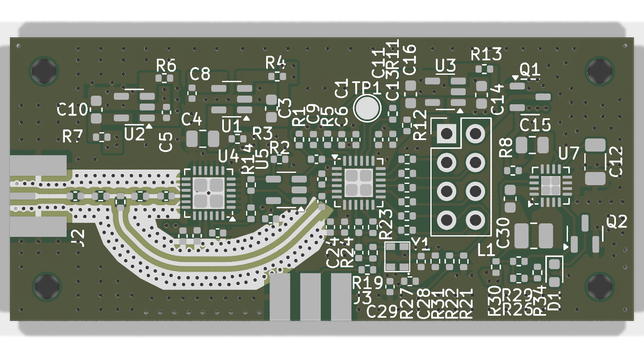
A week ago I posted here a PCB design I've been working on with an ADF4158 and HMC391 for the LO of an FMCW 10 GHz radar. Thanks to all who reviewed this and sent suggestions. I have now switched to a 4-layer FR4 stackup, added M2 mounting holes and done other tweaks. Probably I will send the board to the fab sometime this week. Until then, there is still time to give feedback: https://github.com/daniestevez/ADF4158_PCB
GitHub - daniestevez/ADF4158_PCB: ADF4158 + HMC391 PCB for 10 GHz FMCW radar LO

ADF4158 + HMC391 PCB for 10 GHz FMCW radar LO. Contribute to daniestevez/ADF4158_PCB development by creating an account on GitHub.

GitHub
As an interesting note, I should say that I posted exactly the same in X, Mastodon and Bluesky, and most of the useful feedback I got was from Mastodon.
@destevez I'm going to start using mastodon now too! You're one of the few people I know using it.
@destevez
So there will be some separate boards with the doubler to X-band and the RX mixer?
@ftg the subharmonic mixer and the rest of the stuff will probably be mounted Manhattan style on the feed. See https://github.com/Micromeet-Guadarrama/Year2025/blob/main/docs/4-LOS%20NESTRANSVERTERS-MICROONDAS%20INSTANT%C3%81NEAS_CT1DMK.pdf and https://github.com/Micromeet-Guadarrama/Year2025/tree/main/docs/NESTRANSVERTER for more context. This LO board replaces the typical ADF4350 that one would use for a regular transverter (CW LO instead of FMCW LO).
Year2025/docs/4-LOS NESTRANSVERTERS-MICROONDAS INSTANTÁNEAS_CT1DMK.pdf at main · Micromeet-Guadarrama/Year2025

Reunión año 2025. Contribute to Micromeet-Guadarrama/Year2025 development by creating an account on GitHub.

GitHub

@destevez
So the plan is to use a sub-harmonic mixer on transmit as as well?
Why that instead of a doubler?
Won't the sub-harmonic mixer suppress the 2x LO spur decently well, making it less likely to radiate?
If one is building an FMCW RADAR and not a transverter.
I feel like I'm missing some detail.

I do love the design.
I think I have all the parts used in it in my junkbox. Might build my take on it some nice evening.

@ftg This isn't a zero-IF radar. It is supposed to work on a ~1.6 GHz both for transmit and to receive. The transmit IF waveform will typically be a CW carrier from an SDR. 2x4.45 + 1.6 = 10.5 GHz. With this in mind, maybe it makes more sense? As to why sub-harmonic mixer instead of doubler + fundamental mixer, Luis Cupido explained in this quite well in his presentation (the video will be up at some point).
@ftg Something that I haven't thought about is that I need a high-pass or bandpass to suppress the LSB, at least on transmit. Luis' transverter has 144 MHz and 5.112 GHz LO, so it puts sidebands out on 10.08 and 10.368 GHz. That's not ideal but okayish. In my case the LSB would be at 7.3 GHz, which is way out of band and would mess up with the USB radar return too.

@destevez
That does clear up the thinking quite a lot.
You could even run separate TX and RX mixers if so desired and get some additional TX/RX isolation.

As for the image, I think you might be able to suppress it enough by using a suitable waveguide like WR-75 with it's cutoff is nominally on 7.869 GHz.
WR-62 would be even better, but on that the lower end of 10GHz is already fairly close to the limit and is getting attenuated.
So maybe some surplus WR-75?

@ftg TX and RX will only share the LO. They will use different (but probably identical) mixers and antennas. That's the best way to get good isolation.

@destevez This version looks much better to me.

The main thing that still stands out to me is the use of thermal reliefs on the copper pours. In general these are usually best avoided for GHz work. But they do make things easier to hand solder. Again, I don't think it's anything that will stop this board from working, just general advice.

@martling There are 10 vias in each of the SMA ground pads, and groundplane below it. These cannot be seen in the 3D render because it renders the solder paste on top of the vias (probably there is a way to tweak this, but I haven't messed around with the render settings).