With the LP.8.1.* variant on the way to dominance in most places, it is time to ponder which variant might drive the next wave.

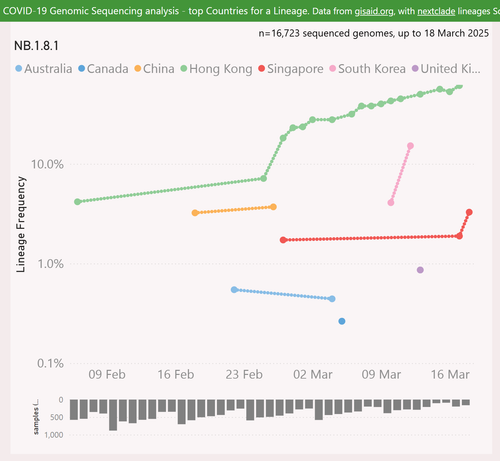
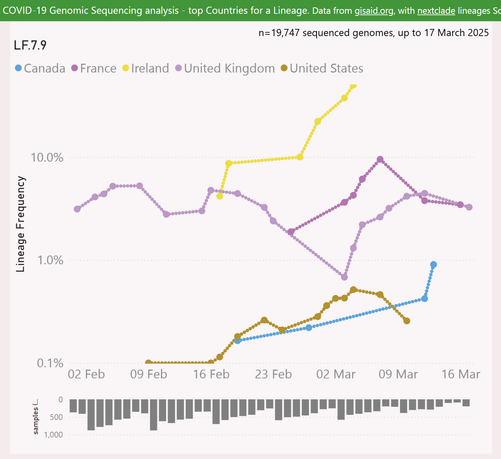
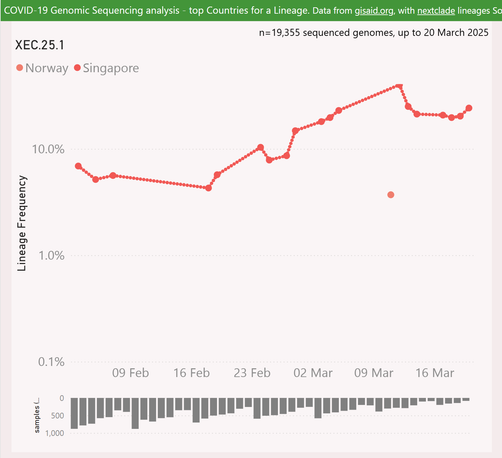
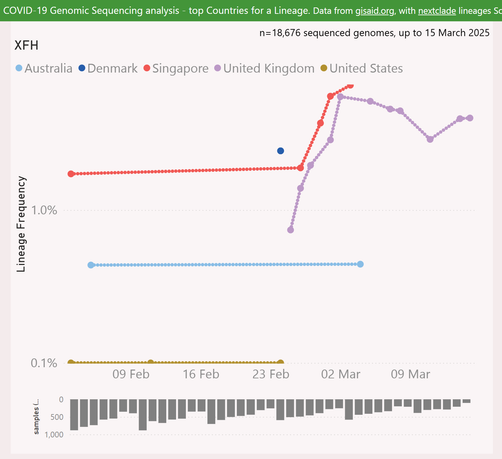
The leading contenders at this point are LF.7.7.2, LF.7.9, NB.1.8.1, XEC.25.1 XFH and (new) XFJ.

I show them here using a log scale, so you can compare their growth rates vs the most common LP.8.1.* sub-lineage: LP.8.1.1. There are more recent samples available, but the frequency analysis becomes increasingly distorted due to low volumes and patchy coverage.

#COVID19 #LF_7_7_2 #LF_7_9 #NB_1_8_1 #XEC #XFH #XFJ
🧵

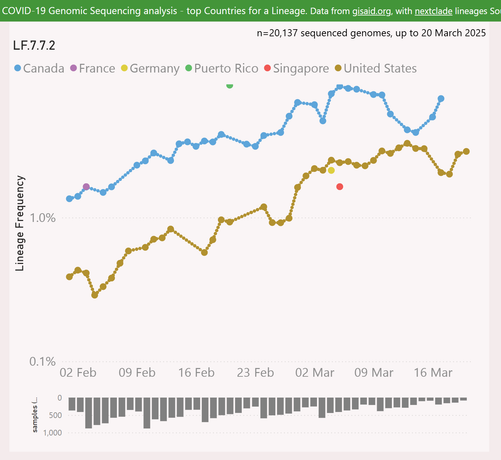
LF.7.7.2 is descended from FLiRT JN.1.16.1. LF.7 added several Spike mutations: T22N, S31P, K182R, R190S and K444. Then LF.7.7.2 added the Spike H445P mutation.

LF.7.7.2 has been most successful in Canada (especially Quebec), rising to 8% frequency. The US has reported growth to 3%.
🧵

NB.1.8.1 is descended from XDV.1.5.1. XDV was a recombinant of XDE and JN.1. XDE was a recombinant of GW.5.1 and FL.13.4, so this represents the last current variant with any non-JN.1 ancestry.

XDV.1 added the F456L mutation, then XDV.1.5 added G184S and K478I. NB.1 then added Spike mutations: T22N and F59S. Then NB.1.8 added the Spike Q493E mutation that characterised KP.3.1 FLuQE – an example of convergent evolution. Finally NB.1.8.1 added the A435S mutation.

NB.1.8.1 has mainly been reported from Hong Kong, rising to 61% frequency.
🧵

LF.7.9 added the Spike L441R, H445P and A475V mutations to LF.7 (described above).

LF.7.9 has been most successful in Ireland, rising to 50% frequency. France has reported growth to 9%.
🧵

XEC.25.1 adds the A435S mutation.

XEC.25.1 has mostly been reported from Singapore, rising to 40% frequency. Prior to this sub-lineage, the XEC.* variant had not been dominant in Singapore.
🧵

XFH is a recombinant of LF.7.1 and XEF. XEF was a recombinant of LB.1.4 and KP.3.

XFH has been most successful in Singapore, rising to 7% frequency. The UK has reported growth to 6%.
🧵

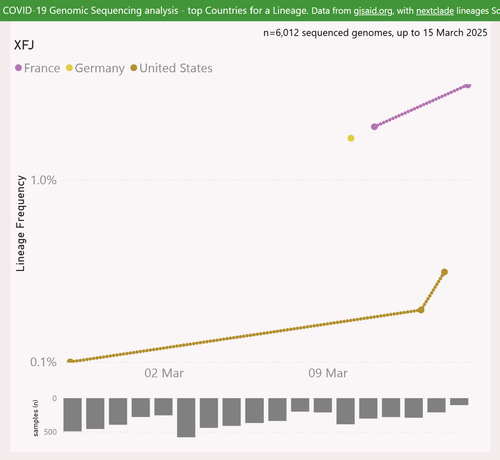
Recently classified XFJ is a recombinant of LF.7 and LS.2. LS.2 was descended from JN.1.18.5.

Starting from February, XFJ has been most successful in France, rising to 3% frequency.
🧵

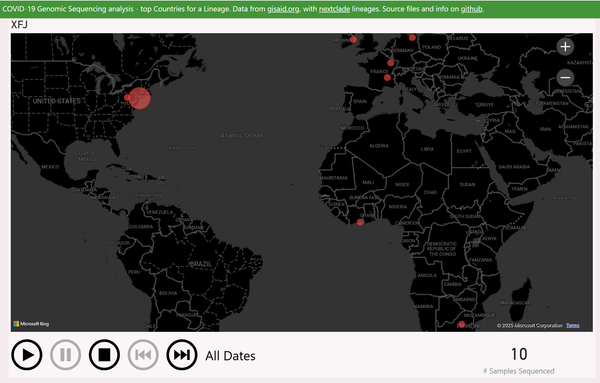
It’s probably too early for frequency analysis of XFJ, so here’s a map view of the 10 samples reported so far.

Locations are approximate - typically country and state/province.
🧵

Here's an animated map showing the spread of the XFJ variant. The first sample was detected in Cote d'Ivoire in late August. After a long pause, a second sample was detected in South Africa in December. Then it appeared in New York in late February and soon began spreading more widely.
🧵
Audio credit:
Swarm_Bees_outdoor_stereo by leonseptavaux -- https://freesound.org/s/573839/ -- License: Attribution 4.0
🧵
Swarm_Bees_outdoor_stereo by leonseptavaux

Freesound: collaborative database of creative-commons licensed sound for musicians and sound lovers. Have you freed your sound today?

Freesound
Here’s a thread by variant hunter Federico Gueli, who first spotted what is now designated as XFJ. He highlights some of the interesting convergent evolutionary steps that helped it along it’s journey.
https://skyview.social/?url=https%3A%2F%2Fbsky.app%2Fprofile%2Fsiamosolocani.bsky.social%2Fpost%2F3llvlfl5prc2j&viewtype=tree
🧵
A BlueSky thread by Federico Gueli on Skyview

Little variant update: now XFJ has been designated: it is a growing recombinant displaying a set of mutations that is rapidly increasing: S:L441R S:V445P S:A475V plus S:T791A hallmark with the NTD coming from LF.7 (22N+31P+182R+190S+346T) interestingly it has T22930A to get S:F456L as XDV.1 , Eg.5.1

Here’s a thread by variant tracker Andrew Urqhart (maintainer of the fabled “Collection 42” on cov-spectrum), tracking the spread of XFJ sample-by-sample:
https://skyview.social/?url=https%3A%2F%2Fbsky.app%2Fprofile%2Fwolfeagle1989.bsky.social%2Fpost%2F3llwhaovrnk2m&viewtype=tree
🧵
A BlueSky thread by Andrew Urquhart on Skyview

It’s early and hard to really tell, but I’m getting concerned about recombinant lineage XFJ designated yesterday 2 April 2025. Why? At 8 sequences, reports are from 6 countries on 3 continents with 2 US states all without travelers. It also has a breakpoint in the Spike RBD. 1/3

So in summary, the battle to challenge LP.8.1.1 just got more complex. My previous pick was LF.7.7.2, but that appears to be running out of steam. Like many of the other contenders, it seems limited to one region.

I will switch my pick to XFJ:
- RBD breakpoint = novel spike to evade immunity
- many of the common escape mutations that seem needed atm
- geographically widespread already

I will continue to monitor this topic.
🧵

The usual caveats apply - recent sample sizes are smaller which might skew these results, and “global” sequencing data is dominated by wealthy countries, with many under-sampled regions.

I removed NB.1.8 from consideration, as it had not improved on very low frequencies.
🧵

Huge thanks to Federico Gueli for his tips on new lineages to watch out for, eg
https://skyview.social/?url=https%3A%2F%2Fbsky.app%2Fprofile%2Fsiamosolocani.bsky.social%2Fpost%2F3lk7ceka3au2p&viewtype=tree
🧵
A BlueSky thread by Federico Gueli on Skyview

Sars Cov 2 variant update [AKA

Interactive genomic sequencing dataviz, code, acknowledgements and more info here:
https://github.com/Mike-Honey/covid-19-genomes#readme
🧵 ends
GitHub - Mike-Honey/covid-19-genomes: Projects on COVID-19 topic of genomic sequencing - mostly DataViz

Projects on COVID-19 topic of genomic sequencing - mostly DataViz - Mike-Honey/covid-19-genomes

GitHub