 The Bright Side
In a lively room filled with an engaged audience, Benin Varghese takes center stage, performing with fervor.
His actions emulate a cautious dog crossing the road, tongue out and all.
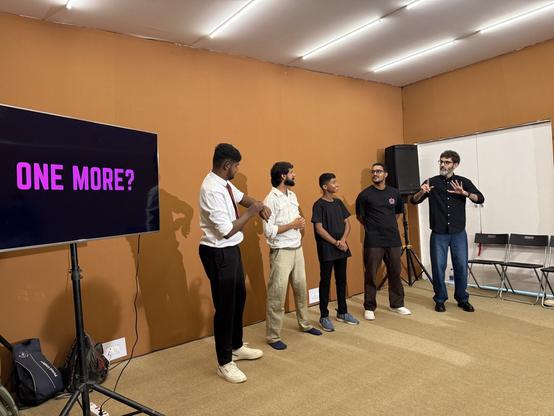
In a lively room filled with an engaged audience, Benin Varghese takes center stage, performing with fervor.
His actions emulate a cautious dog crossing the road, tongue out and all.
Behind him stands Soham Gaikwad, shaping dog's ears with his hands, moving in perfect sync.
Their collaboration brilliantly brings this imaginary dog to life, creating a blend of humor and realism.
Their performance at the Serendipity Arts Festival in Goa showcases Visual Vernacular (VV), a unique silent art form used proudly by the Deaf community for expression.
Here, visual storytelling transcends formal signs, fostering connections between Deaf and hearing individuals.
Despite the eagerness of Deaf artists in India to showcase their work, inclusive art spaces are scarce.
The lack of understanding around sign language and Deaf access needs limits interaction and advocacy efforts—especially for Indian Sign Language (ISL) to become an official language.
Alim Chandani, a Deaf activist, tirelessly strives to integrate Deaf artists into the mainstream art scene.
Leading the initiative 'Hear A Million', he supports Deaf artists in honing their skills in VV and beyond, paving the way for a more inclusive artistic environment.
Though VV remains a budding art in India, its roots trace back to the 1960s through artist Bernard Bragg.
Today, its versatility allows for crossing language barriers and creating widespread impact, enhancing global connections among artists.
