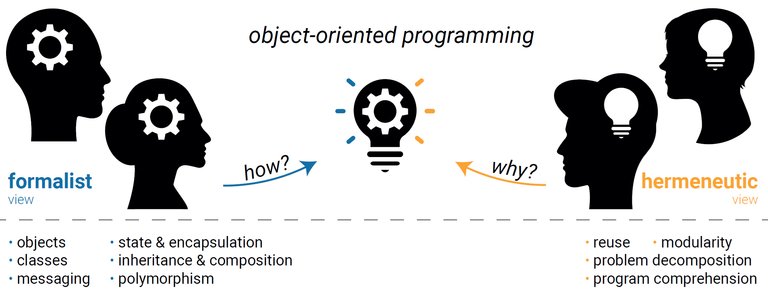
What is the essence object-oriented programming? It depends on whom you ask. The long answer is available in the preprint of our recently accepted paper: https://www.computer.org/csdl/magazine/so/5555/01/10896812/24uGD7wCFvG
@wyrich, Johannes C. Hofmeister, @svenapel , and I dared to go down this rabbit hole.
CSDL | IEEE Computer Society
There are classes and objects. Dog, for example, could be a class. Laika, the first dog in space, is an object of the Dog class. Laika has a state and can respond to messages. That’s one perspective to think of object-oriented programmig (OOP). Taking a closer look at prominent definitions of OOP, different people do not necessarily mean the same thing when they talk about it. The example with Laika, the dog, represents only one side of the coin: how OOP is applied.
 Janet Siegmund