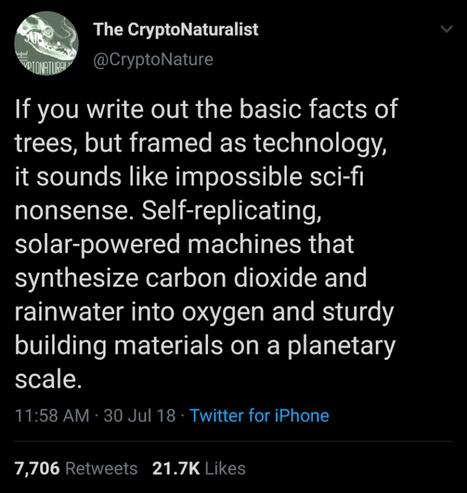
That seems pretty farfetched...

https://lemmy.world/post/27333326

Cells are basically the self replicating nanobots that sci fi sometimes has as an example of highly advanced technology, but naturally occurring.

R&D life cycle… hundreds of millions of years.

The manufacturer takes a really long time to respond to new feature requests, and most of the support tickets are still open.

Plus major patch releases only seem to happen after major events that make old renditions obsolete, if not downright broken and dismantled.

Although new software does have a ton of useless speghetti code.

Typical enshittification. Brilliant and amazing technology taken over by private equity and run into the ground
There are support tickets? I have a few complaints…
Theoretically you can submit complaints to the lead engineer, but there are very few, very old reports of anyone receiving a response and the sources are somewhat suspect.
Update request? Sorry, best I can do is a new kind of cancer.
Went out on a limb for that one.
No reason to bark at them, it has a nice ring to it.
Leaf them bee
I’m rooting for them

“wow, cool. Let’s see how people interact with these magical creatures”

They are mowed down faster than they can regrow and are replaced with asphalt. Oh.

I do live in a bit of a different part of the globe. It is a losing battle here on side of humans. Trees pop up and every year there are less people around.

I like it here, may it make me a hillbilly on a flat ground or not.

Your part of the globe sounds awesome. I suspect it’s close to my part of the globe.
I have to keep reminding myself that effectively our technology is just a loosely-based, extremely primitive, and extremely inefficient mimicry of shit that started happening on its own billions and billions of years ago across the entire universe and perfectly scales from microscopic to galactic levels.
Self-replicating, solar-powered machines with long life cycles that synthesise carbon dioxide and rainwater into oxygen, sturdy building materials and sometimes edible products, while providing shade, cooling and ground stabilisation.
I think this is a missed trope for solarpunkish scifi: manipulating plants to grow anything. Fabric for clothes growing as bark. Tomatoes with pracetamol in them. Flowers depositing certain minerals it picks up from the ground in them. Stuff like this.
Like a factory game but you have to modify plants and animal’s with crispr
Children of time had a lot of this. One factions technology is mostly based on natural processes. Their most complicated computer systems are ant based if I remember well. Great book.
So did the Discworld books!
A setting I’m working on includes engineered plants for construction. Think a tree that can be shaped like a vine, a grow light box strapped to the leader node, the light box changes angles to get the plant to change direction of new growth, forming the main supports to have the floors built on. They’ve also got effectively artificial mycelium cultivated over entire planets that form internet connections and backup power grid, with fruiting bodies that provide solar energy to the system
“Leviathan” by Scott Westerfeld ?
The cotton plant, hemp and flax do grow fabric for clothes, and willow bark contains the active ingredient of Aspirin.
Flowers (Fabaceae) can even pick up nitrogen from the air and deposit it into the ground where it acts as fertilizer.
The Simpsons were the real sci-fi all along with Tomacco

You actually see this kind of shit in tech bro spheres where they describe some “new groundbreaking invention” using terms like this when it’s something we already have, but they’re version is shittier.

Adam Something on Youtube has a saddening amount of videos on this sort of shit.

So Someone Reinvented Trains...

YouTube
I was talking to someone the other day who was really gung-ho about carbon capture technology. I listened patiently, and then asked: “You mean like trees?” Which set him off talking about using genetically modified algae for carbon capture, which is a neat idea, I guess, but the impression I got was that there’s just no money in planting more trees so he wasn’t interested in them.
Sufficiently advanced technology is indistinguishable from biology.
It’s astounding how far simple trial and error has brought us. No need for scrum or agile!
To be fair, it did also take several thousand years to develop instead of a few decades.
It took the Earth almost 1 billion years to come up with photosynthesis 🙃

And another 60 million (the Carboniferous period) to figure out how to break down lignin. Trees were the equivalent of our plastic pollution crises - no way to return the nutrients to the ecosystem or even deal with the mass other than burial or burning - for millions of years.

All fungi today that rot wood descend from just one fungal evolution event, and even today we don’t really understand how they manage to digest the lignin. scientificamerican.com/…/mushroom-evolution-break…

White Rot Fungi Slowed Coal Formation

The evolution of the ability to break down a plant's protective lignin largely stopped the geologic burial of carbon that formed present-day coal deposits—and may provide secrets to making biofuels from inedible parts of plants

Scientific American
I mean, give us a break, if it took 60 million years the last time-
And all it took was eons of mass death.
Star Trek writers seeing this and making a new movie
Replace oxygen with dilithium and introduce a primitive species that safeguards it at conflict with the rolls die cardassians. Throw in some beastie boys for good measure.
I feel Le Guin may have beat them to it.
Yeah, this is a really really neat way of looking at nature that I sometimes thought about. Nature is pretty fucking darn technologically advanced
They have JUST a slight time advantage: over 1.1 billion years. And that’s LESS than ¼ of Terra’s age.
Yup. To put it another way, we’d be hard-pressed to replicate all of that with our current non-tree-based technology track, at even a fraction of the same efficiency. Chlorophyll is basically a miracle-molecule that makes all that possible, and we have yet to engineer anything like it.
We are likely a few hundred years away from actually synthesizing a close equivalent and if we do, this one most likely is THE molecule for planet Earth. Other molecules may be suited for other stars and other atmospheres, but clearly chlorophyll won the race of the most efficient simplest molecule to best utilize the resources of our planet.

I’d think we could probably engineer similarly insanely capable biotech if we were completely reckless, committed a serious fraction of our resources and people, and had infinite Earths to ruin in the process.

I’m not sure how GMO’s are handled, but I’m guessing it’s a quite restrictive on the engineering side and somewhat cautious in implementation.

actually we have solar panels and electrolysis of water, which produces hydrogen, which you can perceive to be H2, which is H-(CH2)0-H, so it’s the simplest (zeroth) hydrocarbon if you will.
They also look amazing, with a stunning variety of forms and foliage.
Careful. Muskrat might read this and think it’s a good idea to try to waste loads of CO2 emissions manufacturing synthetic trees
Don’t forget the symbiotic organic filament network used to transmit raw materials and information between units
To make it more sci-fi: We have only found such thing in one planet in the whole galaxy, maybe universe.
That’s not saying much, since we have only observed roughly 0.0000001% of our galaxy’s planets. For all we know there are more planets with trees than without.
I know you probably just typed a random small number, but you’re gunna need at least 10 more zeros to be close. Absolutely mind boggling
Yeah I figured it was enough zeros to drive the point.
I mean, it wouldn’t have been surprising if you said universe, bur in our Galaxy?! That’s crazy, when does a planet count as observed?