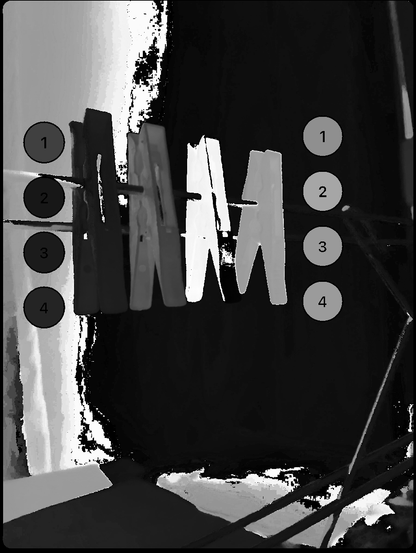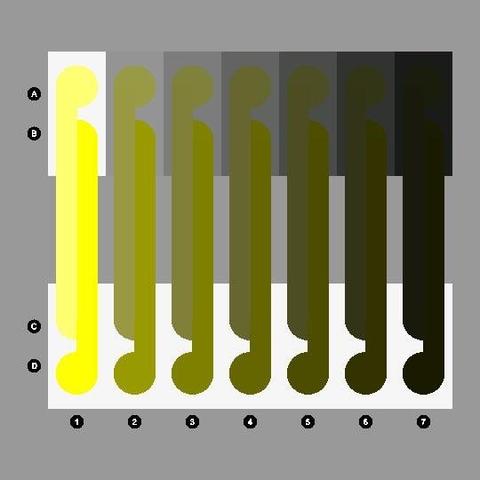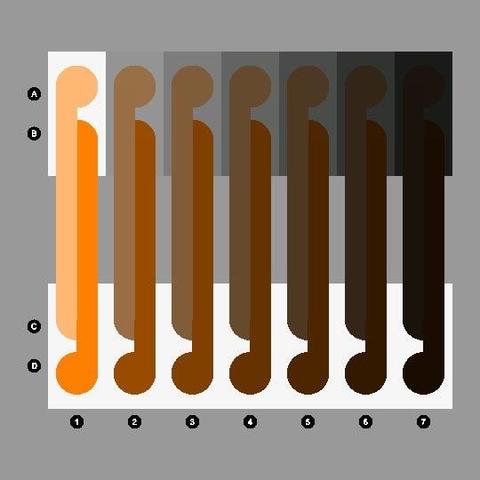
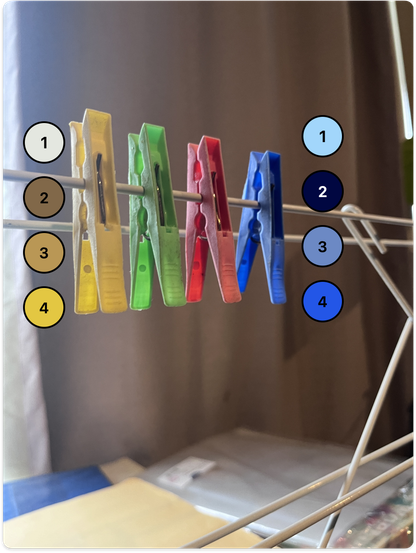
Most folks with "normal" colour vision will say they perceive yellow, green, red and blue pegs hanging on a line here.

Yet the pixel samples shown along each peg illustrate that not a single point on each peg is "diagnostic" of its perceived body colour.

How do we perceive the pegs as solid body colours despite so much variation in the samples?

Nobody knows, but we can speculate that the visual system somehow integrates the samples to produce a percept of body colour.

An even more challenging question is how we perceive different parts of each peg to be translucent, opaque, shadowed and dirty from the image variations.

@TonyVladusich Asking GIMP to "Colors -> Components -> Extract component -> Hue" gives me this image. Doesn't seem that hard? The wraparound in red is because the channel is defined as starting at red and ending at red, so they are adjacent colors still.

@dascandy

Yeah, it's possible to achieve some level of separation of the chromatic components, although I think it can get messy across colour boundaries, depending on the precision of your system.

For example, in the attached images I've used my own (now defunct) "Colors" MacOS app to separate the hues somewhat. But even here I'd argue that perceptually our visual system "collapses" across variations in chromatic purity and luminance in a manner not captured by any existing algorithm. We somehow see unitary "body" colours despite these variations (we don't misperceive those variations as differences in body colour, such as texture).

And, of course, I think you'd agree no existing algorithm can parse an image into objects with surface and illumination "layers", such as object translucency, shadow, shading, gloss, dirtiness etc, as does our visual system?

@TonyVladusich @dascandy Echoing Tony’s point, try to find forms that vary in form stimuli that cross through the achromatic centroid, yet appear as a chromatic cognition.

It is really echoing Vlad’s point in spades.

@troy_s @TonyVladusich @dascandy

Here's the image broken down to Lightness, a&b, a only and b only...(the a and b are additive over a #555 grey) (Krita Lab)...

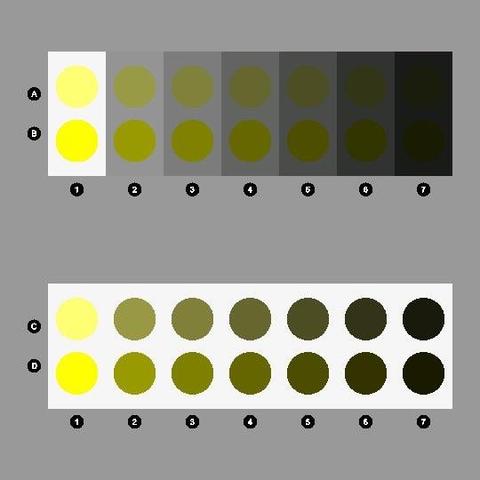
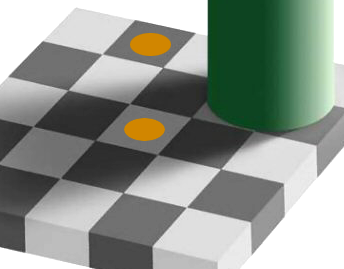
It appears to me the majority of of the variation comes from lightness differences, with mostly stable hue. (This then reminds me of the yellow dot checker board illusion.).

This perhaps makes sense considering saturation relates to the perception of luminance and chroma.

If we think about it, aren't "translucency, shadow, shading, gloss, dirtiness" largely luminance? By gloss I assume we mean specular or anisotropic qualities?

I'm not sure Lab is the best model for this deconstruction, but it's readily available in a few image apps.

In the second group, it's a&b only against black, mid grey, light grey, and white. From this it seems there is still a lightness component in the ab channels. Or is it a transparency component?

Does transparency belong with chrominance? I'll venture that this is becoming more relevant with HDR.

@Myndex @dascandy *Not* “lightness”. There is no correspondence between luminance or luma and lightness.

@troy_s @dascandy

Sorry troy I wasn't clear, where I used the term "lightness" I perhaps should have said Lstar instead, as I meant specifically the "lightness" correlate of Lab.

It probably seemed off as I'm talking about both the Lab model and luminance and chroma.

@Myndex @dascandy Yes, but you understand that Lab is nonsense, yes? Luminance does not correlate to “lightness” or “brightness” for obvious reasons.

Look at my example; every code value corresponds to “white” and “black” hues.

We need to abandon these nonsense constructs.

@troy_s @dascandy

Well yea I know, that's been a focus of my work in recent years...!

And I agree Lab is weak--it just happens to be an available way to separate into approximated opponent channels,

I only used for illustration of the effect of luminance on color perception (i.e. yellow vs brown is the result of luminance).

@Myndex My issue with L*whatever is less the whatever, but more that it forces models that have a polemic of some cognitive facet like “lightness” or “brightness”, when the driving force are the neurophysiological gradients, and steepness thereof.

Case in point is yellow vs olive or orange vs brown; it is rather clearly a segmentation-decomposition problem, and *not* a monotonic scale of luminance derived metrics.

@troy_s

YES! My favorite example is DLyon's take on the checkerboard illusion, adding the yellow dots.

@Myndex Yes. My silly example is a riff on Adelson too.

Hence why it all seems enmeshed in a super structure of segmentation-decomposition computations.

EG: We segment-decompose the multiplicative component, leading to a “steeper” decrement gradient than the lower example.

Seems challenging to discuss without paying attention to some global / local polarity interactions.

@troy_s

These examples probably demonstrate more what is wrong with the Lab model.

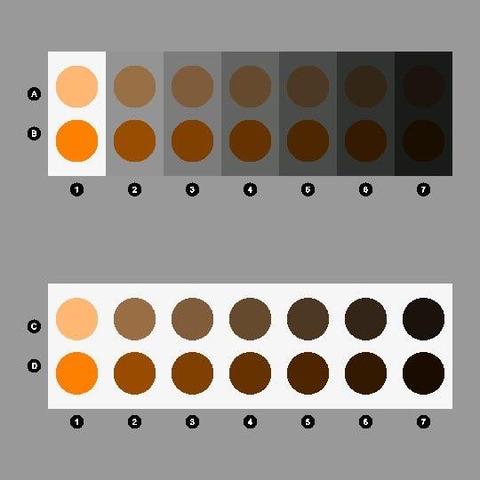
Equal Chroma Dots:

I modified the orange dot examples, setting the a and b channels so that all dots per row were identical chroma (with the L* channel off).

When combined with L*, there are visible shifts, I think these are likely related to the transforms out of Lab to sRGB.

In the second image the left side is using only the a, and right, only the b channel.

The thing I am wanting to explore more is a model with orthogonally independent correlates for luminance, saturation or chroma, and hue, and also "a practical uniformity, consistent with physical light, within a defined range", like with a display.

The third row of the last image makes only the achromatic L* dots darker, without touching a*b*, attempting to match the dots on white. The top, second, and bottom row all have dots same as original. In the third row, some dots ended up black #000, and we still did not get a match, still needing darker.

@Myndex I think the problem with Lab are way, way, way deeper than that; the entire premise is nonsense.

This can be proven.

The *belief* behind these godawful woeful models is that the model metrics map *bijectively* to cognitions. That is, for every stimuli, there is precisely *one* cognition. If we disprove that, we can disprove all of the rest of the garbage. Proof by negation if you will.

One can look at the Tse demonstration and get a very visceral grasp of only a fraction of the errors of this logic.

If the probability of our cognition *modulating* the “configuration” of the forms impacts the colour cognition, we have shown that no such bijective model is possible.

But let’s not stop there…

When we discuss “lightness” and “brightness” using the common nomenclature, we are describing what the researchers have identified as a nebulous demarcation between “reflectance” and “direct view emission” or some such strained nonsense. But frame this from us, the organism.

How do we know which is which?

As best as I can tell, under a *discretized scalar* model, no such demarcation is even reasonable. Everything sits on this polemical scale, and according to these models, that is enough.

But let’s use common sense…

Imagine a “white” cup on a table. Is it “white”, and how do we compute such? Surely there are many other interactions that impact the stimuli presented, that would be in isolation “with colour”?

And what if we slide the cup from the table and gradually move it into shade? Is it still white? What about on the cusp of undetectable sensation? Still white?

The **exact same** logical problem emerges with “black”!

The only tenable conclusion? “White” and “black” must be discernible at every possible stimuli presentation radiance.

But these bogus stimuli derived models are impoverished nonsense, and instead insist on a bijective relationship.

The following pictures illustrate the ridiculous nature of these absurdist model ideologies.

So the first question I have for you would be *What do you mean by “uniformity” or “uniform”?*

If we start there, we may begin to be able to trace the outline of a vastly more tenable framework.

@troy_s

The problem is almost like unifying Newtonian physics and quantum mechanics—there's the easy to quantify "big thing", but an intractably complex minutiae.

Within a tightly defined environment, looking at low spatial frequency diffuse patches, we can model something with some practical use (Munsell or CIELAB). But to encompass perception of physical reality, the model becomes intractably complex.

And for instance a problem with CIELAB, is that it breaks pretty badly for self-illuminated displays, because a display does not fit the narrow environment of diffuse patches. L* is not even close to uniform for a screen which is emitting light and therefore directly affecting adaptation in itself.

But when I say uniform, mostly what I mean is a practical application where a given change in value (say, Lc 15) is perceptually similar, regardless of how light or dark the color pair is overall, and regardless of the adaptating field, assuming all are known (what we might call a three-input-minimum theory).

@Myndex Don’t lump Munsell in with the ridiculous Lab!

Munsell is based on physical energy mixtures, via his Maxwellian disc process.

I reckon we could go a *long* way considering viewing frustum and energy per unit area, and a gradient domain metric under the hood.

@Myndex I would be remiss if I didn’t point out that we do not know “emissive” or “reflective”; that’s entirely cognitive. And *that* answer likely also rests with gradient domain increment and decrements, *and* segmentation-decomposition.

I don’t see any way out of that. The “models” are flatly trivial to break, but sadly folks just accept the bogus nonsense as modeling *something*, as opposed to being entirely unwarranted credibility.

Absolute tripe.

@Myndex But again… what does “uniform” **mean**?

Uniform implies a *series*. As in *gradient domain* analysis. But we ought to be dreadfully clear, and explicit in our definitions.

@troy_s

Right--so for example, for "lightness contrast, Lc" defined as "perceived luminance differences for a defined context", the simplest example is two axes, one the perceived distance between the higher and lower luminance stimuli, and the second, local adaptation due to the combined stimuli, where, a given numerical value implies a particular intensity of contrast sensation, no matter how high or low the local adaptation intensity is, within the limits of the model.

I.e. a change of Lc15 seems the same regardless of the total darkness or lightness, and a value of Lc30 can be interpreted as "twice as much" as Lc15.

That's the goal, the idea being to have a value that can be assigned to a given spatial frequency stimuli to communicate a threshold for text contrast that works with a practical consistency, and importantly, automated assessment and adjustment.

@Myndex That sounds suspiciously like the logic behind Lab and other stimuli models. I just reject them outright.

Despite the stimuli being identical, the “increments” appear non-uniformly distributed based on the boundary conditions.

I can’t see how folks believe the stimuli models, as the foundation of the idea behind “uniformity” is betrayed by “shape from shading” or the Cartesian cognitive assembly of form.

@troy_s

> 'Despite the stimuli being identical, the “increments” appear non-uniformly distributed based on the boundary conditions.'

Yes I agree, I must not be explaining myself well...

@Myndex My current question that is important for cracking a specific nut is to what extent are we decomposing the forms, in the segmentation-decomposition case. It’s just really tricky to test “at equivalent”.

For example, when I remove the additive offsets, the lower row “discs” flip to decrements, making the whole test invalid, as the polarity has flipped.

@troy_s

A thing I've found interesting is how different threshold sensations are vs suprathreshold, and the effect of peripheral stimuli.

And how we have more than just light adaptation & hue/chroma adaptation, we also have contrast adaptation, or "detail" adaptation.

I've been working on something that uses "light anchoring" ... you've mentioned something along the lines of dark anchoring... Is gain control affected by both darkest and lightest elements in a view? And how much does that change the shape of the perception curve?

There are so many different takes on lightness curves—this is unsolved IMO.

And something else we've been working on in some experiments here, relates to minimum spatial frequency of stimulus that sets a light-anchor (adaptation level). Very high spatial frequency stimuli don't seem to affect adaptation the way low freq do, and if that's the case, then a model describing the spatial characteristics of an adapting field might be useful.

@Myndex The frustum / spatial sampling dilemma is of a “super importance” in my mind. If we are a kilometer away from a glyph, we cannot identify the gradient field, and for all intents and purposes, there is no glyph. Conversely, if we are incredibly close in proximity to the glyph, it also ceases to exist due to the lack of gradient fields.

In between is *also* unique! Imagine being on the “straddle” of the glyph “figure” and the “ground”. At some frustum this becomes

“ambiguous”, and even worse, in terms of C continuity, our notion of continuity in the visual sense of “boundary” is ambiguous; all fields are continuous depending on frustum, and proximal stimuli sampling in the log polar map of the retina!

This is why I feel that *the most important* part of visual cognition is this mysterious segmentation-decomposition mechanism. Or more clearly, what disparate constellation of gradient axon firings belong to what, and how we piecemeal assemble them into

broader, and potentially **modulating** configurations.

We need to focus on “communal” gradient fields in my mind. That is, think about a glyph in maximum and minimum energy, a portion of the gradient signal will “belong” to the glyph, and a portion “belongs” to non-glyph. And a “sheen” on the screen? That gradient is *communally shared* across the segmented forms. It is our cognition that decomposes-partitions the “share” of the gradient portions, and assigns those computed results.

This is a bit of a wretched paper, but the general complexities of the whole system should be far more clear if you haven’t yet read it.

Ignore the models Grossberg suggests, and simply try to understand the complexities that our visual cognition computation faces that he is highlighting.

https://drive.google.com/file/d/1bFoirxVqqSN24Vp3NY5QVbJ5KBcHN1Vt/view?usp=drivesdk

Grossberg - 1994 - 3-D vision and figure-ground separation by visual cortex.pdf

Google Docs

@troy_s

Z-axis (focus) plays a role here…

Either due to non-motion blur, or some feedback from the focusing physiology…

@troy_s

> 'we do not know “emissive” or “reflective”; that’s entirely cognitive'

Yes, and I know you know I agree with all this—visual perception is cognitive (higher or lower) "we see with our brain".

But also consider the differences in display type, and emitting polarized vs diffuse light, and metameric sensations arising from three narrow, primary illuminants.

I'm not pointing away from cognition, just pointing to different model techniques needed. It's not surprising that RGB displays need a different model than diffuse patches, even if there are conditions where we may confuse one for the other, they nevertheless model differently.

@troy_s

I only say them together as L* is mapped directly from Munsell value.