 Beau
BeauI’ve found Bang & Olufsen Beovision MX4000 CRT TV in thrift store last week and it did not have a remote. So while I’m looking for one that would not cost me an arm and a leg, I’ll be attempting to use Raspberry Pi to control it… 1/?
The first obstacle is lack of anything I could use to connect GPIO to breadboard. I thought I was clever and IDE cable would do but life is unfair and it does not fit. 2/?
For this skull’s contents the idea of “let’s adjust the plan and continue another day” is totally non-negotiable, so with a bit of legwork and hard earned cash I’m now a proud owner of 40-pin “kopplingskabel”.
Time to do some breadboarding, baby! 3/?
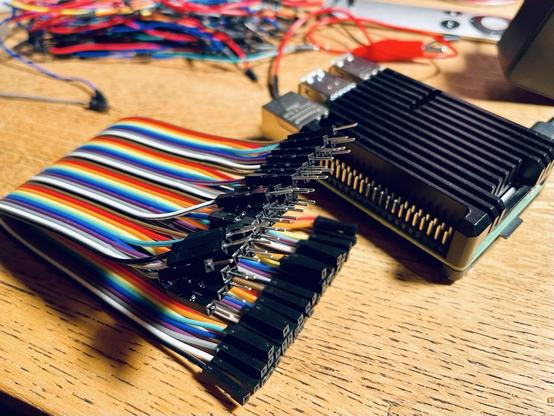
Was it required to connect all 40 pins to GPIO? No. Did I have the need, the unbearable urge to satisfy? Absolutely.
Now everything is connected as per this article: https://web.archive.org/web/20210205152652/https://www.raspberry-pi-geek.com/Archive/2015/10/Raspberry-Pi-IR-remote
It is time to write some Python code and make it blink! To make sure it’s functional.
Feel free to rate my breadboarding. And I hope that “breadboarding” is a term. If it’s not, it is now.
4/?
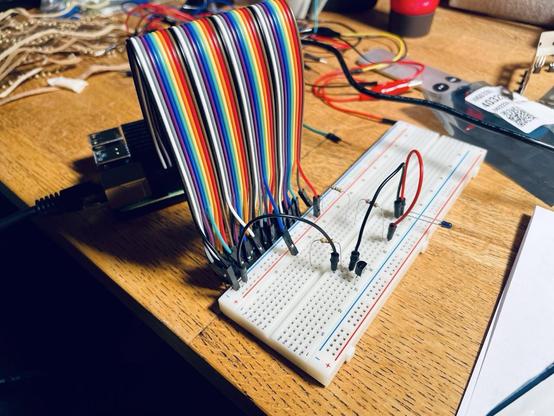

It blinks! I had to mess with unattended upgrades service that kept lock file hostage which did not let me install venv, then Python was refusing to see the RPi module but it does work.
I’m just surprised that I had more issues with software than hardware. Next step is to setup LIRC and try blasting some signals via CLI.
All in all, it progresses quite smoothly. Let’s hope it stays this way. 5/?
Had to do couple steps back by reinstalling OS. I had k3s as initially I wanted to use RPi as homelab and I could not find a single config that guides online are pointing to.
It’ll be easier with RPi OS for sure. 6/?
Spent almost 2 hours trying to understand why IR LED is controlled from Python code but not by LIRC. Imagine me when I swapped it with regular LED and realised it was working all along. It’s just that it was too dim, the TV has to be like a meter away from the source.
Now to redo the breadboard to make the signal stronger and not to burn the diode at the same time. 7/?
 Fuzz-Ra
I'm really late here but, as someone who used to hand build early ANPR cameras with savage IR illuminators with a 23M throw, you can overdrive the absolute shit out of an LED if it's only firing short pulses and you're able to dissipate the heat.
You can go even harder that the first thought would suggest if you PWM those pulses at a higher frequency than the receiver runs at.
@Fuzz_Ra thanks for the tip, it will come handy as I am pretty sure I’ll need to simulate remotes in future. The problem in this case is precise frequency. There’s a photo deeper in the thread, LED is like 2 cm from receiver now and I still get problems with reception as B&O is really sensitive on hardware level according to some forum posts I found about B&O protocol.
@Fuzz_Ra I should’ve tested it with other devices I have, I’m pretty sure it would work more reliably.
It night actually be worth looking at the schematics and software for the Flipper Zero.
If I were some sort of naughty chaos monkey I might have used a Flipper to cause chaos in a B&O shop a few doors down from a pub in town.
Obviously I'd never actually troll the crap out of a shop selling rebadged Alba gear at wild prices. Honest.
By the same token, I certainly don't take a childish glee from popping the charge ports of Teslas.
@Fuzz_Ra oh no! It’s great that you for sure are absolutely definitely totally not some sort of chaos monkey.